Discover.
Search nature’s protein diversity for candidates with this behaviour.


We’re building an automated way to discover proteins whose fluorescence changes with magnetic fields—and engineer them into new sensing tools.
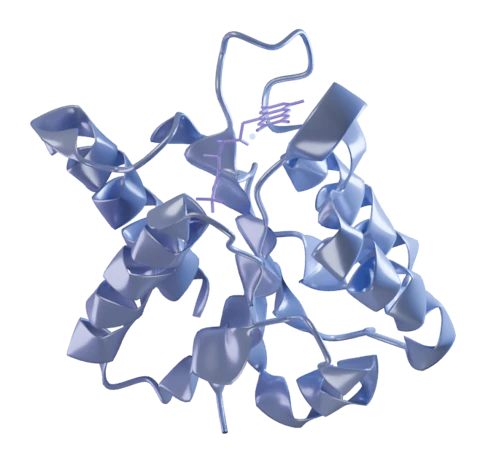
A molecule within the protein
absorbs incoming light.
Energy is released
as fluorescent light.
Fluorescence can increase
or decrease.
The animation cycles through two distinct response examples. Under illumination, the first example brightens when a magnetic field is applied; the second dims. Each returns to its own baseline with the field off, before the next example begins. Response direction depends on the protein and field conditions; this reference structure is not a demonstrated Nebula candidate. The displayed response sizes are illustrative. Use the arrow keys to rotate the reference structure, or Home to reset its orientation.
Some protein systems are already known to change their fluorescence in response to magnetic fields. How many more exist in nature remains an open question.
Nebula is developing an automated discovery workflow to search natural protein diversity, identify promising candidates and test their responses.
Each experimentally confirmed system would expand what we know—and provide a starting point for engineering proteins around a useful application.
Search nature’s protein diversity for candidates with this behaviour.
Measure their responses and learn which predictions hold up.
Develop promising starting points for specific sensing and research needs.
Published research establishes the phenomenon. Nebula is developing a systematic way to discover more responsive proteins, validate their behaviour and engineer promising candidates.
Magnetic effects on fluorescence have been reported in natural and engineered protein systems. Their direction and size depend on the system and experimental conditions.
These studies provide scientific precedent. They do not establish the performance of Nebula candidates. Our discovery workflow is in development; candidates and proposed applications require experimental validation.
The proteins we discover could become
starting points for these applications.
Each would need its own validation.
Biological Research
Biological samples can glow in ways that obscure a useful fluorescent signal. A protein probe that responds to an applied magnetic field could help separate its signal from background that does not respond.The next test: establish a repeatable response and improved signal separation in relevant samples.
Living Systems
Could proteins discovered through Nebula become reporters inside cells or engineered tissues, helping researchers monitor changes within living models?

Biological Interfaces
Investigate how responsive proteins might help living components communicate with sensors and devices. This remains a longer-term research ambition.
Bring a question that matters.
Let’s explore what we could make possible together.
Bring a research question, experimental method or complementary capability.
Bring a practical challenge and what solving it would enable.
In research and development. Sensing performance and applications require experimental validation.
Orbion builds tools to understand proteins and choose which candidates are worth taking to the laboratory.
Nebula applies that foundation to a new discovery challenge: finding natural proteins with magnetic responses, validating their behaviour and engineering promising systems for use.
Meet Orbion