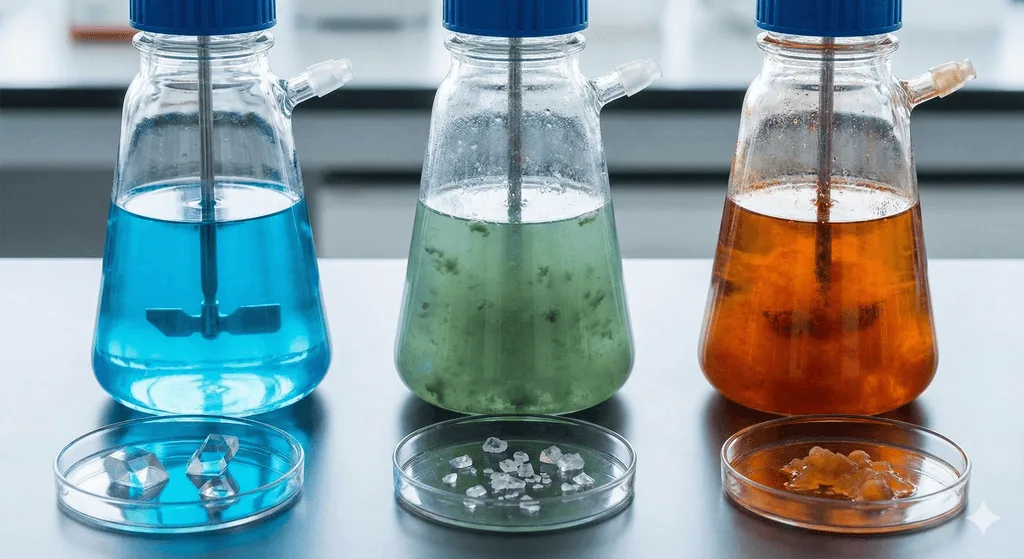
Last month's protein worked perfectly. Same construct, same protocol, same everything. This month's batch has half the activity, runs as multiple bands on the gel, and aggregates during concentration. You've changed nothing—but the results changed anyway.
Welcome to batch-to-batch variability, the silent killer of reproducibility in protein biochemistry.
Key Takeaways
-
Identical protocols don't guarantee identical products: Biological production systems have inherent variability
-
Small changes compound: Minor fluctuations in expression, purification, and storage accumulate into major differences
-
Activity variation matters more than concentration: A batch with the same protein concentration can have vastly different specific activity
-
Quality control catches problems only if you measure: Most labs don't QC rigorously enough to detect batch differences
-
Standardization requires effort: Consistent protein requires consistent processes, reagents, and characterization
The Hidden Variability Problem
What Varies Between Batches
Even with "identical" protocols, each protein batch differs in:
| Property | Typical Variation | Downstream Effect |
|---|---|---|
| Total yield | ±50-100% | Changes how much you have |
| Specific activity | ±20-50% | Changes what the protein does |
| Aggregation state | Variable | Affects assays, crystallization |
| Purity | ±5-15% | Contaminants affect results |
| PTM profile | Batch-dependent | May alter function |
| Degradation | Time-dependent | Activity loss over storage |
Why This Matters
Research reproducibility:
-
"We can't reproduce our own results from six months ago"
-
"The positive control doesn't work anymore"
-
"Different students get different IC50 values"
Drug discovery:
-
Screening campaigns span multiple protein batches
-
Hit validation uses different batch than primary screen
-
Lead optimization compared to wrong baseline
Structural biology:
-
Crystallization conditions are exquisitely sensitive to protein quality
-
Batch A crystallizes, Batch B doesn't—same conditions
-
Cryo-EM sample heterogeneity varies with batch
Sources of Variability
Source 1: Expression System Fluctuations
E. coli:
-
Glycerol stock age and passage number
-
Starter culture density at induction
-
Exact temperature (even ±0.5°C matters)
-
Shaking speed affects aeration
-
Media lot-to-lot variation
-
IPTG concentration and timing
Insect cells:
-
Viral titer variation
-
Passage number affects expression
-
Cell health varies week to week
-
MOI (multiplicity of infection) critical
Mammalian cells:
-
Transfection efficiency varies
-
Serum lot variation (if used)
-
Cell density at harvest
-
Time of harvest after transfection
Research on fed-batch cultures has shown that "with respect to batch-to-batch reproducibility, production processes for recombinant proteins are lagging far behind most other industrial processes."
Source 2: Purification Inconsistencies
Column performance:
-
Resin age and regeneration history
-
Binding capacity degrades over time
-
Carryover from previous purifications
-
Column packing quality
Buffer variations:
-
pH meter calibration drift
-
Stock solution concentration errors
-
Reagent lot changes (imidazole, DTT, etc.)
-
Water quality variation
Timing:
-
Time between lysis and first column
-
How long protein sits before concentration
-
Time on ice vs. at room temperature
-
Weekend preps vs. weekday preps
Source 3: Post-Purification Handling
Concentration:
-
Different concentrators have different characteristics
-
Protein loss at membrane varies
-
Aggregation during concentration is batch-dependent
-
Final concentration accuracy
Storage:
-
Freeze-thaw cycles
-
Aliquot size affects freeze-thaw damage
-
Storage buffer stability over time
-
Glycerol concentration accuracy
Time:
-
Protein degradation is time-dependent
-
Activity loss accelerates with age
-
Fresh batch ≠ aged batch
Source 4: Raw Material Variation
Studies emphasize that "critical raw materials such as plasmids, viral vectors, lipid nanoparticles, etc. also have batch-to-batch variability, which means the entire production process is a constant balancing act."
Even commercial reagents vary:
-
Protease inhibitor cocktails (activity varies)
-
Inducer potency (IPTG lot variation)
-
Media components (yeast extract is notoriously variable)
-
Buffer salts (trace metal contamination)
The Activity vs. Concentration Problem
Total Protein ≠ Active Protein
Research has demonstrated that "lot-to-lot differences in protein activity often still occur, leading to uncertainty in the accuracy of downstream measurements. These differences are postulated to be caused by a misrepresentation of the protein concentration as measured by traditional total protein techniques, which can include multiple types of inactive protein species."
What total protein methods (UV280, BCA, Bradford) measure:
-
All protein, regardless of folding state
-
Aggregated protein counts the same as native
-
Inactive protein counts the same as active
-
Degraded fragments contribute to absorbance
What you actually need:
-
Active, properly folded protein
-
In the correct oligomeric state
-
Free of aggregates
-
Functionally competent
The Specific Activity Gap
Two batches, both at "5 mg/mL":
| Batch | Total Protein | % Active | Active Protein |
|---|---|---|---|
| A | 5 mg/mL | 90% | 4.5 mg/mL |
| B | 5 mg/mL | 45% | 2.25 mg/mL |
If you normalize experiments by total protein concentration, Batch B has half the active enzyme—and your data won't make sense.
Studies found that "defining protein reagents by their assay-specific concentration improved consistency in reported kinetic binding parameters and decreased immunoassay lot-to-lot coefficients of variation (CVs) by over 600% compared to the total protein concentration."
Measuring Batch-to-Batch Variability
Minimum QC Checklist
Guidelines for protein quality assessment emphasize that "purified protein quality control is the final and critical checkpoint of any protein production process, though it is unfortunately too often overlooked and performed hastily."
Tier 1 (Every batch):
-
[ ] SDS-PAGE (purity, degradation, MW confirmation)
-
[ ] Total protein concentration (consistent method)
-
[ ] Activity assay (specific activity calculation)
-
[ ] Visual inspection (aggregation, precipitate)
Tier 2 (Recommended):
-
[ ] Analytical SEC or DLS (aggregation state)
-
[ ] Mass spectrometry (intact mass, modifications)
-
[ ] Thermal stability (Tm by DSF)
Tier 3 (Critical applications):
-
[ ] SEC-MALS (absolute MW, oligomeric state)
-
[ ] Endotoxin testing (cell-based work)
-
[ ] Detailed PTM analysis
What to Compare
For each new batch, compare to a reference batch:
| Parameter | Method | Acceptable Range |
|---|---|---|
| Purity | SDS-PAGE densitometry | ≥90% of reference |
| Yield | UV280 | Within 2-fold |
| Specific activity | Functional assay | ≥80% of reference |
| Aggregation | DLS or SEC | <10% aggregate |
| Tm | DSF | Within 2°C |
| MW | Mass spec | Correct MW ±50 Da |
The Reference Standard
Keep a reference batch for comparison:
-
Well-characterized, high-quality protein
-
Aliquoted to avoid freeze-thaw
-
Stored at -80°C
-
Used as positive control in all QC
-
Replace when depleted (characterize new reference against old)
Strategies for Reducing Variability
Process Standardization
Expression:
-
Use glycerol stocks with controlled passage number
-
Standardize starter culture protocol (OD at inoculation)
-
Control induction time and temperature precisely
-
Use calibrated shaker/incubator settings
-
Document and control media lot numbers
Purification:
-
Use dedicated columns (avoid cross-contamination)
-
Track column usage and regenerate on schedule
-
Make buffers from same stock solutions within a campaign
-
Document timing of each step
-
Keep detailed batch records
Storage:
-
Establish standard aliquot sizes
-
Document freeze-thaw history
-
Use consistent buffer and glycerol concentration
-
Label with production date and lot number
Fed-Batch and Controlled Feeding
Research has shown that "guiding the process along a predefined profile of the total biomass derived from a given specific growth rate profile" can "drastically improve batch-to-batch reproducibility compared to the process control strategies typically applied in industry."
For labs with bioreactor capability:
-
Control feeding rate to manage growth rate
-
Monitor dissolved oxygen and pH continuously
-
Use feedback control for key parameters
For shaking flask/plate cultures:
-
Auto-induction media with controlled glucose release reduces variability
-
Enzyme-based nutrient release provides more consistent expression
Activity-Based Normalization
Don't normalize by total protein—normalize by activity.
For each batch:
-
Measure total protein concentration
-
Measure activity (appropriate assay for your protein)
-
Calculate specific activity (activity per mg)
-
Normalize experiments to specific activity, not total protein
This ensures that different batches contribute equal functional protein to each experiment.
When Batch Variation Causes Problems
Case 1: The Screening Campaign Disaster
Situation:
-
HTS campaign over 6 months
-
4 protein batches used
-
Batch 3 had 40% lower specific activity (undetected)
-
All plates from Batch 3 had shifted Z' factor
Consequence:
-
False negatives from Batch 3 plates
-
True actives missed
-
Discovered months later during hit validation
Prevention:
-
QC every batch before use
-
Include reference compound on every plate
-
Monitor assay performance metrics continuously
Case 2: The Irreproducible Structure
Situation:
-
Batch A crystallized beautifully
-
Batch B (same protocol) never crystallized
-
Difference: Batch B had 15% aggregate
Consequence:
-
Months of failed crystallization trials
-
Eventually traced to protein batch quality
Prevention:
-
DLS or analytical SEC on every batch
-
Set maximum aggregate threshold (<5%)
-
Re-purify if aggregation too high
Case 3: The Kinetic Constants That Changed
Situation:
-
Published Km = 50 µM
-
New batch gives Km = 120 µM
-
Different postdoc, same protocol
Consequence:
-
Reproducibility crisis
-
Revision required (embarrassing)
-
Discovered: Old batch had contaminating activator
Prevention:
-
Include positive control in every assay
-
Side-by-side comparison of old and new batches
-
Mass spec to verify composition
Building a Batch Management System
Documentation Requirements
For each batch, record:
-
Production date
-
Lot numbers of all reagents
-
Expression conditions (detailed)
-
Purification chromatograms
-
QC results (all tiers)
-
Storage location and aliquot scheme
-
Any deviations from standard protocol
Acceptance Criteria
Before using any batch, verify:
| Test | Acceptance | Reject |
|---|---|---|
| Purity | ≥90% | <80% |
| Activity | ≥80% of reference | <60% |
| Aggregation | <10% | >20% |
| Mass spec | Correct MW | Wrong MW |
| Tm | Within 2°C of reference | >5°C difference |
Batch Tracking
Maintain a log that links:
-
Protein batch ID → Experiments using that batch
-
Allows retrospective analysis if batch problem discovered
-
Enables identification of batch-dependent artifacts
Special Considerations
Multi-Site Collaborations
When sharing protein between labs:
-
Establish common QC standards
-
Ship reference standards for side-by-side validation
-
Compare results from same batch before comparing across batches
-
Communicate batch changes explicitly
Long-Term Studies
For studies spanning months or years:
-
Produce large batch at start (if possible)
-
Characterize extensively
-
Store carefully to minimize degradation
-
Have backup plan for producing equivalent batch
-
Document any batch transitions in publications
Commercial Protein
Even commercial proteins vary lot-to-lot:
-
Request certificates of analysis
-
Consider keeping internal standard for comparison
-
Track lot numbers used in experiments
The Cost of Ignoring Variability
Time Lost
-
Troubleshooting "failed" experiments that worked before
-
Repeating experiments that should reproduce
-
Chasing artifacts caused by protein quality
-
Remaking protein that should have been adequate
Data Lost
-
False negatives from inactive batches
-
False positives from contaminated batches
-
Irreproducible results that can't be published
-
Retracted or corrected papers
Trust Lost
-
"This lab's data doesn't reproduce"
-
Collaborations damaged by inconsistent results
-
Reviewers skeptical of protein-dependent data
The Bottom Line
Batch-to-batch variability is not randomness you have to accept—it's a technical problem you can manage. The solution requires:
| Element | Implementation |
|---|---|
| Awareness | Acknowledge that batches vary |
| Measurement | QC every batch systematically |
| Standardization | Control what you can control |
| Documentation | Track batches through all experiments |
| Response | Act on QC failures before they contaminate data |
Studies have shown that implementing rigorous quality control of protein reagents dramatically improves research data reproducibility. The investment in QC pays dividends in reproducible, trustworthy data.
The bottom line: If you can't characterize the difference between your batches, you can't interpret the difference between your experiments.
Quality-Focused Protein Analysis
For researchers working to improve batch consistency, platforms like Orbion can help identify characteristics that might contribute to variability:
-
Aggregation propensity prediction: Flag proteins likely to have variable aggregation behavior
-
PTM site prediction: Identify modifications that might vary between expression conditions
-
Stability assessment: Predict regions prone to degradation or instability
-
Disorder mapping: Understand which regions might contribute to heterogeneity
Understanding your protein's intrinsic properties helps you anticipate and control the sources of batch-to-batch variation—leading to more reproducible protein and more reliable data.
References
-
Zobel-Roos S, et al. (2019). Economic analysis of batch and continuous biopharmaceutical antibody production: A review. Biotechnology Journal, 14(1):e1700739. PMC6432653
-
Jungbauer A, et al. (2006). Improving the batch-to-batch reproducibility in microbial cultures during recombinant protein production by guiding the process along a predefined total biomass profile. BMC Biotechnology, 6:35. PMC1705514
-
Marhöfer RJ, et al. (2024). Overcoming lot-to-lot variability in protein activity using epitope-specific calibration-free concentration analysis. Analytical Chemistry, 96(15):5982-5990. PMC11044105
-
Raynal B, et al. (2014). Quality assessment and optimization of purified protein samples: why and how? Microbial Cell Factories, 13:180. PMC4299812
-
Bhambure R, et al. (2021). Quality control of protein reagents for the improvement of research data reproducibility. Nature Communications, 12:2795. Nature
-
Panula-Perälä J, et al. (2016). The fed-batch principle for the molecular biology lab: controlled nutrient diets in ready-made media improve production of recombinant proteins in Escherichia coli. Microbial Cell Factories, 7:31. Link
-
Hage C, et al. (2019). Recent developments in bioprocessing of recombinant proteins: expression hosts and process development. Bioengineering, 6(4):119. PMC6932962
-
R&D Systems. (2024). Recombinant protein quality—Protein production. Technical Documentation. Link