The Orbion Blog
Protein Science, in Practice
Field-tested deep-dives on structural biology, protein engineering, expression, and the AI behind it all — written for the people at the bench
Your Protein Expressed as Inclusion Bodies — Refold, Redesign, or Re-Host? A Decision Guide
Your SDS-PAGE says the protein expressed beautifully — a fat band at exactly the right molecular weight. Your supernatant says otherwise: it's clear, and…
AlphaFold Gave You a Structure, Not a Function: How to Predict What a Protein Actually Does From Sequence
Your AlphaFold model is beautiful — pLDDT 92 across the core, a clean two-domain architecture, a pocket you could practically dock a ligand into. And you…
Astra on Proteases: A 545-Protease Benchmark
Proteases are one of the most clinically validated enzyme classes in medicine — from the ACE and neprilysin inhibitors in cardiovascular disease to the HIV,…
Getting Your Protein Secreted: Signal Peptide Selection That Actually Works
Signal peptides are host-specific, cargo-dependent gatekeepers, not portable parts. How to match the leader to your expression host and secretion pathway…
Prediction-Guided FGF21 Construct Design: Our First Wet-Lab Study
Orbion's first public wet-lab study: a prospective, head-to-head test of prediction-guided FGF21 construct design. The AI kept the tail the textbook trims.
Calibration, Not Compounding: What Experimental Feedback Did for a Protein-Stability Model
Does feeding a protein-stability model your own lab results make it better on future proteins? Target-specific adaptation eventually helped the measured…
Choosing an Affinity Tag: His6, Strep-II, FLAG, and When Each One Fails You
You picked a His6 tag because everyone does, ran your protein over Ni-NTA, and got a gel lane with three extra bands you can't explain. Or you ran the same…
Can Structure Prediction Model Ternary Complexes? The Degrader Problem
You designed a PROTAC with two strong binders — a sub-nanomolar warhead for your target, a clean VHL ligand, and a linker that looked reasonable in the…
Can You Predict Whether Your Protein Will Be Soluble — Before You Express It?
You've designed the construct, ordered the gene, transformed your cells, and run the induction. The gel looks promising — a fat band at the right molecular…
What AlphaFold3 Changes for Binding and Complex Prediction — and What It Doesn't
You fed your kinase and a lead fragment into the AlphaFold3 server, and 90 seconds later you had an all-atom protein–ligand complex with the ligand sitting…
When Cell-Free Expression Beats E. coli (and When It's a Waste of Money)
Your target is a single-pass membrane protein that's killed three rounds of BL21 cultures. Every induction either gives you nothing or fills the cells with…
Reading Membrane Protein Topology From Sequence Alone
You inherited a transporter project with a 12-helix prediction from a 2009 paper. You designed a C-terminal His-tag construct, expressed it, and got nothing…
Can You Predict Which Proteins Will Fight You at the Bench?
You have twelve targets and budget to seriously pursue four. Three months from now, some of these constructs will express cleanly, purify in a day, and…
How Many Constructs Should You Screen in Parallel — and Which Ones?
You picked the construct that looked best on paper — full-length, an N-terminal His6, a TEV site — cloned it, expressed it, and got nothing in the soluble…
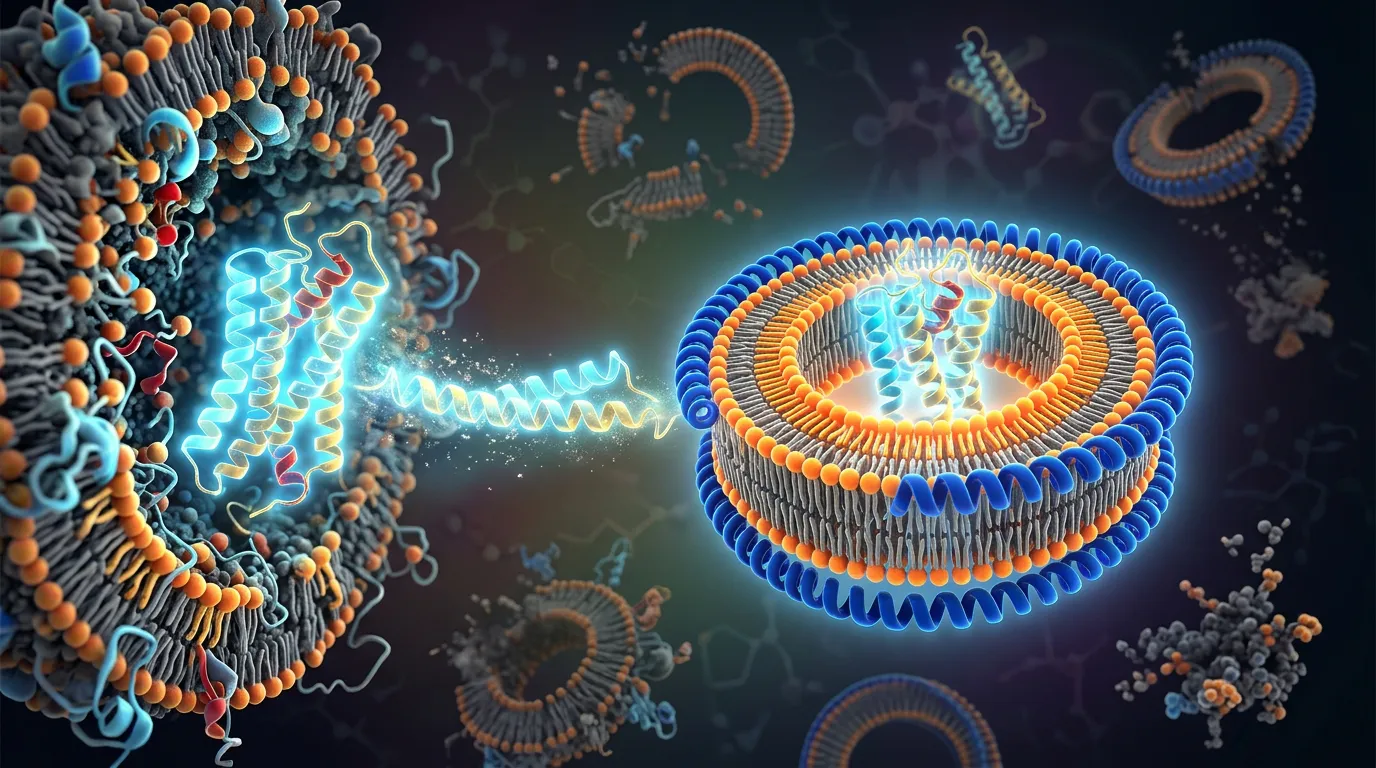
Lipid Nanodiscs vs Detergent Micelles vs SMALP: Choosing a Membrane Protein Reconstitution System
You have a 7-TM GPCR that finally expresses in Sf9 cells at 1 mg/L of membrane fraction. The grant deadline says "cryo-EM structure by Q4," the binding…
The 6 Cases Where pLDDT Confidence Misleads You
You opened your AlphaFold model in PyMOL, saw a deep-blue α-helix at pLDDT 92, and used it to define a truncation boundary for crystallization—or worse, to…
When AlphaFold-Multimer Gets Protein Complexes Wrong: Six Failure Modes Every Structural Biologist Should Know
A structural biologist runs AlphaFold-Multimer on a kinase-scaffold pair, gets a confident-looking heterodimer with ipTM of 0.74, and designs a panel of 18…
Crystallization Optimization Beyond the Sparse Matrix Screen
You ran a 96-condition sparse matrix screen and three drops contain something. One has a shower of needle clusters, one shows a 30-micron birefringent rod…
Tag-Free Purification Strategies: When Affinity Tags Ruin Your Downstream Assay
Your protein is His-tagged. Your binding assay is for metal-dependent activity. You're either purifying clean protein with bad tags, or fighting the…
Astra on Ion Channels: A 2,700-Channel Benchmark
Ion channels are among the most consequential — and most treacherous — protein classes in drug discovery. They are validated targets across pain, epilepsy,…
Astra on Enzymes: A 6,304-Enzyme Benchmark
Enzymes are the catalysts of biology and the most heavily exploited drug-target class in the history of medicine — the kinase inhibitors of oncology, the…
Astra on Transporters: A 6,203-Protein Benchmark
Membrane transporters move ions, nutrients, neurotransmitters, and drugs across the lipid bilayer — and they are among the most important and most…
Astra on GPCRs: A 2,615-Receptor Benchmark
G protein-coupled receptors are the most-drugged protein family in biology and one of the hardest to characterize computationally. Roughly a third of…
Why Your Crystal Diffracts to 2 Å But Won't Solve
You spent eighteen months crystallizing the target. The hexagonal plates are gorgeous, the synchrotron data scales beautifully, and the merging statistics…
Surface Entropy Reduction Mutagenesis: A Practical Guide for Crystallographers
You have purified protein at 20 mg/mL. It is monodisperse by SEC-MALS, runs as a single band on SDS-PAGE, and shows clean Tm transitions by DSF. You have…
Preferred Orientation in Cryo-EM: Diagnosis and Six Strategies to Fix It
You spent three months optimizing expression, two weeks tuning grids, and a 48-hour data collection on the Krios. The 2D classes look gorgeous. But when you…
The 7 Reasons Your Cryo-EM Map Stops at 4 Å Resolution
Your 2D classes look beautiful. Your 3D reconstruction converges to 4.2 Å. You collect another 5,000 movies, polish the particles, run another round of CTF…
Orbion wins the Scientific Excellence Award at Nucleate Germany 2026
On 20 May 2026, at the Nucleate Activator semi-finals at WERK1 in Munich, an independent jury awarded Orbion the Scientific Excellence Award.
Cryptic Proteolysis: Why TEV and PreScission Proteases Cut Your Protein Internally
After overnight TEV cleavage you see your protein has lost 5 kDa. The tag is gone — but so is a piece of your protein. The cut site is buried inside your…
The Solubility Tag Paradox: Why Your Protein Precipitates After Tag Cleavage
Your MBP-fusion was crystal clear at 10 mg/mL. The SEC trace was a textbook symmetric peak. You added TEV protease at a 1:50 molar ratio and left it…
Why Does My Protein Elute in the Void Volume on SEC
You load your "pure" protein onto a Superdex 200 column, expecting a nice peak at 70 kDa. Instead, the entire sample elutes in the void volume—the dead space…
Scale-Up Nightmares: When Your 50 mL Protocol Fails at 5 L
Your protein is perfect at the bench. 50 mL cultures in shake flasks, 25°C induction, overnight expression, Ni-NTA purification. You get 5 mg of pure,…
Glycosylation Matters More Than You Think
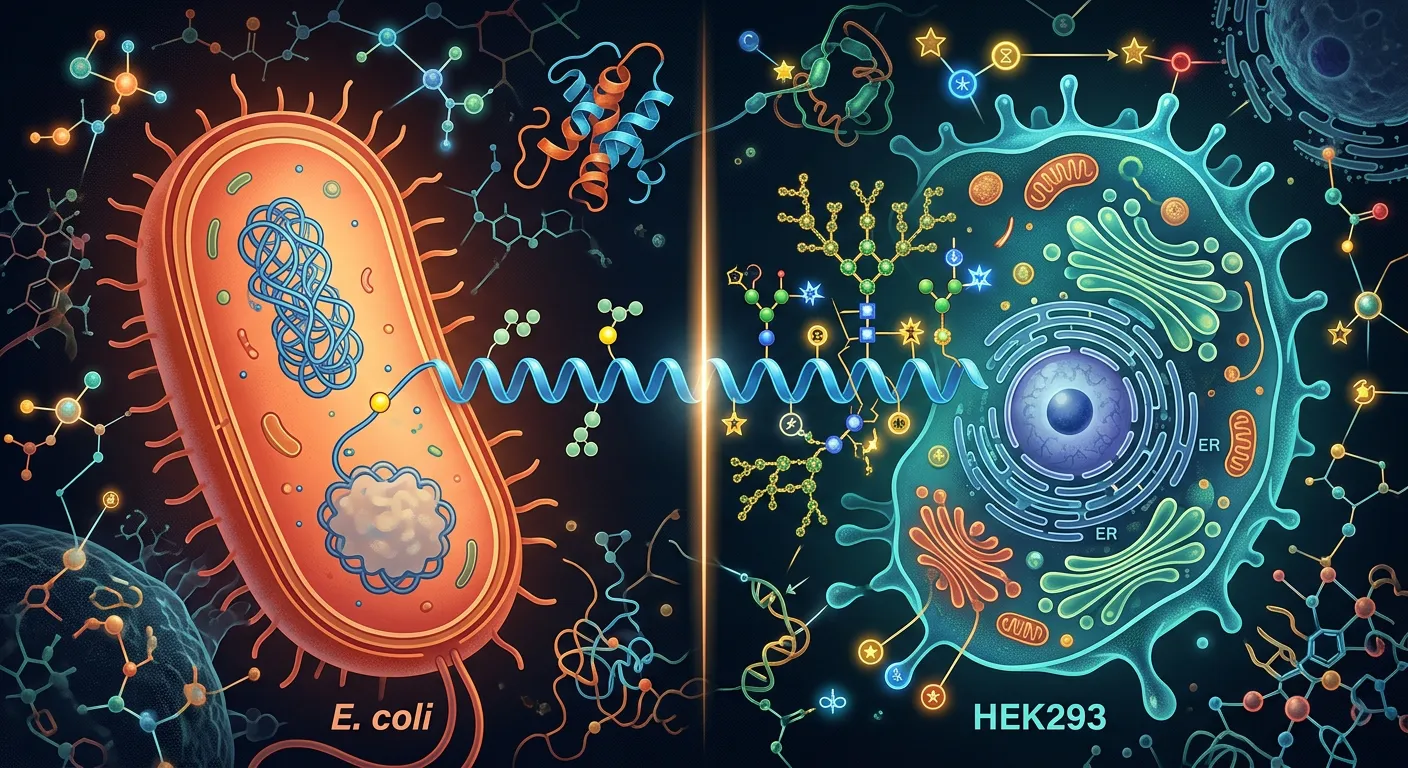
You expressed your therapeutic target in E. coli. The protein folds, purifies, and runs as a monodisperse peak on SEC. You screen compounds against it. You…
Disulfide Bond Engineering: When to Add, Remove, or Redesign
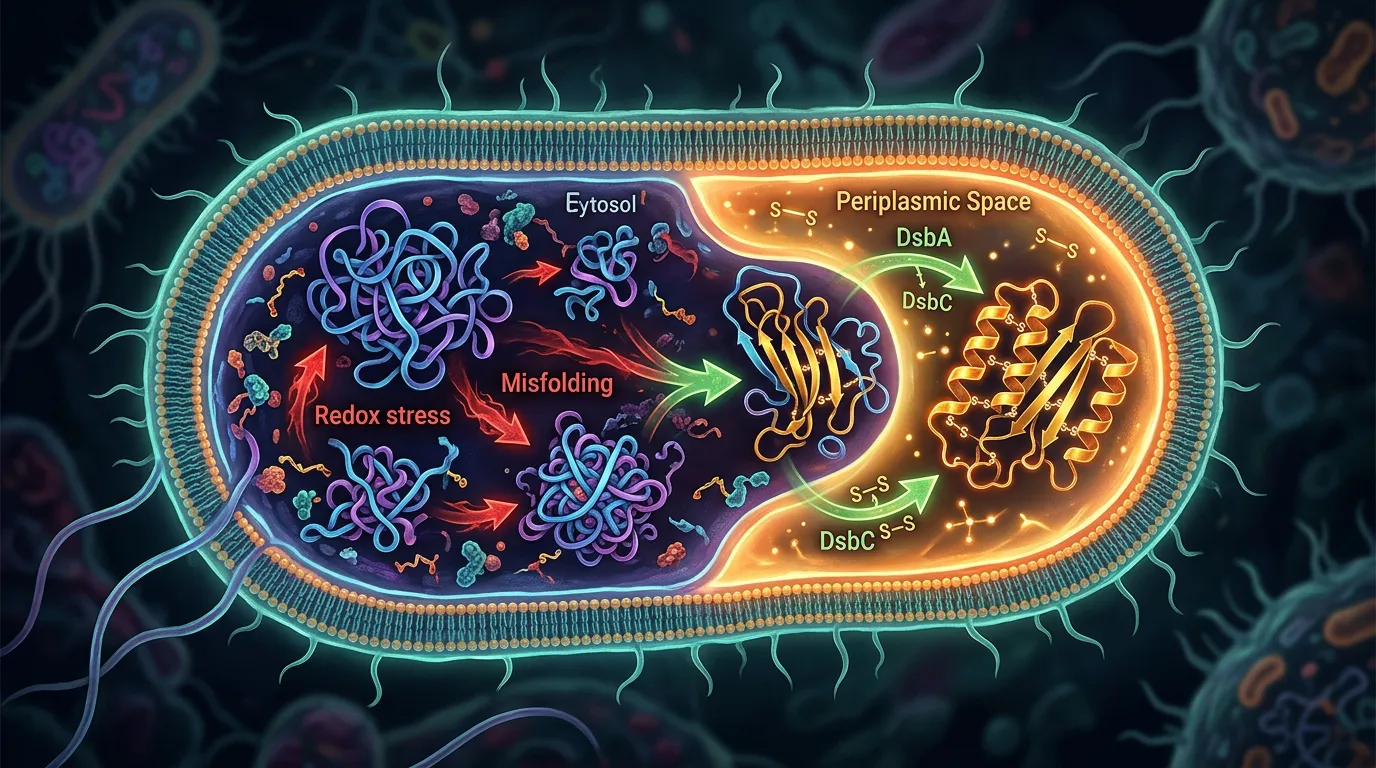
You designed a disulfide bond between residues 45 and 182 to stabilize your protein. The Cβ-Cβ distance in the AlphaFold model was 4.2 Å—perfect geometry.…
Why Does My Protein Aggregate at 4°C?
You purified your protein at room temperature. It looked great—single peak on SEC, clear solution, good activity. You put it in the fridge overnight. The…
How to Remove Endotoxin from Recombinant Protein
Your protein is pure. SDS-PAGE shows a single band. Activity is fine. Then you add it to your cell-based assay and everything lights up—NF-κB activation,…
My AlphaFold Model Doesn't Match My Crystal Structure
You solved your crystal structure at 2.0 Å. You also ran AlphaFold2. The backbone RMSD between them is 3.5 Å. The loops are in different places. A helix is…
Why Is My Purified Protein Yellow (or Brown)?
You eluted your protein off the column and it's... yellow. Or amber. Or outright brown. Your target is not a flavoprotein. It's not supposed to have a…
SDS-PAGE Band at the Wrong Molecular Weight
Your protein is 45 kDa. You calculated it from the sequence. The mass spec confirms it. But on SDS-PAGE, it runs at 55 kDa. Or 35 kDa. Or as a doublet. The…
Why Does My Protein Lose Activity After Freezing
You purified 10 mg of enzyme last month. Activity was perfect: kcat = 45 s⁻¹. You aliquoted, flash-froze in liquid nitrogen, and stored at –80°C. Today you…
My His-Tagged Protein Doesn't Bind Ni-NTA
You expressed your His6-tagged protein. The lysate is loaded onto the Ni-NTA column. You elute with imidazole and... nothing comes off. Or worse: your…
The Same Sequence Signal Can Mean Opposite Things
One of the easiest mistakes in de novo binder design is assuming that a useful signal in one setting should also help in another.
Why Some Binder Signals Transfer and Others Flip
When people evaluate de novo protein binders, the focus usually lands on two things:
Can Quantum Computing Actually Improve Protein-Ligand Binding Prediction?
Finding new drugs is expensive. A typical compound costs about $2.6 billion and 10–15 years to bring to market, and most of that time is spent figuring out…
Why Your Thermal Shift Assay Doesn't Predict Real Stability
You screened 50 buffer conditions by differential scanning fluorimetry. Found one that shifts the Tm from 52°C to 67°C. Fifteen degrees—amazing. You switch…
Beyond Structure and Affinity: Our New Preprint on CD20 and EGFR Benchmarks
De novo protein binder design has advanced quickly.
Why Your Protein Works in the Assay but Fails in Cells
Your enzyme inhibitor has an IC50 of 12 nM in the biochemical assay. Clean dose-response. Competitive mechanism confirmed. You move to cells, expecting a…
Homology Modeling in the AlphaFold Era: What Still Matters
AlphaFold changed everything. You type in a sequence, wait a few minutes, and get a structure that's often within 1 Å RMSD of the experimental result. So why…
Codon Optimization Doesn't Fix Everything
You ordered a codon-optimized gene from your favorite synthesis vendor. The Codon Adaptation Index went from 0.45 to 0.95. E. coli should love this sequence.…
Can the current tools predict protein epistasis?
We thought protein epistasis was everywhere. Turns out, much of it was an illusion.
Why Your Protein Precipitates During Buffer Exchange
You spent three days purifying your protein. Size exclusion gave a beautiful monodisperse peak. You measured the concentration: 8 mg/mL, perfect for…
Protein Language Models Explained for Bench Scientists
Your colleague mentions that their new prediction tool uses "ESM-2 embeddings." Your PI asks whether you should use "protein language models" for variant…
Intrinsically Disordered Regions: Why They Break Your Protein Pipeline
Your protein expresses well. It purifies to apparent homogeneity—a single peak on size exclusion, a clean band on SDS-PAGE. You set up 2,000 crystallization…
MBP vs SUMO vs GST vs Thioredoxin: Choosing the Right Fusion Partner
Your protein doesn't express solubly in E. coli. Your advisor says "try MBP." Your labmate swears by SUMO. The postdoc down the hall uses GST for everything.…
From Single Mutants to Combinatorial Libraries: Scaling Protein Engineering
You identified eight single mutations that each improve thermostability by 2–5°C. Beautiful, consistent ΔTm data from differential scanning fluorimetry. You…
What pLDDT and PAE Actually Tell You (And What They Don't)
Your AlphaFold model just finished. The average pLDDT is 85—looks great. You download the structure, open it in PyMOL, and start planning mutations at the…
When to Give Up on a Protein Target
You've spent six months on this protein. Twelve expression constructs. Three expression systems. Refolding from inclusion bodies. Co-expression with…
The Batch-to-Batch Variability Problem in Protein Production
Last month's protein worked perfectly. Same construct, same protocol, same everything. This month's batch has half the activity, runs as multiple bands on…
Why High-Throughput Screening Hits Don't Reproduce
The primary screen identified 847 hits. Dose-response narrowed it to 127 confirmed actives. You cherry-picked the best 20 for follow-up. Six months later,…
Your Protein Is a Dimer in Solution But a Monomer in the Crystal
The SEC column says your protein is 85 kDa—clearly a dimer of your 42 kDa subunit. You solve the crystal structure. It's a monomer. The crystallographers say…
The Tag Removal Problem: Why Your Protease Won't Cleave
The purification went perfectly. His-tag affinity, ion exchange, gel filtration—textbook chromatography. Now you just need to remove the tag before…
Why Your Protein Loses Activity After Purification (Even Though It's Pure)
The chromatogram looked perfect. You ran the gel—single band at the expected molecular weight. The mass spec confirmed the identity. Your protein is 95%…
From Structure to Experiment: What Computational Biologists Miss
Your collaborator ran AlphaFold. They sent you a beautiful PDB file and a confident email: "Here's the structure. Let me know when you have crystals." Three…
Why Stabilizing Mutations Sometimes Make Everything Worse
You ran the stability prediction software. It suggested L134I would increase thermal stability by 3°C. You made the mutation, expressed the protein, measured…
Finding Druggable Pockets When the Active Site Is Too Conserved
Your kinase inhibitor is potent. Sub-nanomolar IC50. Beautiful binding to the ATP pocket. There's just one problem: it also inhibits 47 other kinases in the…
The Hidden Link Between Disorder, Aggregation, and Failed Purifications
Your protein looked perfect after affinity chromatography. Eluted as a single peak. Then you concentrated it for crystallization trials, walked away for…
How to Interpret AlphaFold Confidence Scores for Multi-Chain Complexes
You ran AlphaFold-Multimer on your protein complex. The structure looks beautiful—two chains wrapped around each other in an intricate dance. The pLDDT…
Why Your Protein Doesn't Express in E. coli (When It Should)
You cloned the gene. Sequence-verified the construct. Transformed competent cells. Induced with IPTG. And got... nothing. No band on SDS-PAGE. Or worse—a…
Modern Alternatives to FoldX and Rosetta: The AI/ML Revolution
We showed why traditional tools like FoldX and Rosetta have become bottlenecks: slow, complex, expert-required, and no confidence scores. Now we'll show you…
FoldX and Rosetta: The 5 Reasons They're Still Your Bottleneck
You need to stabilize your therapeutic antibody. Your supervisor suggests FoldX. You spend 3 days installing dependencies, compiling binaries, and reading…
How to Design Optimal Construct Boundaries: Step-by-Step Workflow
In this article, we'll show you exactly how to design optimal boundaries before you clone.
Construct Boundary Design: The 4 Problems Killing Your Protein Expression
You clone the full-length gene. Express it. Inclusion bodies. You try with tags. Still insoluble. You try insect cells. It expresses, but aggregates during…
Fixing Cryo-EM Sample Problems: Optimization Strategies & Workflows
We've diagnosed the 5 cryo-EM sample killers: preferred orientation, aggregation, denaturation, heterogeneity, and ice quality issues. Now comes the critical…
The 5 Cryo-EM Sample Killers: Understanding Why Your Particles Won't Align
You've spent $150K on a high-resolution cryo-EM microscope session. Your protein is pure, stable, and monodisperse. You make grids, collect data, and begin…
How to Fix Crystallization Problems: The Modern Troubleshooting Guide
There are 6 common reasons why proteins won't crystallize: flexibility, surface entropy, heterogeneity, wrong boundaries, aggregation, and missing cofactors.…
Why Your Protein Won't Crystallize: Understanding the 6 Common Failure Modes
You've spent 6 months expressing and purifying your protein. The SEC-MALS looks perfect—monodisperse, no aggregates. Thermal stability is excellent. You set…
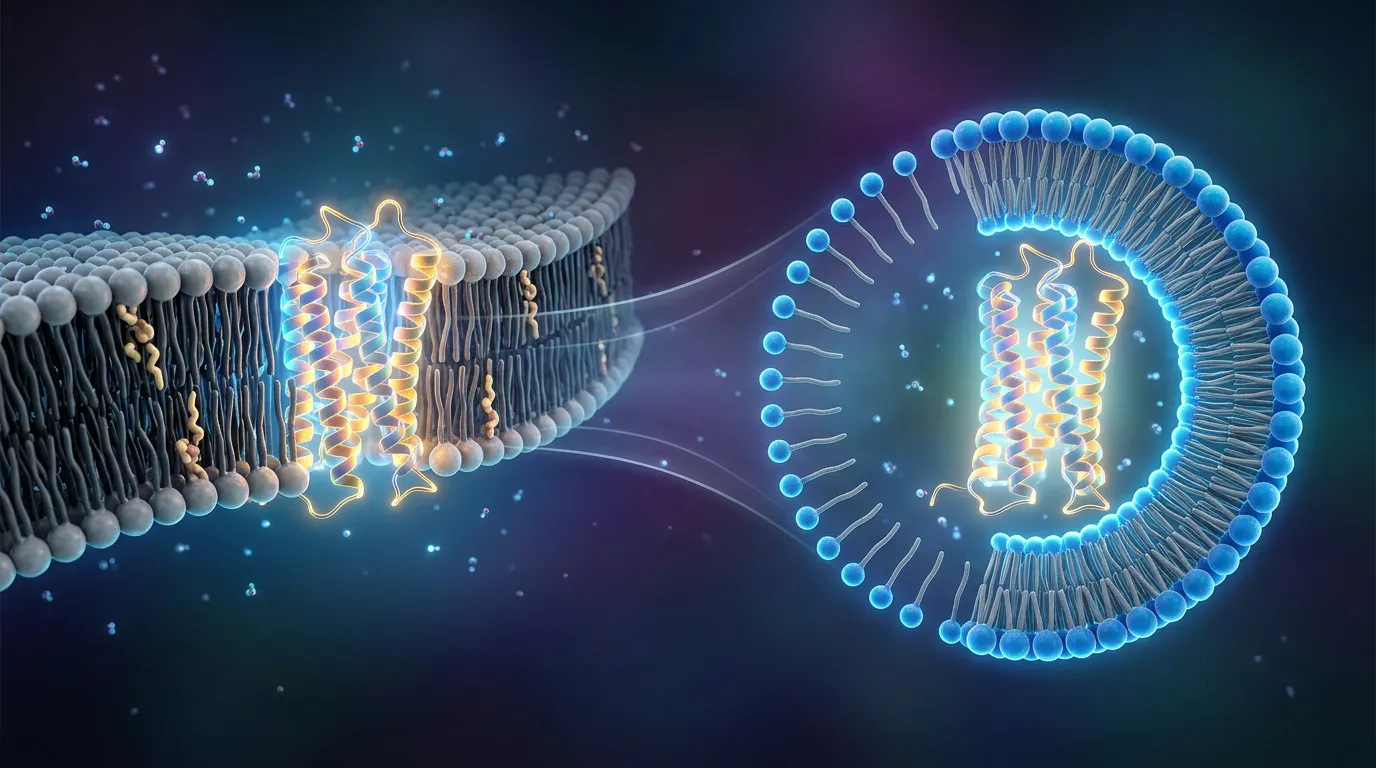
Detergent-Free Membrane Protein Purification: Nanodiscs and Beyond
You've screened detergents. You found one that solubilizes your GPCR without aggregation. But there's a lingering concern: Is your protein really native-like…
Cofactor Prediction and Supplementation: A Practical Guide
You've learned that your protein needs a cofactor. Now the critical questions: Which one? How much? When do you add it? And how do you know if you got it…
How to Engineer Developable Antibodies: AI-Driven Optimization
You've identified that your antibody has developability liabilities—aggregation at high concentration, high viscosity, or chemical instability. Now what?…
Membrane Protein Purification: Detergent Screening Guide
You've spent six months optimizing expression. Finally, your Western blot shows your GPCR is in the membrane fraction—success! Now you just need to purify…
Why Your Protein Aggregates (It's Missing Zinc)
You purified your enzyme. The gel looks perfect—a single band at the expected molecular weight. SEC shows a beautiful monomer peak. Then you run the activity…
#ProteinWrapped: Your Protein of the Year
Which protein defined your 2025?
The Antibody Developability Crisis: Why 40% of Candidates Fail
You've identified a high-affinity antibody. It binds your target with nanomolar affinity. The selectivity looks perfect. In cell assays, it shows the exact…
Why Your Protein Aggregates (And How to Fix It): A Structural Biologist's Guide
You expressed your protein. It looked perfect in gel filtration. Then you concentrated it to 5 mg/mL and found a white precipitate at the bottom of the tube.…
The Art of "Domesticating" Proteins: A Guide to GPCR Construct Design
Any structural biologist knows the sinking feeling of "Expression Hell." You clone your gene, put it into HEK293 or Sf9 cells, and… nothing. Or worse, you…
Structure-Based Drug Design: From Protein Structure to Lead Compound
AlphaFold gave us the structure. Now what? With over 200 million predicted protein structures available, the bottleneck in drug discovery has shifted from…
Complex Predictions Now Live — Structure to Protocol in One Workflow
Most complex structure projects fail at construct design, not data collection.
AlphaFold's Limitations: What It Can't Predict (And How to Fill the Gaps)
AlphaFold solved protein folding. But structure prediction is just the beginning. When you're trying to actually express, purify, crystallize, or drug a…
How to Choose Expression Systems for Your Protein's PTM Requirements
The fundamental question in protein engineering: Which expression system should you use? The answer isn't about convenience—it's about post-translational…
GPCRs: Bridging the Gap in the Druggable Genome
GPCRs are one of the most important and druggable protein families in humans, but their instability and membrane-dependence have left most of them…
AstraBIND Preprint is Published on bioRxiv
We’re excited to announce the release of our latest preprint: AstraBIND — a Graph Attention Network for Predicting Ligand Binding Sites.
Orbion Wins Drumbeat Capital Award at Stage Two 2025
We’re proud to share that Orbion, representing WHU – Otto Beisheim School of Management, was among the six startups recognized at Stage Two 2025, Europe’s…
Orbion at leadXpro’s 10-Year Symposium
We were honored to join leadXpro’s 10-Year Symposium this week in Villigen, Switzerland — and to present our talk, “Context Is All You Need: Sequential,…
AstraPTM2 Preprint is Published on bioRxiv
Introducing AstraPTM2 — the next generation of residue-level PTM prediction.
Characterize is Live!
CHARACTERIZE IS LIVE!
Orbion was in Berlin Bio Innovation Day
We were at Berlin Bio Innovation Day!
450+ Protocols in August
🚀 450+ Protocols in August
Model Update — AstraROLE2 + AstraSUIT2
When you work with AI to design or modify proteins, it is easy to drift away from macroscopic target properties. Looking at the protein on amino-acid level,…
Bench, Your Wet-lab Co-pilot, Now in Early Access
The road of protein research is riddled with problems. Bench helps you see further ahead and avoid the wrong turns.
Advancing Structural Biology with leadXpro
Membrane proteins are the living cell’s connection to the outside world. They are extremely important both in health and disease. Despite representing only…
Supporting Oncology Research at Columbia University and CUNY
How do our cells know when they have enough oxygen – and when they are in trouble and need to adapt? A key sentinel in this process is hypoxia-inducible…
Astra AI demo is live! Annotate your proteins and find protocols.
The day has come —you can now take Orbion’s first Astra models for a test drive!
New Preprint — AstraROLE + AstraSUIT for Full-Length Protein Annotation
Orbion’s latest twin models are now live on bioRxiv, collapsing an entire wet-lab triage workflow into a single forward pass:
Orbion Announces Application for ESA BSGN/MEDES Accelerator
Did you know how Orbion and its Astra AI models got their names?
Orbion Showcases at WHU Accelerator Demo Day
Our team stepped into the spotlight at WHU Accelerator Demo Day, presenting Orbion’s AI-driven protein-tech platform to investors and mentors. Two intense…
Orbion Hits the Google Stage with Antler
Last Thursday we joined fellow Antler portfolio founders at Google’s Berlin office for a rapid-fire pitch session. In 90 seconds we showcased how Orbion’s…
Aniruddh Goteti at WHU Entrepreneurship Roundtable Podcast
Orbion's Co-Founder & Co-CEO Aniruddh “Ani” Goteti joins WHU’s Entrepreneurship Roundtable to share how his journey in computer science, AI and an MBA at WHU…
Cryo-EM Grid Optimization: From Quantifoil to Graphene Oxide, How to Choose
You purified a beautiful sample. SEC shows a single monodisperse peak. Negative stain looks textbook. So you book the microscope, prepare five…
Orbion on Stage at BIONNALE 2025
Last week our team pitched Orbion’s AI-driven protein-tech platform at BIONNALE 2025 in Berlin’s striking Kant Atrium at Ludwig Erhard Haus. Here are the…
Orbion Beta is now live!
Protein research is time-consuming. At Orbion, we’re on a mission to make it faster using advanced computational tools—and today, we’re excited to share our…
AstraPTM Preprint on bioRxiv
Orbion’s first model, AstraPTM, is now publicly available as a preprint on bioRxiv.