Your His-tagged construct is almost entirely in the pellet, so you replace His6 with MBP. The next expression test looks transformed: the fusion is abundant in the soluble fraction, it binds the column, and the SEC trace has a dominant peak. Then you cleave MBP. The target precipitates before the digest is finished. The tag solved soluble production of the fusion—not necessarily folding of the passenger.
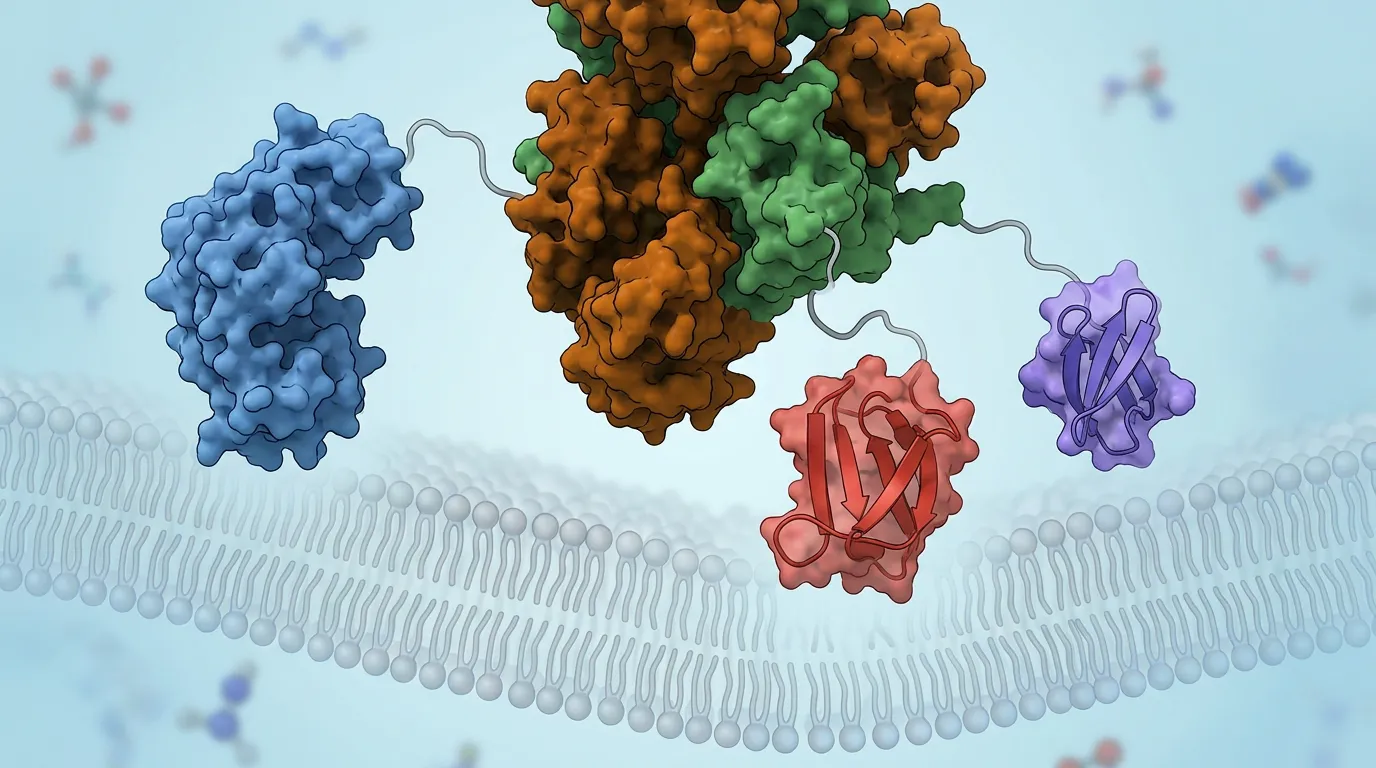
MBP, SUMO, and Fh8 are often grouped under “solubility tags,” but they solve different constraints. MBP is a large, unusually effective solubility enhancer with chaperone-like behavior. SUMO is smaller and pairs solubility enhancement with highly specific, scarless cleavage. Fh8 is an 8 kDa calcium-binding tag that can enhance soluble expression and double as a purification handle. None can repeal the hydrophobic physics of an integral membrane domain.
The right question is not “Which tag gives the most soluble band?” It is “Which fusion lets the target reach the state needed after the tag has done its job?”
Key Takeaways
- Soluble fusion does not equal folded passenger. Always measure the target after cleavage—or justify keeping the fusion for the final assay.
- Choose MBP when rescue power matters most. Its ~42 kDa footprint is a liability for some assays but often an advantage during expression and folding.
- Choose SUMO when a native N-terminus and clean cleavage matter. SUMO proteases recognize the folded SUMO surface rather than a short linear motif, enabling scarless release.
- Choose Fh8 when a small footprint is valuable and you can validate it empirically. Its evidence base is smaller and more target-dependent than MBP’s.
- For integral membrane proteins, tags help the soluble regions, expression, detection, and purification. They do not shield a transmembrane bundle from water; detergent, lipid, polymer, or a bilayer is still required.
- Screen tag, terminus, linker, and cleavage as one construct problem. The same tag can help at the N-terminus and hurt at the C-terminus—or vice versa—because topology and folding order change.
What a Solubility Tag Can—and Cannot—Do
A useful fusion partner can improve production through several mechanisms:
- Raise the solubility ceiling of the whole fusion. A highly soluble domain reduces intermolecular association while the passenger folds.
- Slow or redirect folding. A large N-terminal partner changes cotranslational folding and can reduce early aggregation.
- Recruit cellular folding help. Some fusions interact more productively with endogenous chaperones.
- Protect a vulnerable terminus. A folded tag can shield the passenger from proteases.
- Provide an affinity handle. MBP binds amylose; Fh8 can support calcium-dependent hydrophobic-interaction purification; most SUMO systems pair SUMO with His6 or another handle.
What a fusion cannot guarantee:
- native passenger folding;
- activity after cleavage;
- correct oligomerization;
- correct membrane insertion or topology;
- preservation of a native terminus while still fused;
- long-term stability at the required concentration;
- compatibility with structural or interaction assays.
The soluble fraction contains at least three biologically different outcomes:
| Outcome | What the gel shows | What the passenger is doing | What happens after cleavage |
|---|---|---|---|
| Native fusion | Soluble | Folded and functional | Often remains soluble |
| Soluble but non-native fusion | Soluble | Misfolded or locally unfolded but held apart | Often precipitates or is inactive |
| Tag-dominated assembly | Soluble | Passenger oligomerizes or aggregates around soluble tags | Heterogeneous SEC; cleavage worsens it |
Your screen must distinguish these states.
MBP: The High-Rescue, High-Footprint Option
Escherichia coli maltose-binding protein is approximately 42 kDa. It is not merely a large soluble mass. In a classic comparison across six aggregation-prone passengers, MBP was substantially more effective than GST or thioredoxin at producing soluble fusions, and some passengers became biologically active (Kapust & Waugh, 1999).
Later mechanistic work refined the story. MBP has an intrinsic ability to keep passengers soluble, but soluble recovery after in vitro refolding did not always produce active passenger. In cells, some passengers still depended on endogenous chaperones (Nallamsetty & Waugh, 2012).
Use MBP when
- an untagged or His-tagged construct is absent or insoluble;
- the target is a difficult cytosolic domain or soluble domain from a membrane protein;
- you can tolerate a large N-terminal fusion during expression;
- you plan a cleavage-and-polishing step;
- you need a sensitive “can this target be rescued at all?” test.
MBP’s liabilities
- At ~42 kDa, MBP can dominate SEC, scattering, cryo-EM alignment, and interaction assays.
- Amylose capture is gentle but often lower capacity and less universally robust than IMAC.
- The fusion may remain soluble only while MBP is attached.
- MBP can mask the true oligomeric or aggregation behavior of the target.
- A poorly exposed protease site creates an expensive, stable uncleaved species.
Design MBP as a removable folding aid
A strong default architecture is:
His6–MBP–flexible spacer–TEV or HRV 3C site–target
The His tag provides predictable capture; MBP provides solubility; the spacer exposes the cleavage site; the second affinity step removes His–MBP and tagged protease. The exact architecture must respect the target’s native N-terminus and compartment.
SUMO: Small Footprint, Native N-Terminus
Small ubiquitin-like modifier (SUMO) is roughly 11 kDa. It is widely used as an N-terminal fusion because it can enhance expression and solubility while giving an unusually clean cleavage reaction.
SUMO-specific proteases recognize the folded three-dimensional SUMO domain and cleave at its C-terminus. The first residue of the target sits immediately after SUMO, so cleavage can release a native N-terminus without a protease scar. The original SUMO-fusion system demonstrated improved expression and solubility across difficult targets together with efficient proteolysis (Malakhov et al., 2004). A direct comparison with traditional fusion systems found strong target-to-target variation, with SUMO and NusA among the most effective for the proteins tested (Marblestone et al., 2006).
Use SUMO when
- the exact N-terminal residue matters for activity, processing, or structure;
- MBP’s size would interfere with the workflow;
- you need a removable expression/solubility enhancer rather than an assay fusion;
- the target is a peptide, small domain, toxic protein, or protease-sensitive N-terminus;
- you want cleavage selectivity without engineering extra residues into the target.
SUMO’s liabilities
- It is not as universally powerful a rescue tag as MBP.
- SUMO protease requires the SUMO domain to be correctly folded; denatured fusion is not an equivalent substrate.
- The target can still precipitate immediately after release.
- Most SUMO constructs need an additional affinity handle for straightforward capture.
- Internal sequence context and steric occlusion can slow cleavage even when the junction is correct.
SUMO is especially strong when the downstream molecule cannot tolerate a scar. It is not automatically the strongest choice when the only goal is maximum soluble expression.
Fh8: A Small Solubility and Purification Tag With a Narrower Evidence Base
Fh8 is an approximately 8 kDa calcium-binding protein derived from Fasciola hepatica. Comparative studies placed Fh8 among effective solubility-enhancing partners for several difficult proteins while keeping a much smaller footprint than MBP or NusA (Costa et al., 2013).
Fh8 also exposes hydrophobic surfaces in a calcium-dependent manner. That property has been used for hydrophobic-interaction chromatography: the fusion binds phenyl-Sepharose in the presence of calcium and can be eluted by chelation under mild conditions. GFP and superoxide dismutase fusions retained activity in the initial demonstration (Costa et al., 2013).
Use Fh8 when
- MBP works but its footprint is unacceptable;
- a small N-terminal solubility enhancer is worth screening;
- calcium-dependent HIC fits the purification workflow;
- you are building a parallel tag panel rather than betting the project on one fusion;
- target-specific evidence or prior lab experience supports it.
Fh8’s liabilities
- Far fewer independent target panels exist than for MBP or SUMO.
- Calcium binding and HIC conditions may conflict with metal-sensitive targets, chelators, or downstream assays.
- The same small size that reduces interference may also provide less rescue for strongly aggregation-prone passengers.
- Commercial vector/protease ecosystems are less standardized.
Fh8 belongs in a rational screen. It should not be presented as a universal replacement for better-established fusions.
The Membrane-Protein Exception: “Soluble” Has Two Meanings
For an integral membrane protein, a solubility tag cannot make the transmembrane surface compatible with bulk water. Once the protein leaves the membrane, those helices still need detergent, lipid, polymer, amphipol, or another membrane mimetic.
Tags can nevertheless be useful at four points.
1. Improve expression of a soluble domain
An N-terminal MBP or SUMO fusion can help a large cytosolic domain fold before or while the transmembrane segments insert. This is most plausible when the problematic region is outside the membrane.
2. Stabilize a detached domain construct
If the experiment requires only the soluble ectodomain or cytosolic domain, a fusion tag can rescue that isolated domain. This is a conventional soluble-protein problem, even though the parent protein is membrane-bound.
3. Improve detection and purification
GFP and MBP fusions can increase detection sensitivity and provide a folded reporter or capture handle. A properly folded C-terminal GFP has historically been used as a proxy for successful membrane-protein expression and for FSEC screening.
4. Control topology or localization
Here the fusion can help or destroy the experiment. MBP with its native signal peptide enters the periplasm; cytosolic MBP variants do not. SUMO and Fh8 have their own folding constraints. A tag placed on the wrong side of the membrane may fail to fold, fail to bind resin, or invert the interpretation of yield.
Before cloning, map both termini and every intended tag to the predicted compartment. Our guide to N- versus C-terminal tag placement covers the topology decision in detail.
Decision Matrix: MBP, SUMO, or Fh8?
| Dominant constraint | First choice | Second choice | Why |
|---|---|---|---|
| No detectable expression | MBP | SUMO | MBP gives the strongest rescue test; SUMO tests a smaller architecture |
| Strong expression, mostly pellet | MBP | SUMO + lower temperature | Test whether a large folding aid can suppress aggregation |
| Exact native N-terminus required | SUMO | MBP with a carefully designed protease site | SUMO cleavage is naturally scarless |
| Large tag disrupts assay | SUMO | Fh8 | Smaller final fusion or cleaner release |
| Need small dual solubility/purification tag | Fh8 | His–SUMO | Fh8 offers calcium-dependent HIC but needs empirical validation |
| Membrane protein with fragile cytosolic domain | MBP or SUMO on cytosolic side | soluble-domain construct | Tag can help the domain, not replace detergent/lipid |
| Protein precipitates after every tag is removed | Keep fusion if assay allows; redesign target | change boundary/host | The passenger itself is the dominant liability |
| Structural biology endpoint | Cleavable SUMO or MBP | Fh8 screen | Plan early removal and monodispersity validation |
When two options are plausible, do not debate them for a month. Clone both.
Screen the Construct, Not Just the Tag
A productive first round changes a few high-leverage variables in parallel.
A compact eight-construct panel
- His6–target control
- His6–MBP–protease site–target
- His6–SUMO–target
- His6–Fh8–protease site–target
- Best fusion with an alternate linker
- Best fusion at the opposite terminus, if topology permits
- Best fusion with an alternate domain boundary
- Best fusion in a slower-expression vector or host condition
For a membrane protein, add detergent-solubilized FSEC or a target-specific membrane fractionation readout. Do not call cytosolic soluble signal a success if the biological target should be membrane inserted.
Score five checkpoints
| Checkpoint | Minimum readout | Failure it catches |
|---|---|---|
| Total expression | quantitative gel or fluorescence | tag does not rescue production |
| Correct localization/fraction | soluble vs pellet or membrane fraction | mislocalization masquerading as solubility |
| Intact fusion | Western/intact mass | proteolysis leaves soluble tag only |
| Pre-cleavage behavior | analytical SEC + activity | soluble but heterogeneous fusion |
| Post-cleavage behavior | recovery + SEC + activity | tag-dependent solubility |
The intact-fusion checkpoint is crucial. A strong MBP band can be almost entirely free MBP after proteolysis in the cell.
Cleavage Is Part of the Screen, Not a Cleanup Detail
Run microscale cleavage before scaling expression.
Optimize the junction
Place a short flexible spacer around TEV or HRV 3C sites so the protease can access the sequence without unfolding the target. SUMO is different: preserve the folded SUMO domain and the exact target junction required by the SUMO protease.
Cleave below the precipitation threshold
If the target aggregates above 1 mg/mL after release, do not cleave at 10 mg/mL and interpret the pellet as a protease problem. Test a concentration series with stabilizing ligand, salt, glycerol, arginine, detergent, or lipid as appropriate.
Separate products immediately
Uncleaved fusion, free tag, protease, and target can interact. Use reverse IMAC or another orthogonal polishing step promptly. Then evaluate the target alone.
Decide whether removal is actually required
Keep the fusion when:
- the tag does not perturb activity;
- the final assay benefits from immobilization or added mass;
- structural interpretation explicitly includes the tag;
- removal destroys the only usable state.
Remove it when the tag changes oligomerization, blocks a binding surface, dominates the biophysical signal, or prevents the intended structural method.
Worked Example: MBP Rescues Expression, SUMO Rescues the Final Product
Imagine a 24 kDa eukaryotic domain that is undetectable with His6 alone. His–MBP produces a strong soluble fusion, but only 15% of the target remains soluble after TEV cleavage. His–SUMO produces less total fusion, yet most of the released target remains monodisperse and the native N-terminal residue is restored.
Which tag won?
- For rapid antigen production where the fusion can remain attached, MBP may still win.
- For NMR, crystallography, or an N-terminus-sensitive activity assay, SUMO wins despite the lower expression band.
- If both fail after cleavage, the next experiment should change the target boundary or environment—not add a fourth large tag without a hypothesis.
The objective function determines the winner.
Troubleshooting Patterns
Fusion is soluble; target precipitates after cleavage
Reduce cleavage concentration, add stabilizing ligand/cofactor, change buffer, or redesign the boundary. Screen a smaller tag only if the large fusion is suspected of preventing native folding.
Only the tag is visible
Confirm full-length fusion with antibodies or mass mapping on both sides of the junction. Reduce induction temperature, move the tag, use protease-deficient strains, or remove a vulnerable disordered segment.
Fusion is monodisperse but inactive
Test whether the tag occludes the active site or prevents assembly. Measure activity after partial cleavage and after full separation. Confirm cofactors and PTMs.
Membrane target is in the soluble fraction without detergent
Treat this as a warning. You may have soluble tag, truncated target, misinserted protein, or a non-native aggregate—not a detergent-free integral membrane protein.
The Economics of a Fusion-Tag Screen
| Approach | Cloning effort | Information gained | Risk |
|---|---|---|---|
| One favorite tag | Low | One outcome | Repeats the project if the choice is wrong |
| MBP/SUMO/Fh8 parallel panel | Moderate | Separates rescue power, footprint, and cleavage behavior | Requires standardized comparison |
| Tag panel plus boundaries | Higher | Tests tag dependence and construct liability together | More constructs, much better diagnosis |
| Scale before cleavage test | Low initially | Misleading yield | Expensive failure at purification scale |
The correct time to learn that a target precipitates after tag removal is during a 50–200 µL cleavage test, not after a 10 L expression.
Bottom Line
Use MBP when you need the strongest folding and solubility rescue test. Use SUMO when a smaller fusion and a native N-terminus matter. Use Fh8 as a compact, experimentally validated option when its footprint or purification mechanism fits the target. For membrane proteins, place every fusion with topology in mind and remember that a soluble tag cannot replace a membrane mimetic.
The winning construct is not the one with the darkest soluble band. It is the one that produces an intact, functional, monodisperse target in the state required downstream.
Designing Fusion Screens With Orbion
Orbion’s Design module includes MBP, SUMO, Fh8, linkers, cleavage sites, affinity tags, and topology-aware construct components. It compares constructs against predicted solubility, disorder, aggregation, stability, PTM retention, and vector compatibility, then hands the selected construct directly into Bench for an expression and purification plan.
Characterization adds transmembrane topology and per-residue disorder/amyloidogenicity tracks, helping distinguish a tag-rescuable terminal liability from a target that needs a different host, boundary, or membrane environment.
References
- Kapust, R. B. & Waugh, D. S. Escherichia coli maltose-binding protein is uncommonly effective at promoting the solubility of polypeptides to which it is fused. Protein Science 8, 1668–1674 (1999). doi:10.1110/ps.8.8.1668
- Nallamsetty, S. & Waugh, D. S. The ability to enhance the solubility of its fusion partners is an intrinsic property of maltose-binding protein but their folding is either spontaneous or chaperone-mediated. PLoS ONE 7, e49810 (2012). Full text
- Malakhov, M. P. et al. SUMO fusions and SUMO-specific protease for efficient expression and purification of proteins. Journal of Structural and Functional Genomics 5, 75–86 (2004). doi:10.1023/B:JSFG.0000029237.70316.52
- Marblestone, J. G. et al. Comparison of SUMO fusion technology with traditional gene fusion systems: enhanced expression and solubility with SUMO. Protein Science 15, 182–189 (2006). Full text
- Costa, S. J. et al. The novel Fh8 and H fusion partners for soluble protein expression in Escherichia coli: a comparison with the traditional gene fusion technology. Applied Microbiology and Biotechnology 97, 6779–6791 (2013). doi:10.1007/s00253-012-4559-1
- Costa, S. J. et al. The Fh8 tag: a fusion partner for simple and cost-effective protein purification in Escherichia coli. Protein Expression and Purification 92, 163–170 (2013). doi:10.1016/j.pep.2013.09.013
- Moon, A. F. et al. Expression of proteins in Escherichia coli as fusions with maltose-binding protein to rescue non-expressed targets in a high-throughput protein-expression and purification pipeline. Acta Crystallographica D 66, 722–731 (2010). Full text