A sequence cannot tell you which incubator will produce a perfect protein. It can tell you when a host is fighting the biology: six disulfides in the bacterial cytosol, essential human glycosylation in insect cells, a toxic membrane protein under a maximal promoter, or a cofactor pathway the host does not have.
Host selection from sequence is therefore a shortlisting problem. Use sequence features to eliminate mismatches, rank plausible systems, and define the minimum comparison that must still be run.
Key Takeaways
- Begin with the required product, not the cheapest host. Activity, modification, membrane context, scale, and timeline define success.
- E. coli wins on speed and cost when the protein’s biology permits it. It is not a neutral default for secreted, glycosylated, disulfide-rich, or complex membrane proteins.
- Insect cells offer productive eukaryotic folding and membrane workflows. Their glycosylation and processing are not identical to mammalian cells.
- Mammalian cells provide the most native-like context for many human proteins. Cost and throughput are the tradeoffs.
- Cell-free systems are powerful for rapid, toxic, labeled, or membrane targets. Reaction composition is controllable, but scale and optimization still matter.
- Sequence predictions narrow the field; a small host screen decides. Cell line, vector, expression rate, and construct can reverse the ranking.
Read the Sequence as a Production Specification
Annotate these features before choosing a host:
- signal peptide and secretion route;
- transmembrane helices and topology;
- disulfide pattern;
- N- and O-glycosylation sites;
- lipidation, phosphorylation, acetylation, or other required PTMs;
- cofactor and metal requirements;
- domain boundaries and disorder;
- protease-sensitive regions;
- oligomeric state and partners;
- low-complexity or aggregation-prone segments;
- enzyme activity that may be toxic to the host;
- sequence motifs requiring specific processing.
Then separate required features from incidental ones. A predicted glycosylation sequon does not prove the glycan is needed. A transmembrane helix, however, is a hard physical constraint.
E. coli: The Fast Default With Clear Boundaries
E. coli offers rapid growth, inexpensive media, mature vectors, high throughput, and straightforward scale-up. It is a strong first choice for many soluble bacterial proteins, domains that do not require eukaryotic processing, and early screening libraries.
It becomes riskier when the target requires:
- complex disulfide formation in a reducing cytosol;
- mammalian glycosylation;
- secretion through a eukaryotic pathway;
- native membrane lipid composition;
- specific chaperones or assembly partners;
- extensive PTM-dependent regulation.
These are not absolute bans. Periplasmic targeting, oxidative strains, coexpression, fusion tags, lower temperature, and refolding can rescue some targets. The question is whether the added engineering is still cheaper than moving to another host.
E. coli optimization is reviewed in detail by Rosano and Ceccarelli (2014).
Insect Cells: Eukaryotic Machinery With Productive Scale
Baculovirus–insect cell systems are widely used for receptors, channels, multiprotein complexes, viral proteins, and eukaryotic enzymes. They provide membrane insertion, secretion, disulfide formation, and many eukaryotic processing capabilities.
The main caveat is “eukaryotic” does not mean “human-identical.” Glycan structures, proteolytic processing, lipid composition, and regulatory PTMs can differ. Insect cells are attractive when native-like folding matters but exact mammalian modification is not a hard requirement.
Sequence flags favoring an insect-cell comparison include:
- multiple transmembrane helices;
- extracellular disulfides;
- large multidomain eukaryotic proteins;
- assembly with several eukaryotic subunits;
- secretion where mammalian glycan detail is not essential.
Mammalian Cells: Closest Context, Highest Cost
Mammalian systems offer native-like secretory processing, glycosylation, disulfide formation, trafficking, membrane composition, and partner availability for many human proteins.
Use them early when function depends on:
- specific glycoforms or glycan occupancy;
- mammalian proteolytic maturation;
- trafficking and surface presentation;
- complex receptor assembly;
- PTM-dependent activity;
- native membrane signaling context.
The costs are slower cycles, more expensive media and infrastructure, and sometimes lower throughput. If the assay only needs a stable isolated domain, a simpler host may still be superior.
Cell-Free Expression: Control the Reaction Directly
Cell-free protein synthesis removes the need to keep a host cell alive. You can add lipids, nanodiscs, detergents, chaperones, cofactors, isotope-labeled amino acids, or noncanonical residues directly.
It is especially useful for:
- toxic proteins;
- rapid construct comparison;
- membrane-protein insertion into supplied mimics;
- isotope labeling;
- difficult cofactor or additive requirements;
- proteins that destabilize living hosts.
The limitations are extract-specific background, reaction optimization, variable PTM capability, and economics at scale. “Cell-free” is a family of systems—E. coli lysate, wheat germ, rabbit reticulocyte, insect, and engineered extracts do not provide the same biology.
For a direct comparison, read When Cell-Free Expression Beats E. coli.
A Sequence-First Decision Matrix
| Sequence or product requirement | E. coli | Insect | Mammalian | Cell-free |
|---|---|---|---|---|
| Simple soluble enzyme, no essential PTMs | strong first choice | usually unnecessary | usually unnecessary | useful for rapid screen |
| Multiple disulfides, secreted | periplasm/refolding possible | good candidate | strong candidate | extract-dependent |
| Human-like glycosylation required | poor fit | incomplete match | strongest fit | specialized system only |
| Multi-pass membrane protein | target-dependent | strong candidate | strong native-context candidate | strong screening option with lipids |
| Toxic enzyme | expression control needed | possible | possible | strong candidate |
| Large multiprotein complex | coexpression burden | good candidate | strong if mammalian context matters | possible with optimized coexpression |
| Rapid variant library | strongest throughput | moderate | costly | strong at small scale |
| Isotope/noncanonical labeling | established for many targets | harder | harder | highly controllable |
PTM Compatibility Is a Matrix, Not a Yes/No Field
“Requires PTMs” is not specific enough. Record each modification and its role:
- N-linked glycosylation for folding or pharmacology;
- O-linked glycosylation;
- disulfide formation;
- phosphorylation;
- acetylation;
- lipidation;
- proteolytic cleavage;
- cofactor incorporation.
Then classify:
- required for folding;
- required for activity;
- required for trafficking;
- present in vivo but not needed for the assay;
- unknown.
This prevents an incidental sequon from forcing an expensive host and prevents an essential modification from being ignored because the bacterial protein appears soluble.
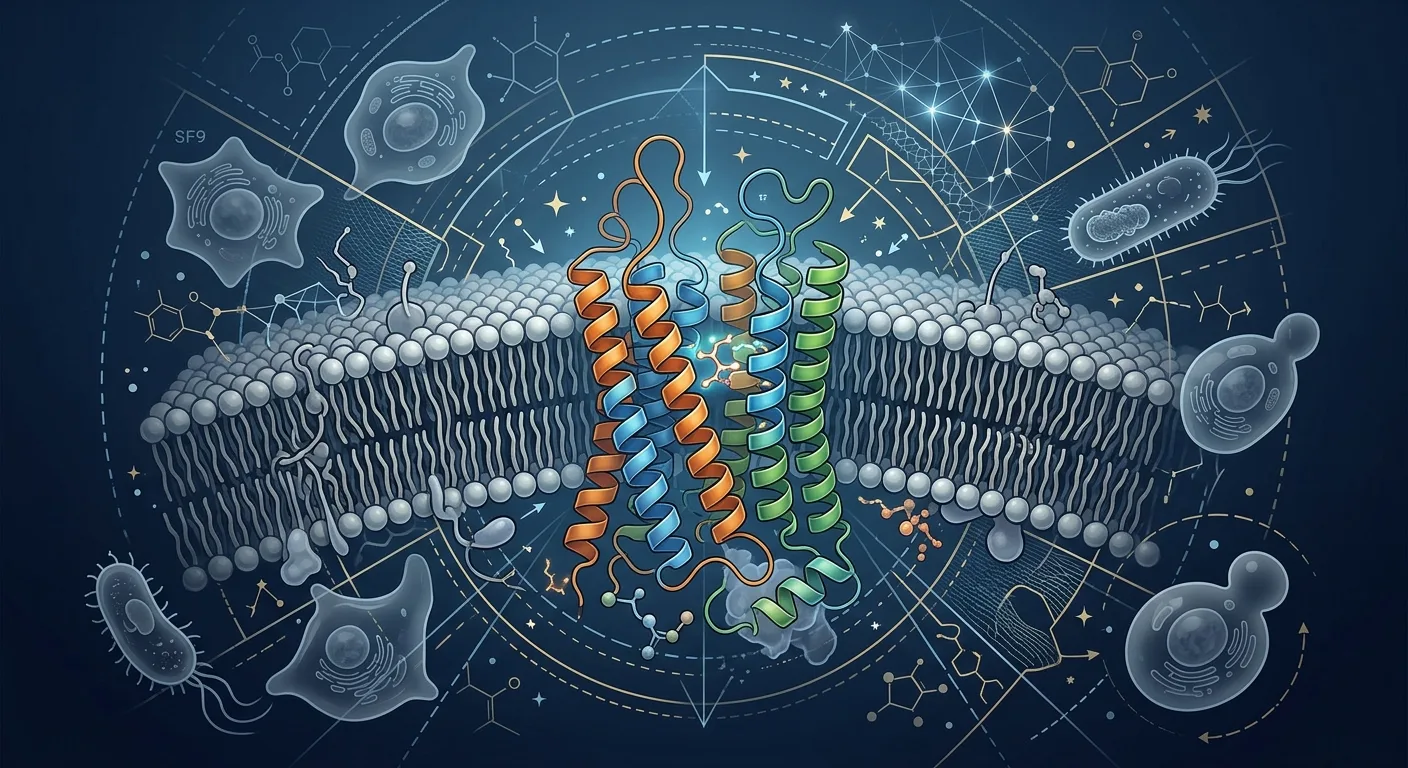
Membrane Proteins Need More Than an Insertion Signal
Sequence can predict topology, but productive expression also depends on:
- lipid composition;
- translocon capacity;
- folding assistants;
- trafficking and quality control;
- oligomeric partners;
- toxicity of the expressed protein;
- extraction and stabilization conditions.
A GPCR may express at high total levels in one host but fail to reach the membrane or bind ligand. A bacterial transporter may be easier in E. coli than in a eukaryotic cell. Use receptor family, native organism, and assay context alongside generic host scores.
Worked Example: A Human Secreted Enzyme
The sequence is 480 residues with an N-terminal signal peptide, four disulfides, five N-glycosylation sequons, and a propeptide cleavage site. The assay needs catalytic activity, not a therapeutic glycoform.
Sequence-first ranking:
- Mammalian: highest chance of native processing, slowest and most expensive.
- Insect: plausible folding and secretion; glycosylation differs but may be acceptable for activity.
- Cell-free eukaryotic extract: useful for rapid processing tests; uncertain scale.
- E. coli: possible only with extensive redesign, periplasmic expression, or refolding; poor first choice.
A rational screen compares insect and mammalian expression on the same mature-domain boundaries, with an activity assay and intact-mass or glycan check. If insect-derived protein is active and stable, exact mammalian glycosylation may not be needed. If propeptide processing fails, the host ranking changes.
Worked Example: A Toxic Bacterial Membrane Enzyme
The sequence has six predicted transmembrane helices and an active site expected to perturb lipid metabolism.
E. coli is biologically familiar but toxicity may cap expression. The first screen might compare:
- tightly controlled low-temperature E. coli expression;
- cell-free synthesis directly into nanodiscs;
- two construct boundaries preserving all helices;
- catalytic-dead control to separate toxicity from folding.
If catalytic-dead protein expresses while wild type suppresses growth, host toxicity—not intrinsic misfolding—is the primary bottleneck.
How to Run the Minimum Informative Host Screen
Avoid changing host, construct, tag, and induction conditions simultaneously. Start with:
- one or two sequence-supported construct boundaries;
- a consistent affinity handle where possible;
- two host systems chosen for distinct biological reasons;
- matched assays for total yield, soluble or membrane-localized yield, purity, and function.
The winning host is not the one with the darkest band. It is the one that produces the required form of the protein at a usable yield.
Host Selection in Orbion
Orbion’s AstraSUIT can shortlist host suitability from sequence and target context. Its outputs can be reviewed alongside a PTM–expression-system compatibility matrix, topology, disorder, and membrane features before constructs enter Design and Bench.
That workflow preserves the reasoning: why a host was selected, which biological requirements it satisfies, and which unknowns the first experiment must resolve.
For a broader expression-system overview, see How to Choose Expression Systems for Your Protein's PTM Requirements. Its host comparison also covers the PTM tradeoffs that should shape the first screen.
Bottom Line
Sequence alone cannot select a final host with certainty. It can identify hard incompatibilities, rank plausible systems, and keep you from spending weeks optimizing a host that cannot make the required product.
Annotate topology, PTMs, processing, assembly, toxicity, and disorder. Separate required biology from incidental features. Then compare the smallest set of hosts that differ on a real mechanistic hypothesis—and judge them by functional protein, not raw expression.
References
- Rosano GL, Ceccarelli EA. Recombinant protein expression in Escherichia coli: advances and challenges. Frontiers in Microbiology. 2014. doi:10.3389/fmicb.2014.00172
- Kost TA, Condreay JP, Jarvis DL. Baculovirus as versatile vectors for protein expression in insect and mammalian cells. Nature Biotechnology. 2005. doi:10.1038/nbt1095
- Baldi L, Hacker DL, Adam M, Wurm FM. Recombinant protein production by large-scale transient gene expression in mammalian cells. Biotechnology Letters. 2007. doi:10.1007/s10529-006-9297-y
- Katzen F, Chang G, Kudlicki W. The past, present and future of cell-free protein synthesis. Trends in Biotechnology. 2005. doi:10.1016/j.tibtech.2005.07.013
- Tripathi NK, Shrivastava A. Recent developments in bioprocessing of recombinant proteins: expression hosts and process development. Frontiers in Bioengineering and Biotechnology. 2019. doi:10.3389/fbioe.2019.00420