Your membrane prep contains the target. One percent DDM moves most of it into the supernatant. The yield looks excellent—until the sample reaches immobilized metal-affinity chromatography, where the receptor loses ligand binding and half of it appears in the void volume. The detergent succeeded at extraction and failed at the job that actually mattered: keeping the protein native after extraction.
That distinction is the center of detergent selection. A detergent can be an efficient extractor, a good long-term stabilizer, a small-micelle choice for crystallography, or a convenient species to remove during reconstitution. It is rarely the best at all four. The practical question is therefore not “Which detergent is best?” but “Which detergent should do each stage of this workflow?”
Key Takeaways
- Separate extraction from stabilization. High soluble yield after ultracentrifugation does not prove that the extracted protein is monodisperse, functional, or stable for 24 hours.
- DDM is the rational first screen, not the automatic final answer. It is inexpensive, effective, nonionic, and compatible with many assays; keep it when it works.
- Move toward LMNG or GDN when extraction is good but the protein deteriorates downstream. Their lower critical micelle concentrations and stronger protein–detergent assemblies often improve kinetic stability, but exchange can be slow and removal is harder.
- Treat cholesterol-like lipids as experimental variables. For many GPCRs, LMNG alone and LMNG plus cholesteryl hemisuccinate are meaningfully different conditions.
- Rank detergents on four readouts: extraction yield, monodispersity, stability over time or heat, and retained function. A winner on only one axis is not a winner.
- Screen by protein class and endpoint. A detergent that produces a beautiful cryo-EM sample may be a poor choice for transport assays, native-lipid questions, or rapid nanodisc reconstitution.
The First Decision: Are You Extracting or Stabilizing?
Detergent selection starts with two physical events that are often collapsed into one.
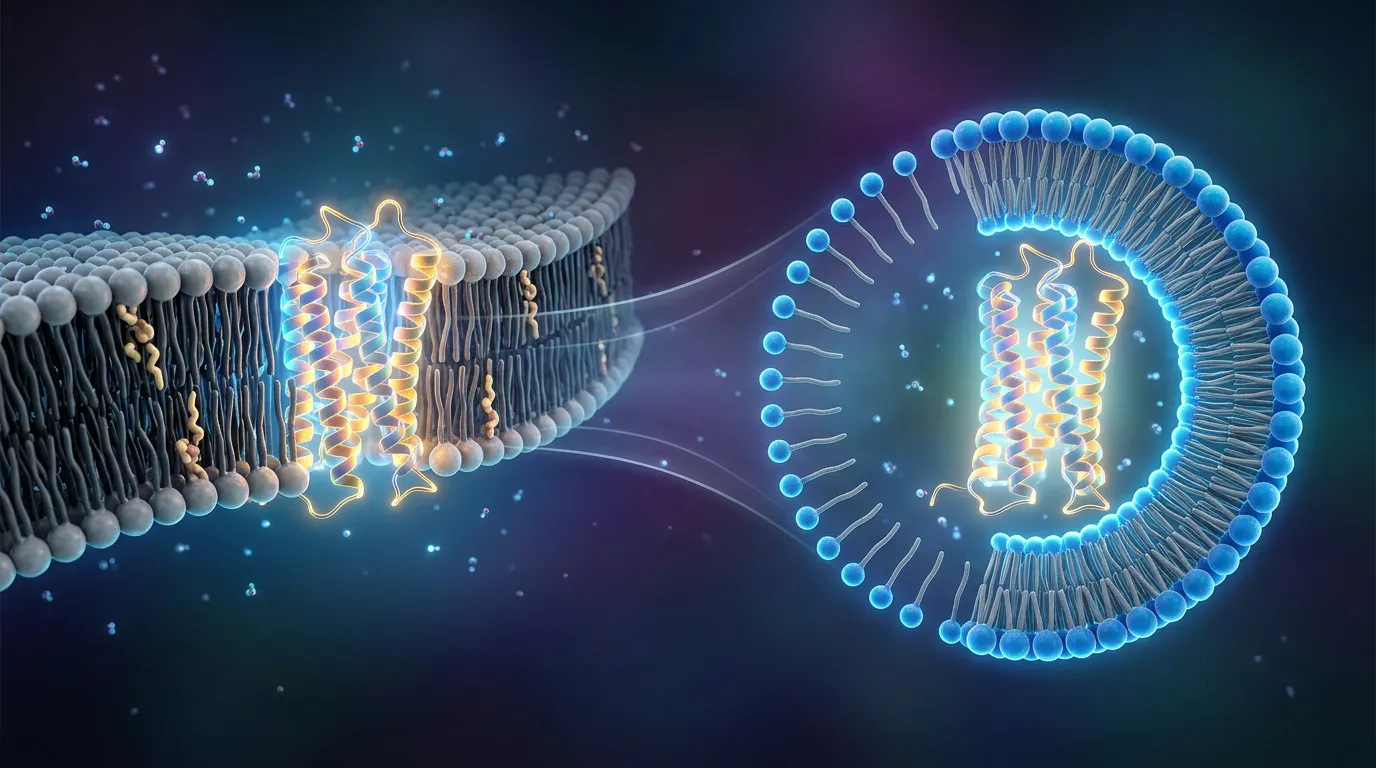
During extraction, detergent partitions into the membrane, disrupts the bilayer, and surrounds exposed hydrophobic surfaces. The useful readout is recovery of the target in the clarified supernatant. Aggressive detergents can look excellent here because they dissolve the membrane efficiently.
During stabilization, the protein–detergent complex must remain folded, monodisperse, correctly assembled, and functional after lipids have been stripped away and the target has been diluted, concentrated, bound to resin, eluted, and stored. The useful readouts are a symmetric size-exclusion peak, retained ligand or substrate response, a stable oligomeric state, and limited loss over the actual experimental window.
These objectives can conflict. Increasing detergent concentration can improve extraction while increasing delipidation or conformational damage. A short-chain detergent can make a smaller micelle but exchange rapidly at the protein surface. A very low-critical-micelle-concentration detergent can stabilize a fragile complex but become difficult to remove by dialysis or Bio-Beads.
The default workflow should therefore allow a two-detergent strategy:
- Extract with the condition that gives adequate recovery without obvious damage.
- Exchange during affinity purification or size-exclusion chromatography into the condition that best preserves the downstream state.
This is not a compromise. It is often the correct design.
What DDM, LMNG, GDN, and the Alternatives Actually Buy You
| Detergent | What it is good at | Main liability | Sensible role |
|---|---|---|---|
| DDM | Broad extraction, mild nonionic environment, routine purification | Some fragile receptors or complexes decay over hours; micelle is not small | First-line extraction and purification control |
| DM | Smaller micelle than DDM; useful intermediate maltoside | Often less stabilizing than DDM | Crystallography-oriented secondary screen |
| LMNG | Strong stabilization of many GPCRs, channels, and transporters; very low CMC | Slow exchange and difficult removal; not universally better | Downstream stabilization after DDM extraction, or direct extraction for fragile targets |
| GDN | Stable, digitonin-like environment with defined chemistry; often cryo-EM friendly | Expensive; may exchange slowly; can preserve an unwanted state | Fragile complexes and final cryo-EM buffer screen |
| Digitonin | Gentle handling of native complexes | Batch heterogeneity and a large, compositionally variable micelle | Native complex extraction when activity dominates |
| OG / NG | Small micelles and comparatively easy removal | High CMC and faster exchange can destabilize proteins | Crystallization or reconstitution screen after stability is proven |
| C12E8 / Triton X-100 | Efficient extraction for some targets | UV background or heterogeneous detergent chemistry; not always ideal downstream | Extraction-only branch |
| LDAO / Fos-cholines | Strong extraction and small micelles | Higher risk of delipidation, unfolding, or non-native states | Diagnostic rescue screen, especially for robust targets—not a default |
| CHAPS | Zwitterionic, steroid-like scaffold; useful in mixed systems | Often insufficient alone for integral proteins | Additive or specialized mixed-micelle condition |
The maltose–neopentyl glycol architecture was introduced specifically to improve membrane-protein stabilization. In the original LMNG study, maltose neopentyl glycols outperformed conventional detergents across several membrane-protein systems and enabled structural work that was difficult in standard amphiphiles. That paper established an important principle: a detergent can be designed to exchange more slowly from the protein surface without simply becoming harsher (Chae et al., 2010).
But “LMNG is more stabilizing” is a population-level observation, not a rule for every target. In a five-transporter stability screen, LMNG shifted both unfolding and aggregation readouts in the favorable direction for all five proteins tested, yet the same study showed that proteins already stable in DDM could be destabilized by other exchanges (Alexandrov et al., 2019). The experimental control is therefore not optional: always retain the starting detergent as a benchmark.
Why CMC Is Useful—and Commonly Misused
The critical micelle concentration (CMC) is the detergent concentration above which micelles form in a defined solution. It matters because the free monomer concentration and the micelle population change sharply around that threshold. It does not directly tell you whether a detergent is mild, whether it extracts well, or how much detergent is bound to your protein.
Three practical implications matter:
- Stay safely above the CMC during purification. Dilution during washing, concentration, or assay setup can drop a detergent below the level needed to maintain the protein–detergent complex.
- Think in absolute concentration, not “times CMC” alone. One hundred times the CMC of LMNG and one hundred times the CMC of OG describe very different mass concentrations and micelle environments.
- Low-CMC detergents are hard to remove. LMNG can remain associated during dialysis or partial exchange. That is useful for storage and inconvenient for reconstitution.
Salt, temperature, glycerol, lipids, and mixtures of detergents shift real behavior away from a value measured in pure water. Use published CMCs to avoid obvious errors, then treat the final concentration as an empirical variable.
A Minimal Detergent Screen That Answers the Right Question
A useful first screen can fit on one membrane preparation. The goal is not to test every detergent sold; it is to sample distinct physicochemical regimes and keep enough material for follow-up.
Stage 1: Standardize the membrane input
Use the same membrane-protein concentration, total membrane mass, buffer, salt, ligand, reductant, and incubation time in every condition. Normalize by total membrane protein or a target-specific fluorescence/Western signal before adding detergent.
Include a no-detergent control and keep an aliquot of the starting membrane fraction. Without those controls, “high extraction” can be confused with target degradation or poor fraction recovery.
Stage 2: Start with a compact panel
A practical six-condition panel is:
- DDM
- DDM plus a target-relevant lipid or sterol, such as CHS for many GPCRs
- LMNG
- GDN or digitonin
- a shorter-chain maltoside, such as DM or OG/NG
- one chemically distinct extractor, such as C12E8 or LDAO
Use concentrations supported by the detergent supplier and the published protocol for your protein class. For a new target, a common starting point is around 1% detergent for extraction, followed by a lower maintenance concentration after clarification. That is a starting condition, not a universal recipe.
Extract at 4 °C with gentle mixing for a defined interval—often 60–120 minutes—then clarify every sample with the same high-speed spin. Record both fraction extracted and total recovered target. A detergent that fragments or degrades the protein can produce a misleading supernatant signal.
Stage 3: Read monodispersity before purification
Fluorescence-detection size-exclusion chromatography (FSEC) allows a GFP-tagged target to be evaluated directly from solubilized material. Rank traces by:
- a single symmetric main peak;
- minimal signal in the void volume;
- limited tailing;
- a plausible apparent particle size;
- consistency across replicates.
FSEC screening was developed precisely to decouple expression and detergent behavior from the cost of full purification. Later high-throughput implementations showed that the goal is not the tallest fluorescence peak but a strong, sharp, nonaggregated peak that survives the workflow (Kawate & Gouaux, 2006; Hattori et al., 2017).
If a fluorescent fusion is impossible, use differential filtration, analytical SEC after microscale affinity capture, or sedimentation after a defined stress. The assay changes; the logic does not.
Stage 4: Add a stability challenge
Run the leading conditions again after one stress that resembles your real bottleneck:
- 24–72 hours at 4 °C;
- a 10-minute temperature series;
- concentration to the intended working concentration;
- freeze–thaw if storage matters;
- detergent dilution into the assay buffer.
This separates “looks good immediately” from “survives long enough to use.” A differential filtration assay can make this comparison at small scale by quantifying the fraction that becomes large particles after detergent exchange or incubation (Vergis et al., 2010).
Stage 5: Measure one function
For a receptor, measure ligand binding or signaling-partner coupling. For a transporter, use substrate binding or ATPase activity where appropriate. For an ion channel, use a conformational ligand, flux proxy, or reconstitution-based activity assay.
Do not wait until the end to ask whether the protein works. Monodisperse, inactive membrane protein is one of the easiest false successes to manufacture.
The Decision Tree: From DDM to LMNG
Use this sequence of decisions rather than ranking a detergent table in isolation.
1. Does DDM extract enough target?
Yes: keep DDM as the control and move to monodispersity and activity.
No: increase the detergent-to-membrane ratio, extend the extraction modestly, or test C12E8, Triton X-100, digitonin, LMNG, and one carefully chosen zwitterionic detergent. If only an aggressive detergent extracts the target, shorten exposure and plan an early exchange.
2. Is the DDM extract monodisperse immediately?
Yes: do not switch just because LMNG is fashionable. Test whether DDM survives the downstream window.
No: screen LMNG, GDN, DDM plus lipid/sterol, and a different chain-length maltoside. If all conditions aggregate, revisit construct boundaries, expression host, ligand occupancy, oligomeric partners, and membrane preparation. Detergent cannot rescue a fundamentally heterogeneous starting material.
3. Does the DDM sample decay with time, concentration, or heat?
Yes: exchange into LMNG or GDN during affinity washing or SEC. Run a DDM-to-LMNG gradient or several column volumes rather than assuming one buffer exchange removes the original micelle completely.
No: keep DDM unless the downstream method creates another constraint.
4. Does function improve with CHS or another lipid?
Yes: carry the additive as its own optimized variable. For metabotropic glutamate receptor 2, LMNG plus CHS preserved allosteric behavior longer than LMNG alone, and adding GDN improved it further; the important result was target-specific and functional, not merely a prettier chromatogram (Olofsson et al., 2021).
No: remove the additive. Extra lipid can complicate mass measurements, grid behavior, and reproducibility without helping the target.
5. What is the endpoint?
- Cryo-EM: screen LMNG, GDN, digitonin, and nanodiscs; pay attention to particle distribution at the air–water interface.
- LCP crystallography: plan for a compatible small-micelle detergent or controlled exchange before LCP setup.
- Binding assays: prioritize retained ligand binding and low nonspecific background over micelle size.
- Transport or channel function: detergents are an intermediate. Move toward proteoliposomes, nanodiscs, or another bilayer system.
- Native-lipid biology: consider SMA/DIBMA extraction or a rapid move into a defined lipid system; see our guide to lipid nanodiscs, micelles, and SMALPs.
How to Exchange Detergents Without Creating a New Failure
Detergent exchange is not instantaneous. The protein carries a belt of its original amphiphile; the free detergent and micelle pools also have to equilibrate.
Exchange on affinity resin
This is often the most material-efficient approach. Bind the tagged protein in the extraction detergent, then wash with several column volumes containing the destination detergent above its maintenance concentration. A gradual transition can be safer for fragile targets.
Watch for two artifacts:
- the target elutes during the low-detergent transition because its complex falls apart;
- the original detergent remains because the wash was too short or because the destination detergent exchanges slowly.
Exchange by SEC
SEC removes most free original micelles while placing the protein in the new mobile phase. It is excellent for a final buffer transition but consumes material and can expose a fragile sample to dilution. A mixed-detergent state may persist in the protein–detergent complex even when the bulk buffer has changed.
Exchange by dilution and reconcentration
This is fast and risky. It works best when the starting detergent has a high CMC and the protein tolerates transient dilution. With LMNG or GDN, repeated concentration can retain detergent and concentrate micelles along with the protein.
After any exchange, repeat the assay that motivated the change. If LMNG sharpens SEC but abolishes ligand binding, the exchange failed scientifically even if it succeeded chromatographically.
Troubleshooting the Four Most Common Outcomes
High extraction, large void-volume peak
The detergent dissolves the membrane but does not maintain a uniform protein–detergent complex. Reduce extraction time, add ligand or lipid, move to LMNG/GDN, and test whether the aggregate forms during extraction or after clarification.
Low extraction, sharp FSEC peak
You may have found a gentle detergent that preserves the fraction it extracts. Decide whether the yield is sufficient. If not, use a stronger extraction detergent and exchange into the gentle condition immediately.
Sharp SEC peak, no function
Test ligand, cofactor, lipid, redox state, and orientation-sensitive assay controls. Screen a native-like additive and compare to intact membranes. Do not conclude that the target is intrinsically inactive.
Good at small scale, poor after concentration
Protein concentration, detergent concentration, and free micelle concentration are changing together. Track all three. Concentrator membranes can retain micelles, and an apparently harmless tenfold protein concentration step can create a much larger change in the colloidal environment.
Worked Example: A Receptor That Extracts in DDM but Stores in LMNG
The ligand-gated ion channel OlZAC illustrates the two-stage logic. A detergent screen found that DDM could extract the channel, while LMNG and GDN gave better stability under a heat challenge. The resulting purification strategy used DDM or DDM–CHS for extraction and LMNG or GDN downstream (Uysal et al., 2021).
The transferable lesson is not “use LMNG for ion channels.” It is:
- preserve an efficient extractor;
- test stability separately;
- exchange only after the target is captured;
- choose the final detergent from a target-specific readout.
That logic saves material because it avoids forcing one molecule to solve incompatible jobs.
The Economics of a Detergent Screen
| Strategy | Up-front effort | Main hidden cost | Best use |
|---|---|---|---|
| One detergent from literature | Lowest | Months lost if the homolog behaves differently | Close homolog with replicated protocol and same endpoint |
| Six-condition microscreen | 1–2 days | Small amount of membrane prep and analytical time | Default for a new target |
| Broad 24–96 condition screen | Several days | Data interpretation and false positives from mismatched concentrations | High-value target after compact panel fails |
| Early move to nanodiscs/polymers | Several days to weeks | Reconstitution optimization | Lipid-dependent function or detergent-sensitive complex |
The expensive reagent is rarely LMNG. The expensive event is scaling a condition whose failure was already visible in 50 microliters. A compact screen should happen before liter-scale expression, before a cryo-EM grid campaign, and before a long ligand-binding series.
Bottom Line
Start with DDM because it is a strong baseline. Stay in DDM when extraction, monodispersity, function, and time stability all pass. Move toward LMNG, GDN, or a lipid-supplemented condition when DDM extracts the protein but fails to preserve it. If no detergent preserves function, stop optimizing micelles and move the question into a bilayer.
The best detergent workflow is staged: extract, measure, challenge, exchange, and measure again.
Designing the Screen With Orbion
Orbion’s Characterization module maps predicted membrane topology, disorder, hydrophobicity, ligand-binding context, and confidence tracks onto the sequence before you choose constructs or purification conditions. The Design module lets you compare boundaries, tags, fusions, and topology-aware constructs; Bench can then generate a target-specific extraction and purification screen with explicit variables and QC gates.
That does not replace the detergent screen. It makes the screen smaller and more informative by separating likely construct failures from true amphiphile failures.
References
- Chae, P. S. et al. Maltose–neopentyl glycol amphiphiles for solubilization, stabilization and crystallization of membrane proteins. Nature Methods 7, 1003–1008 (2010). doi:10.1038/nmeth.1526
- Alexandrov, A. I. et al. High-throughput stability screening for detergent-solubilized membrane proteins. Scientific Reports 9, 10096 (2019). doi:10.1038/s41598-019-46686-8
- Kawate, T. & Gouaux, E. Fluorescence-detection size-exclusion chromatography for precrystallization screening of integral membrane proteins. Structure 14, 673–681 (2006). doi:10.1016/j.str.2006.01.013
- Hattori, M. et al. A rapid expression and purification condition screening protocol for membrane protein structural biology. Protein Science 26, 1455–1464 (2017). Full text
- Vergis, J. M. et al. A high-throughput differential filtration assay to screen and select detergents for membrane proteins. Analytical Biochemistry 407, 1–10 (2010). Full text
- Olofsson, L. et al. Allosteric modulators enhance agonist efficacy by increasing the residence time of a GPCR in the active state. Nature Communications 12, 5436 (2021). doi:10.1038/s41467-021-25620-5
- Uysal, S. et al. Fluorescence-detection size-exclusion chromatography utilizing nanobody technology for expression screening of membrane proteins. Communications Biology 4, 512 (2021). Full text