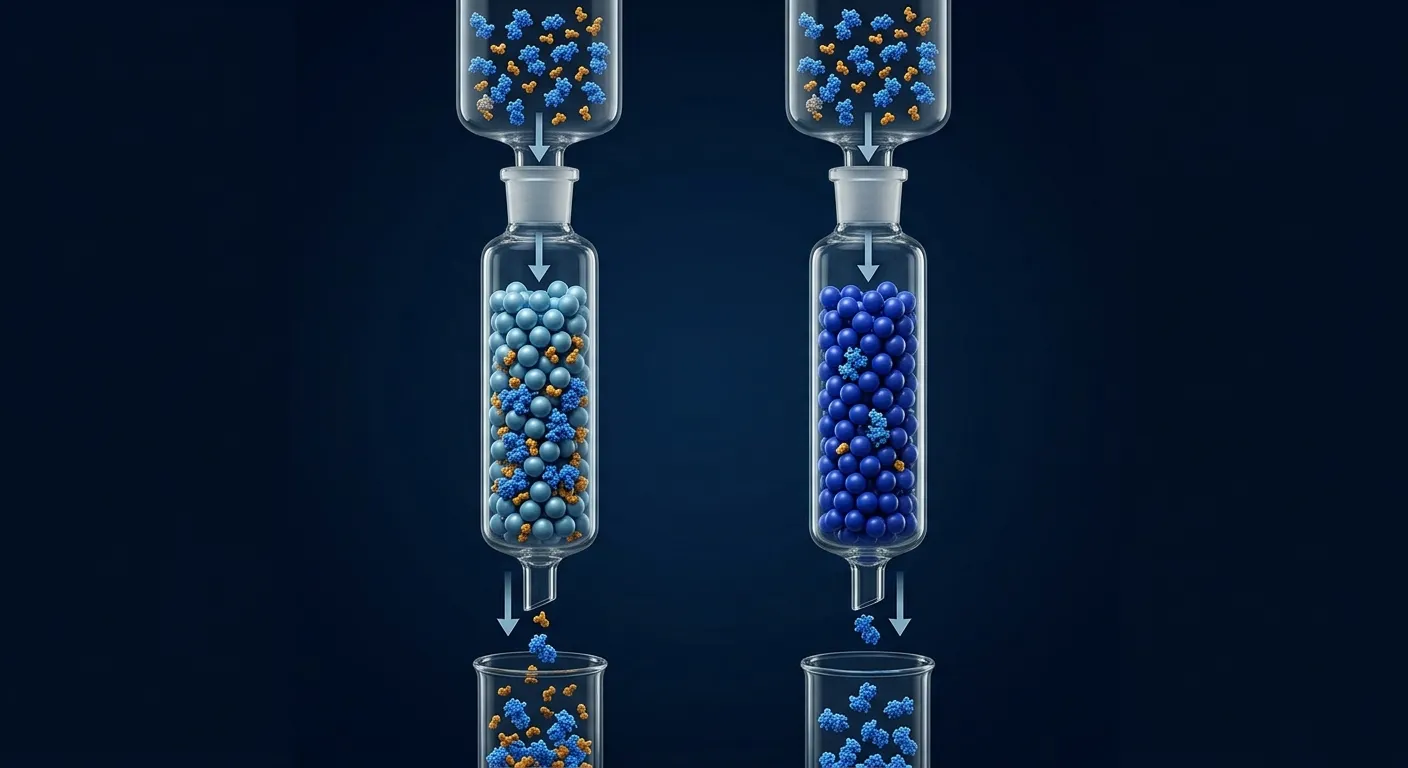
Nickel resin gives you 18 mg of target plus a forest of host-cell proteins. Cobalt resin gives you 7 mg and a cleaner lane. Which one is better? The answer depends on whether your bottleneck is capture capacity, final purity, weak tag accessibility, metal sensitivity, or the cost of the polishing steps that follow.
Nickel and cobalt are not interchangeable colors of the same IMAC product. The immobilized metal, chelator, resin matrix, ligand density, and operating buffer jointly determine binding strength and selectivity. A comparison is meaningful only when the same feed, residence time, buffer, tag position, and loading basis are used.
Key Takeaways
- Nickel is the default for capacity and robustness. It usually tolerates high target loads and captures accessible His6 tags strongly.
- Cobalt is often more selective but binds more weakly. That can reduce host-cell protein carryover and also reduce target recovery.
- Metal choice cannot rescue a buried tag. If neither resin retains the target under mild conditions, revisit tag placement and construct design.
- Optimize imidazole separately. The correct load and wash concentrations are resin- and target-specific; copying the nickel program onto cobalt is not a fair test.
- Measure total process recovery, not just the elution lane. A cleaner chromatogram can lose protein in the flow-through; a dirtier capture can still win after one cheap polishing step.
- Treat metal leaching as an assay variable. Chelating proteins, metalloproteins, redox-sensitive targets, and cell-based assays may require extra controls.
What the Metal Changes
IMAC works because histidines coordinate an immobilized transition metal while the chelator occupies the metal’s other coordination sites. Native host proteins with exposed histidine clusters, cysteines, or metal-binding sites can bind too.
Nickel–NTA became the common laboratory standard because it combines useful selectivity with high practical capacity and strong His-tag retention. Cobalt-based media often discriminate more sharply for a contiguous polyhistidine tag, but the interaction is weaker. A proteomics comparison of IMAC chemistries found cobalt and zinc more selective than nickel and copper, with that selectivity accompanied by weaker binding (Wegner et al., 2021).
That trend is not a universal performance ranking. “Nickel” may mean NTA or IDA at different ligand densities; “cobalt” may use a distinct chelator and base matrix. Resin architecture can matter as much as the ion.
The Practical Decision
| Situation | Start with | Why |
|---|---|---|
| High-expression soluble target, crude bacterial lysate | nickel | forgiving capture and capacity |
| Low-expression target hidden among host proteins | cobalt screen | selectivity may matter more than capacity |
| Weak or partially occluded His tag | nickel | stronger retention is usually safer |
| Target elutes with many histidine-rich contaminants | cobalt or optimized nickel wash | tests whether selectivity is the bottleneck |
| Large-scale capture where resin cost dominates | nickel | broad supplier choice and high loading |
| Metal-sensitive downstream assay | neither by assumption | test leaching and consider Strep-tag or tag-free capture |
If you are choosing the tag itself, start with our broader affinity-tag decision guide. This article assumes a His-tagged construct already exists.
Why Nickel Often Wins on Yield
The stronger interaction gives nickel more operating margin. A tag that is transiently exposed, adjacent to a structured terminus, partially proteolyzed, or competing with imidazole can still bind. Nickel also tends to support higher dynamic capacity in common commercial formats.
Yield, however, should be divided into three different numbers:
- binding recovery: target loaded minus target in flow-through;
- elution recovery: target recovered from what bound;
- process recovery: active, acceptable target after polishing.
Nickel can score highly on the first metric and poorly on the third if co-eluted contaminants force an aggressive polish. Conversely, cobalt can lose weakly tagged molecules during loading but eliminate a later ion-exchange step.
Why Cobalt Can Produce a Cleaner Elution
Many E. coli proteins bind immobilized metals through native surface features. SlyD, ArnA, GlmS, and other recurring IMAC contaminants have been identified experimentally; their behavior reflects metal-binding motifs, exposed histidines, and protein–protein associations (Bolanos-Garcia and Davies, 2006; Robichon et al., 2011).
A weaker, more discriminating cobalt interaction can reduce some of this background. The improvement is most visible when the target is a small fraction of total soluble protein. If the target already dominates the lysate, changing metal may do little.
Run a Fair Side-by-Side Screen
Use the same clarified lysate and normalize resin by bed volume first. If supplier capacity data are credible and measured on comparable proteins, also evaluate equal nominal capacity.
Keep these variables identical
- lysate batch and dilution;
- protein load;
- temperature;
- column geometry or batch-contact time;
- residence time;
- salt, pH, reducing agent, and detergent;
- fraction volumes;
- analytical method.
Optimize these variables separately
- imidazole in load and wash;
- wash volume;
- elution concentration or gradient;
- target loading relative to capacity.
A useful microscale matrix is:
| Resin | Load imidazole | Wash imidazole | What it tests |
|---|---|---|---|
| nickel | 5–10 mM | 20–30 mM | high-recovery baseline |
| nickel | 10–20 mM | 40–60 mM | contaminant rejection |
| cobalt | 0–5 mM | 10–20 mM | protects weaker binding |
| cobalt | 5–10 mM | 20–40 mM | higher-selectivity wash |
These are screening ranges, not guaranteed recipes. Phosphate, Tris, detergents, reducing agents, and chelators can shift performance.
Collect total lysate, soluble input, flow-through, wash, and every elution. Quantify target by densitometry or a target-specific assay. “The cobalt lane looks cleaner” is incomplete if half the target is in the flow-through.
Buffer Variables That Confound the Comparison
pH
Histidine must be sufficiently deprotonated to coordinate the metal. Binding generally weakens as pH drops. If the target is unstable above neutral pH, both resins may underperform and the tag chemistry itself may be a poor match.
Imidazole
Low imidazole suppresses nonspecific binding; too much competes off the target. Because cobalt binding is often weaker, its load buffer usually needs less imidazole than a nickel protocol.
Chelators
EDTA and strong chelators strip metal. Even when a supplier lists limited compatibility, exposure time and concentration matter. Remove chelator before loading.
Reducing agents
Compatibility differs among resins. High concentrations can reduce metal or alter the matrix. Use the lowest concentration your target requires and follow the specific resin’s data.
Salt
Moderate to high NaCl often reduces electrostatic contaminants without disrupting coordination. It is especially useful when nucleic acid or chaperones co-purify. See our guide to DNA/RNA carryover and viscous lysates.
Detergent
Membrane-protein detergents can change target accessibility and resin flow. Keep detergent above its required concentration but below the resin’s compatibility limit, and include the same detergent in all comparison buffers.
When the Real Problem Is Tag Accessibility
If a His-tag binds in denaturant but not in native buffer, the sequence is present and the tag is probably buried or engaged. Metal swapping rarely fixes that.
Test:
- N- versus C-terminal placement;
- a short flexible linker;
- a longer His8 or His10 tag, if the downstream assay permits it;
- limited proteolysis or intact-mass confirmation;
- native versus denaturing binding;
- a smaller construct that exposes the terminus.
Our guide to N- versus C-terminal tags covers the design decision. Do not compensate for a hidden tag by increasing resin volume indefinitely.
Decision Tree: Stay With Nickel or Switch to Cobalt?
Target is absent from nickel elution
Check the soluble input and flow-through. Confirm tag sequence, proteolysis, pH, chelators, and accessibility. Cobalt is unlikely to recover a target that does not bind nickel.
Target binds nickel, but contaminants dominate
First raise wash imidazole, salt, and wash volume at small scale. If recovery remains good but purity stalls, run cobalt in parallel.
Nickel is clean, but yield is low
Lower load/wash imidazole, slow the residence time, reduce load, and examine whether target remains in the pellet. Switching to cobalt will usually reduce, not increase, binding margin.
Cobalt is clean, but most target is in flow-through
Reduce imidazole, load more slowly, decrease salt only if electrostatic stability permits, and verify resin capacity. If loss persists, nickel followed by a small polishing step may be the better process.
Both resins co-elute the same band
The contaminant may bind the target rather than the metal. Change lysis/wash chemistry, add nuclease, disrupt chaperone association, or separate by ion exchange/SEC.
Activity drops after IMAC
Desalt immediately, measure metal dependence, and compare an alternative tag or tag-free route. For a native metalloprotein, immobilized metal and high imidazole may disturb the correct cofactor state.
Metal Leaching and Downstream Risk
Both nickel and cobalt can leach, particularly under harsh pH, chelator, or reducing conditions. The absolute amount may be small and still matter to:
- metalloproteins and metal-binding enzymes;
- oxidation-sensitive proteins;
- fluorescence assays;
- cell-based experiments;
- biophysical measurements at low protein concentration.
Include a rapid desalting or SEC step, and measure residual metal when the application warrants it. A blank purification through charged resin can reveal assay interference from the process itself.
Denaturing IMAC Changes the Comparison
His-tagged inclusion-body targets are often captured in 6–8 M urea or guanidinium. Denaturant removes the tag-accessibility problem but exposes native histidines and changes how every protein interacts with the resin. A resin that is selective in native lysate may not retain the same advantage in denaturant.
In a denaturing comparison:
- equilibrate both resins fully in the same chaotrope;
- verify the matrix and metal are compatible with the concentration used;
- normalize pH after adding urea or guanidinium;
- compare refolding yield, not only denatured elution yield;
- check whether released metal or imidazole affects refolding.
If target recovery is high from both media, choose based on contaminant clearance and the burden placed on refolding. A cleaner denatured pool can reduce aggregation during dilution, but a lower-concentration cobalt elution may be harder to refold efficiently.
Membrane Proteins Need a Detergent-Controlled Screen
For membrane proteins, resin behavior is inseparable from the detergent micelle. Detergent can cover a terminal tag, enlarge the particle relative to resin pores, and carry lipids or host membrane proteins into the elution.
Use the same detergent lot and concentration for nickel and cobalt, keep it above the concentration needed to maintain the target, and measure target in the insoluble material after detergent exchange. If binding improves only after changing detergent, the metal was not the main variable.
A His tag located on a short cytosolic tail may become sterically inaccessible in a micelle or nanodisc. A linker or opposite-terminal tag often has more effect than switching ions. For construct decisions, topology and terminal orientation must be considered before purification chemistry.
Resin Reuse Can Reverse the Result
First-cycle performance does not predict tenth-cycle performance. Metal loss, fouling, incomplete stripping, and carryover change capacity and selectivity. Cobalt’s lower practical capacity may decline into the failure range earlier for a high-load process; nickel’s broader nonspecific binding may worsen as the surface fouls.
If reuse matters, qualify it deliberately:
- define a cleaning and recharge protocol;
- run a blank after regeneration;
- track target recovery, host-cell protein, pressure, and metal leakage over cycles;
- set a discard rule before a batch fails.
Disposable small columns may favor cobalt’s clean single-use convenience. Manufacturing-scale capture may favor nickel’s loading margin and mature cleaning strategy. Cost per milliliter of resin is not cost per milligram of acceptable protein.
What Not to Conclude From One Lane
A single elution lane cannot tell you whether the target bound quantitatively, whether a contaminant co-migrates, whether the target is active, or whether the resin caused oligomerization. Run reducing and nonreducing gels when disulfide or metal-linked species are plausible, and confirm identity by mass spectrometry or a target-specific antibody.
If a visible contaminant disappears on cobalt, ask where it went. If it moved to the flow-through, selectivity improved. If the target also moved there, the apparent purification may simply reflect lower capture.
Worked Example: The Cleaner Resin Is Not Automatically Cheaper
A soluble enzyme is expressed at low level in E. coli.
- Nickel captures 16 mg, 55% pure. Anion exchange yields 10 mg at 95% purity.
- Cobalt captures 9 mg, 88% pure. SEC yields 6 mg at 95% purity.
If the experiment needs 5 mg, cobalt may be faster. If it needs 40 mg, nickel’s recovery and scalable ion-exchange polish may be superior. If the target loses activity during ion exchange, the apparently dirtier route becomes costly.
Evaluate the whole sequence: resin cost, column time, buffer exchange, concentration loss, activity, and batch failure rate.
A Minimal QC Package
For each condition, report:
- target mass loaded and recovered;
- target in flow-through and wash;
- purity by densitometry or orthogonal assay;
- A260/A280;
- SEC monodispersity;
- intact mass or identity confirmation;
- activity per milligram;
- resin lot and number of reuse cycles.
This turns a resin preference into a reproducible process decision.
Bottom Line
Choose nickel when you need binding strength, capacity, and a forgiving capture. Screen cobalt when nickel recovery is acceptable but contaminant rejection is the limiting problem. Optimize each resin on its own terms, account for target lost before elution, and compare the active final product—not the prettiest single lane.
Designing the Capture in Orbion
Orbion Characterize surfaces accessible termini, topology, disorder, charge, and metal-related sequence context. Design compares tag placement and linker choices before cloning. Bench converts the selected capture chemistry into a literature-grounded protocol with matched load, wash, elution, and QC checkpoints.
Metal selection is one lever. The target’s sequence and the entire purification path decide whether it is the right one.
References
- Bornhorst, J. A. and Falke, J. J. Purification of proteins using polyhistidine affinity tags. Methods in Enzymology 326, 245–254 (2000). doi:10.1016/S0076-6879(00)26058-8
- Wegner, J. et al. Proteomics analysis of host cell proteins after immobilized metal affinity chromatography: influence of ligand and metal ions. Journal of Chromatography A 1635, 461770 (2021). doi:10.1016/j.chroma.2020.461770
- Robichon, C. et al. Engineering Escherichia coli BL21(DE3) derivative strains to minimize E. coli protein contamination after purification by immobilized metal affinity chromatography. Applied and Environmental Microbiology 77, 4634–4646 (2011). doi:10.1128/AEM.00119-11
- Bolanos-Garcia, V. M. and Davies, O. R. Structural analysis and classification of native proteins from E. coli commonly co-purified by immobilised metal affinity chromatography. Biochimica et Biophysica Acta 1760, 1304–1313 (2006). doi:10.1016/j.bbagen.2006.03.027
- Lin, F.-Y. et al. Microcalorimetric study of the effect of hexa-histidine tag and denaturant on the interaction mechanism between protein and metal-chelating gel. Journal of Colloid and Interface Science 238, 333–339 (2001). doi:10.1006/jcis.2001.7526