The purification went perfectly. His-tag affinity, ion exchange, gel filtration—textbook chromatography. Now you just need to remove the tag before crystallization. You add TEV protease. Incubate overnight. Run the gel. Nothing happened. The band hasn't shifted. Your beautiful pure protein still has its tag, and your crystallization trials are on hold.
Tag removal should be straightforward: add protease, incubate, purify. In practice, it's one of the most frustrating steps in recombinant protein production.
Key Takeaways
-
Protease cleavage failure is common: Even well-designed constructs frequently show incomplete or absent tag removal
-
Steric hindrance is the #1 cause: Cleavage sites too close to structured regions are inaccessible
-
Non-specific cleavage is a hidden problem: Proteases like thrombin can damage your protein at unexpected sites
-
Protease choice matters: TEV, HRV3C, thrombin, and SUMO protease have different strengths and limitations
-
Incomplete cleavage creates purification nightmares: Separating cleaved from uncleaved protein is often harder than the original purification
The Tag Removal Challenge
Why We Use Tags
Affinity tags revolutionized protein purification:
-
His-tag: Simple, universal, small
-
GST: Improves solubility, large but easy to remove
-
MBP: Excellent solubility enhancement
-
SUMO: Enhances folding, clean removal
-
Strep-tag: Mild elution conditions
Without tags, purification requires protein-specific method development. With tags, almost any protein can be purified with standard protocols.
Why Tags Must Go
Tags interfere with:
-
Crystallization: Tags introduce flexibility and disorder
-
Structural studies: Cryo-EM and X-ray require homogeneous samples
-
Biochemical assays: Tags can affect activity, binding, or localization
-
Therapeutic development: Non-native sequences are immunogenic
-
Native studies: Tags may alter oligomeric state or interactions
The goal: Capture the advantages of tagged expression, then produce tag-free protein for downstream work.
Why This Fails
The cleavage reaction seems simple:
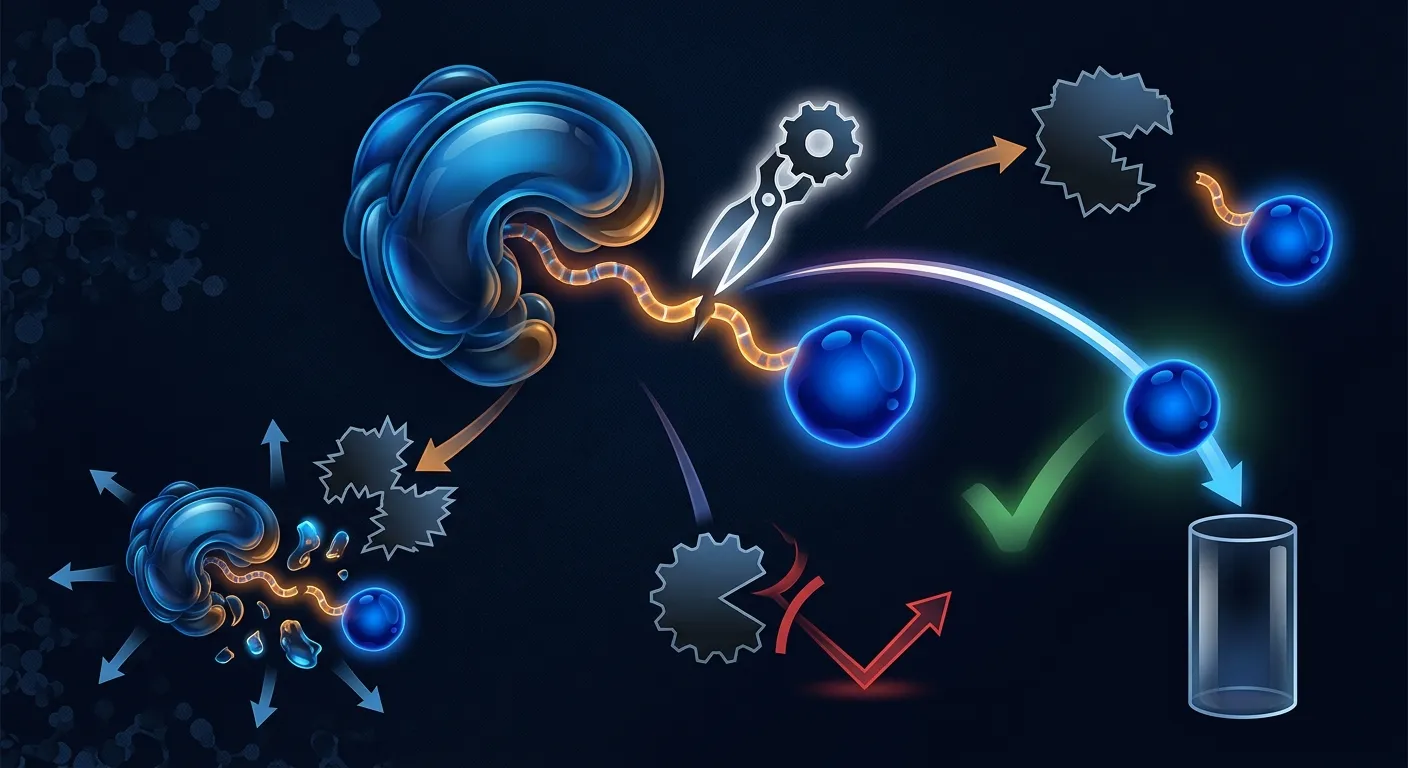
Tagged protein + Protease → Tag + Native protein
In practice:
-
Protease can't access the cleavage site
-
Protease damages the target protein
-
Cleavage is incomplete
-
Protease won't come off the resin
-
Protease is as hard to remove as the tag
The Five Failure Modes
Failure 1: Steric Hindrance (The Cleavage Site Is Buried)
The problem: The protease needs to access and bind to the cleavage site. If the site is:
-
Too close to folded structure
-
Partially buried by the protein surface
-
Occluded by adjacent domains
-
Blocked by oligomerization
-
...the protease physically cannot reach it.
The evidence: Research on affinity tag removal has shown that "the inability of a protease to cleave a fusion protein may be caused by steric hindrance, which can be of several types. For example, the cleavage site may be too close to ordered structure in the target protein."
The problem is especially severe for oligomeric proteins. Even tags as small as polyhistidine can create steric problems when present on multiple subunits of a multimer.
The solution: Insert a flexible linker between the cleavage site and your protein. Studies have demonstrated that adding five glycine residues between the TEV protease recognition site and the target protein dramatically improved cleavage efficiency.
The design principle:
Standard (often fails):
His6 - TEV site - Target protein

Better:
His6 - TEV site - (GGS)2 - Target protein

Even better:
His6 - (GGS)2 - TEV site - (GGS)2 - Target protein
Failure 2: Non-Specific Cleavage (The Protease Damages Your Protein)
The problem: Proteases aren't perfectly specific. They have:
-
Primary site: The designed cleavage site
-
Secondary sites: Weaker recognition sequences elsewhere in your protein
-
Non-specific activity: Especially at high concentrations or long incubations
Thrombin is the worst offender: Research on thrombin-induced degradation found that "while thrombin and factor Xa are quite specific for cleavage at the inserted cleavage site, proteolysis can frequently occur at other site(s) in the protein of interest."
The problem is compounded by commercial thrombin preparations containing secondary protease activity from contaminating proteases.
TEV isn't immune: Recent studies have revealed unexpected TEV protease cleavage of recombinant human proteins at non-canonical sites. Using broader sequence specificity rules, researchers identified 456 human proteins that could be substrates for unwanted TEV cleavage.
The diagnostic approach:
-
Run time course: Remove samples at 1h, 2h, 4h, overnight
-
Analyze by SDS-PAGE
-
Look for: Extra bands (degradation products), decreasing band intensity (target destruction)
The solutions:
| Problem | Solution |
|---|---|
| Thrombin secondary cleavage | Use heparin-Sepharose to remove thrombin immediately after cleavage |
| TEV off-target sites | Check sequence for canonical and non-canonical sites before design |
| General over-digestion | Optimize protease:substrate ratio; less is often more |
| Contaminating proteases | Use high-purity protease sources |
Failure 3: Protease Inhibition (Your Buffer Kills the Enzyme)
The problem: Proteases have specific requirements and sensitivities:
| Protease | Inhibited By | Requires |
|---|---|---|
| TEV | Zn²⁺ >5 mM, iodoacetamide, oxidizing conditions | DTT (1 mM), EDTA (0.5 mM) |
| HRV3C | Oxidizing conditions | Reducing conditions |
| Thrombin | EDTA, DTT, high imidazole | Ca²⁺, appropriate pH |
| Factor Xa | EDTA, high salt | Ca²⁺ |
| SUMO protease | Varies by source | Depends on specific enzyme |
Common mistakes:
-
IMAC elution buffer: High imidazole inhibits thrombin
-
Reducing agents: DTT reduces thrombin activity
-
Metal chelators: EDTA kills metalloproteases
-
Wrong pH: All proteases have pH optima
The solution:
Always buffer exchange into protease-compatible conditions before cleavage. The elution buffer from your affinity step is rarely optimal for proteolysis.
-
50 mM Tris pH 8.0
-
150 mM NaCl
-
1 mM DTT
-
0.5 mM EDTA
-
Temperature: 4°C or room temperature
-
Ratio: 1:100 (TEV:substrate by OD280)
Failure 4: Incomplete Cleavage (You Get a Mixture)
The problem: Even when cleavage works, it's rarely 100%. You end up with:
-
60-90% cleaved protein
-
10-40% uncleaved protein
-
Same affinity tag on both
-
Nearly identical size
Why this is a nightmare: If cleavage is 80% complete:
-
Re-running Ni-NTA removes 20% of your protein (the uncleaved fraction)
-
But 80% of your cleaved protein also binds (weakly) due to native histidines
-
You lose most of your cleaved protein trying to remove the uncleaved fraction
The numbers: Studies report that His-tag cleavage is often "far from 100% efficient," with many proteins showing substantial uncleaved fractions even after optimization.
Solutions for improving cleavage:
-
More protease: But watch for non-specific cleavage
-
Longer incubation: But protein may aggregate or degrade
-
Higher temperature: TEV is maximally active at 34°C, but your protein may not survive
-
Fresh protease: Old protease loses activity
Solutions for separating cleaved/uncleaved:
| Method | Principle | Challenge |
|---|---|---|
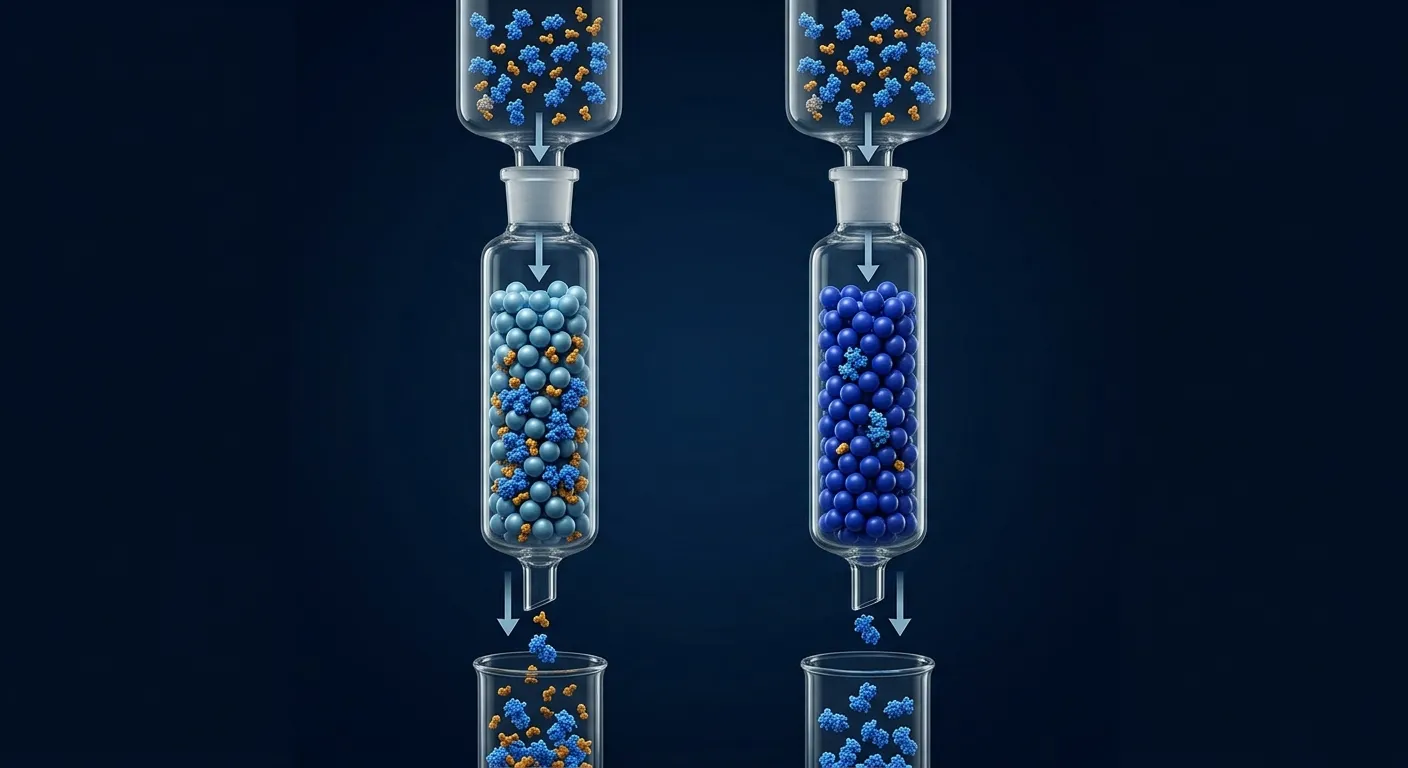
| Subtractive IMAC | Uncleaved binds, cleaved flows through | Cleaved often has weak binding too |
| Ion exchange | Charge difference | Small tag = small charge difference |
| Size exclusion | Size difference | Tag often too small to resolve |
| Reverse IMAC | His-tag protease binds, both proteins flow through | Need His-tagged protease |
Failure 5: Removing the Protease (Now You Have a New Contaminant)
The problem: After cleavage, your sample contains:
-
Cleaved target protein
-
Uncleaved target protein
-
Free tag
-
Protease
If the protease has the same tag as your protein (common with His-tagged TEV), standard subtractive purification won't work—both bind or both flow through together.
The on-column cleavage trap: On-column cleavage (adding protease while protein is on the affinity resin) seems elegant but often fails because the tag-removal protease binds the resin, sterically limiting its proteolytic activity.
Solutions:
-
Use differently tagged protease:
-
His-tagged protein + GST-tagged TEV
-
Then: Ni-NTA (removes uncleaved protein) → Glutathione (removes TEV)
-
-
Use untagged protease:
-
Commercially available
-
Requires additional purification step to separate by size or charge
-
-
Use immobilized protease:
-
Protease covalently attached to resin
-
Cleavage in batch, then filter
-
Protease stays on resin
-
-
Use biotinylated protease:
-
Cleave in solution
-
Remove protease with streptavidin beads
-
Choosing the Right Protease
TEV Protease
Recognition site: ENLYFQ↓S (or G)
Advantages:
-
Very high specificity
-
Works at 4°C (slowly) or room temperature (faster)
-
Well-characterized
-
Easy to produce in-house
Disadvantages:
-
Leaves scar (serine or glycine on target N-terminus)
-
Can cleave non-canonical sites in some proteins
-
Inhibited by zinc, oxidizing conditions
-
Slow at 4°C (overnight typical)
Best for: General use, temperature-sensitive proteins, high-specificity requirements
HRV3C (PreScission) Protease
Recognition site: LEVLFQ↓GP
Advantages:
-
Highly active at 4°C (minutes to hours)
-
Tolerates wider range of buffer additives than TEV
-
Good specificity
Disadvantages:
-
Leaves GP scar on target
-
Commercial sources can be expensive
-
Somewhat less specific than TEV
Best for: Cold-sensitive proteins, fast processing, high-throughput
Thrombin
Recognition site: LVPR↓GS
Advantages:
-
Very fast cleavage
-
Works well at room temperature
-
Cheap and widely available
Disadvantages:
-
Commercial preparations often contaminated
-
Inhibited by reducing agents
-
Requires calcium
Best for: Quick pilot experiments, proteins without secondary thrombin sites
Factor Xa
Recognition site: IEGR↓
Advantages:
-
Leaves only arginine attached to target
-
Fast cleavage
Disadvantages:
-
Non-specific cleavage common
-
Requires calcium
-
Sensitive to buffer conditions
Best for: When minimal scar is important, robust proteins
SUMO Protease
Recognition site: SUMO domain fold (not sequence)
Advantages:
-
Recognizes structure, not sequence
-
No scar—native N-terminus
-
SUMO tag enhances expression and solubility
-
Extremely high specificity
Disadvantages:
-
Requires SUMO tag (not universal)
-
Commercial enzyme expensive
-
SUMO tag is large (~11 kDa)
Best for: When native N-terminus is essential, difficult-to-express proteins
The Troubleshooting Decision Tree
Cleavage failure?
│
├── No cleavage at all
│   ├── Check protease activity (positive control?)
│   │   └── No → Use fresh protease
│   ├── Check buffer compatibility
│   │   └── Wrong buffer → Exchange before cleavage
│   └── Steric hindrance?
│       └── Yes → Redesign with flexible linker
│
├── Incomplete cleavage
│   ├── Optimize ratio, time, temperature
│   ├── Try different protease
│   └── Accept and separate cleaved/uncleaved
│
└── Extra bands (degradation)
    ├── Reduce protease amount
    ├── Shorten incubation time
    ├── Try different protease
    └── Check for secondary sites in sequence
Best Practices for Tag Removal
Design Phase (Before You Clone)
-
Check for secondary cleavage sites:
-
Use PeptideCutter or similar tools
-
If sites exist, choose a different protease
-
-
Include a flexible linker:
-
(GGS)₂ or (GGGGS)₁ between tag and protein
-
Ensures cleavage site accessibility
-
-
Consider the scar:
-
Does your application tolerate extra residues at the N-terminus?
-
If not, use SUMO or choose protease carefully
-
-
Plan the purification:
-
How will you separate cleaved from uncleaved?
-
How will you remove the protease?
-
Cleavage Phase (During Processing)
-
Buffer exchange first:
-
Move from elution buffer to cleavage buffer
-
Never assume elution conditions are compatible
-
-
Start with pilot experiments:
-
Small scale (100 µg)
-
Time course (1h, 2h, 4h, 16h)
-
Multiple protease ratios (1:50, 1:100, 1:200)
-
-
Monitor by SDS-PAGE:
-
Look for: Band shift, new bands, loss of material
-
Quantify cleavage efficiency
-
-
Scale up conservatively:
-
Optimal conditions at small scale may not translate directly
-
Verify at each scale
-
Post-Cleavage Phase (Cleanup)
-
Remove uncleaved protein:
-
Subtractive affinity (if cleaved protein doesn't bind)
-
Ion exchange (if charge difference sufficient)
-
Size exclusion (if size difference sufficient)
-
-
Remove protease:
-
Use orthogonally-tagged protease
-
Or: Accept co-purification if protease doesn't interfere
-
-
Verify final product:
-
SDS-PAGE: Single band?
-
Mass spec: Correct mass? Any clipping?
-
Activity assay: Still functional?
-
Case Studies
Case 1: TEV Won't Cut
Protein: 45 kDa enzyme Construct: His6-TEV site-Target Problem: No cleavage after 24 hours with excess TEV
Diagnosis:
-
Crystal structure of homolog showed N-terminus buried in a groove
-
TEV site was inaccessible to protease
Solution:
-
Redesigned: His6-(GGGGS)₂-TEV site-(GGGGS)₂-Target
-
Cleavage now complete in 4 hours
Case 2: Thrombin Destroys the Protein
Protein: 30 kDa signaling domain Construct: His6-Thrombin site-Target Problem: Multiple bands after cleavage; activity lost
Diagnosis:
-
Target protein contained internal thrombin-like site
-
Both sites cleaved, fragmenting the protein
Solution:
-
Switched to TEV protease
-
No internal TEV sites present
-
Clean cleavage, full activity retained
Case 3: Can't Separate Cleaved from Uncleaved
Protein: 25 kDa structural protein Construct: His6-TEV site-Target Cleavage: 75% complete (couldn't improve further)
Problem: Cleaved protein has native His-rich region, binds Ni-NTA
Diagnosis:
-
Subtractive purification impossible
-
Both species bind column
Solution:
-
Switched to Strep-tag
-
StrepTactin binding is tag-specific
-
Cleaved protein flows through cleanly
The Economics of Proper Design
Getting It Wrong
-
Clone construct: 1 week
-
Express, purify: 1 week
-
Attempt cleavage, fail: 1 week
-
Troubleshoot: 2 weeks
-
Redesign construct: 1 week
-
Express, purify, cleave (success): 2 weeks
Total: 8 weeks
Getting It Right
-
Analyze sequence for cleavage sites: 1 hour
-
Design with flexible linker: 1 hour
-
Clone construct: 1 week
-
Express, purify, cleave (success): 2 weeks
Total: 3 weeks
The difference: 5 weeks of work, plus the frustration of failed experiments.
The Bottom Line
Tag removal failure has predictable causes:
| Cause | Prevention |
|---|---|
| Steric hindrance | Design with flexible linkers |
| Wrong buffer | Exchange before cleavage |
| Non-specific cleavage | Check sequence, optimize conditions |
| Incomplete cleavage | Pilot experiments, optimization |
| Protease contamination | Plan removal strategy before starting |
The most common mistake is assuming cleavage will work without optimization. Every protein is different. What works for one construct may fail completely for another.
Design for success: check sequences, include linkers, plan your purification, and always run pilot experiments before committing to large-scale cleavage.
Construct Design Considerations
For researchers designing expression constructs, platforms like Orbion can help identify potential problems before cloning:
-
Secondary cleavage site detection: Identify sequences that match protease recognition patterns
-
Terminus accessibility analysis: Predict whether N- and C-termini are accessible or structured
-
PTM site mapping: Ensure cleavage sites don't overlap with essential modifications
-
Disorder prediction: Identify flexible regions suitable for tag placement
Good construct design prevents most tag removal problems—and good design starts with understanding your protein's structure and sequence features before you order the first oligonucleotide.
References
-
Waugh DS. (2011). An overview of enzymatic reagents for the removal of affinity tags. Protein Expression and Purification, 80(2):283-293. PMC3195948
-
Feehan RP & Bhattacharya S. (2024). Unexpected tobacco etch virus (TEV) protease cleavage of recombinant human proteins. Protein Expression and Purification, 220:106498. PMC11129917
-
Peti W & Page R. (2007). Strategies to maximize heterologous protein expression in Escherichia coli with minimal cost. Protein Expression and Purification, 51(1):1-10.
-
Ahuja S, et al. (2008). A method for the prevention of thrombin-induced degradation of recombinant proteins. Analytical Biochemistry, 382(1):67-69. PMC2614318
-
Kapust RB & Waugh DS. (2017). Removal of affinity tags with TEV protease. Methods in Molecular Biology, 1586:221-241. PMC7974378
-
Kronqvist N, et al. (2020). NT*-HRV3CP: An optimized construct of human rhinovirus 14 3C protease for high-yield expression and fast affinity-tag cleavage. Journal of Biotechnology, 323:109-117. ScienceDirect
-
Sigma-Aldrich. (2024). Tag removal proteases for recombinant protein purification. Technical Document. Link