You've screened detergents. You found one that solubilizes your GPCR without aggregation. But there's a lingering concern: Is your protein really native-like in a detergent micelle? Are you losing activity? Could the detergent be interfering with your structural studies or functional assays?
Enter detergent-free purification methods: nanodiscs, SMALPs, and amphipols. These approaches keep membrane proteins in a native-like lipid environment (or a stabilizing polymer belt) without the complications of detergent micelles. Here's how they work, when to use them, and how to prepare samples for Cryo-EM.
Key Takeaways
-
Detergent-free methods maintain native-like environment (better stability, function)
-
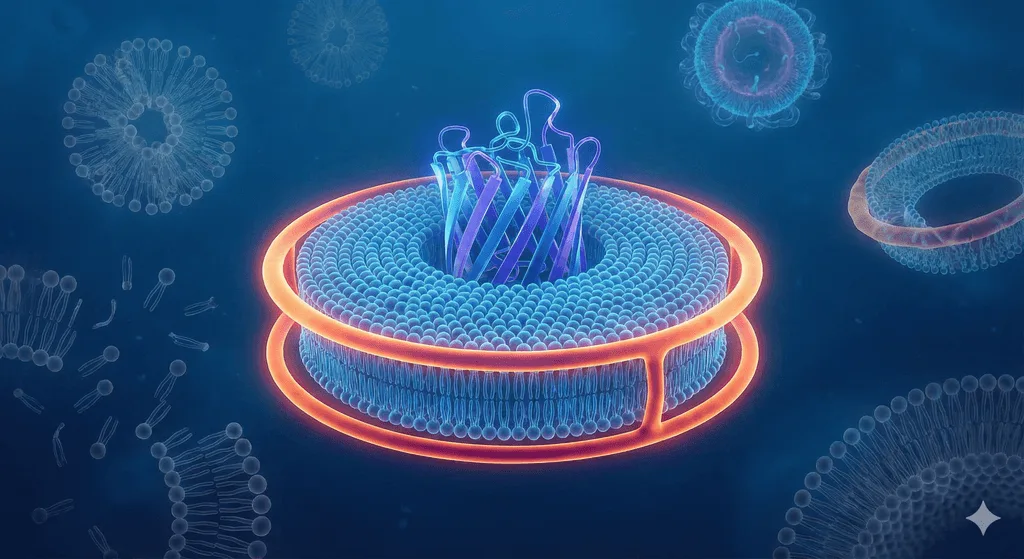
Nanodiscs: Protein in lipid bilayer disc (~10 nm), wrapped by scaffold protein (MSP)
-
SMALPs: Direct extraction from membranes, no detergent needed, preserves native lipids
-
Amphipols: Polymers wrap around protein, stable for months, excellent for Cryo-EM
-
β2-adrenergic receptor: Nobel Prize-winning structure used T4-lysozyme fusion + thermostabilizing mutations
-
Cryo-EM requires: 1-5 mg/mL, >90% monodisperse, small micelles or nanodiscs
Why Detergent-Free Matters
Problems with Detergents
1. Protein may not be in native state
-
Detergent micelles ≠ lipid bilayer
-
Transmembrane regions interact with detergent, not native lipids
-
Can alter protein conformation (inactive state vs active state)
2. Large micelles interfere with Cryo-EM
-
Detergent micelles add ~50-100 kDa mass around protein
-
Obscures protein features (lower resolution)
-
Particle alignment difficult (micelle creates "blob")
3. Detergents can denature proteins
-
Even "mild" detergents (DDM, LMNG) cause partial unfolding for some proteins
-
Activity loss over time (hours to days)
-
Cannot use for long-term studies
4. Hard to remove completely
-
Low-CMC detergents (LMNG, digitonin) stay bound
-
Interferes with crystallization, biophysical assays
-
Detergent in sample causes artifacts (DLS, AUC)
Detergent-Free Approaches Solve These Problems
Nanodiscs:
-
Protein in native lipid bilayer (2D disc)
-
Defined size (~10-12 nm diameter)
-
Better for Cryo-EM (uniform shape, easier particle alignment)
SMALPs:
-
Extract protein directly from membranes with native lipids
-
No detergent step at all (preserves annular lipid shell)
-
Faster than nanodiscs (no reconstitution)
Amphipols:
-
Polymer belt wraps around transmembrane region
-
Very stable (proteins soluble for months at 4°C)
-
Small size (better for high-resolution Cryo-EM)
Method 1: Nanodiscs (Lipid Bilayer in a Disc)
Concept
Self-assembling system:
-
Membrane protein + phospholipids + MSP (membrane scaffold protein)
-
MSP is an amphipathic α-helical protein (22 kDa)
-
MSP wraps around lipid bilayer (forms disc, ~10-12 nm diameter)
-
Protein sits in native-like lipid environment, but disc is water-soluble
Components
1. MSP (Membrane Scaffold Protein)
-
Amphipathic α-helix (derived from apolipoprotein A-I)
-
Wraps around edge of lipid bilayer
-
Sizes:
-
MSP1D1: Standard (~10 nm diameter, holds ~160 lipids)
-
MSP1E3D1: Larger (~13 nm diameter, holds ~250 lipids, for bigger proteins)
-
MSP2N2: Extra-large (~17 nm, for large complexes)
-
2. Phospholipids
-
Synthetic lipids: POPC, POPE, POPG, POPS
-
Native lipids: Brain polar lipids, E. coli polar lipids
-
Ratio: Protein:MSP:Lipids = 1:5:50 to 1:10:100 (needs optimization)
Advantages
1. Native-like lipid environment
-
Protein in bilayer (not detergent micelle)
-
Better stability, closer to physiological state
-
Can test specific lipid requirements (e.g., cholesterol for GPCRs)
2. Defined size
-
Uniform particle size (good for Cryo-EM)
-
Easier to classify particles (clear shape in EM images)
3. Control lipid composition
-
Test different lipids systematically
-
Add specific lipids (cholesterol, cardiolipin, PIP2)
4. Functional studies
-
Better for activity assays (native-like environment)
-
Can study lipid-protein interactions
Disadvantages
1. Requires detergent first
-
Solubilize protein in detergent (DDM)
-
Then reconstitute into nanodiscs
-
Two-step process (more work than SMALPs)
2. Optimization needed
-
Lipid type, MSP:lipid ratio, protein:MSP ratio
-
Can take weeks to optimize
3. MSP adds mass
-
MSP is 22 kDa (2 copies per disc = 44 kDa total)
-
Can interfere with some structural studies
-
Need to account for MSP mass in EM
Protocol: Nanodisc Reconstitution
Starting material: Protein purified in detergent (DDM, from Part 1)
Step 1: Prepare Components
Protein:
-
Concentrate to 5-10 mg/mL (in DDM-containing buffer)
-
Keep at 4°C
MSP:
-
Express MSP1D1 in E. coli (plasmid available from Addgene)
-
Purify by His-tag (MSP has N-terminal His-tag)
-
Store at -80°C in 20 mM Tris pH 7.5, 100 mM NaCl
Lipids:
-
POPC (1-palmitoyl-2-oleoyl-sn-glycero-3-phosphocholine) from Avanti Polar Lipids
-
Dissolve in chloroform (25 mg/mL stock)
-
Store at -20°C under argon
Step 2: Mix Components
Typical reaction (100 μL):
-
Protein: 1 μM (1 nmol)
-
MSP1D1: 10 μM (10 nmol, 10× excess)
-
POPC: 100 μM (100 nmol, 100× excess, ~100 lipids per nanodisc)
-
DDM: 0.5% (in buffer)
Buffer:
- 20 mM Tris pH 7.5, 150 mM NaCl, 10% glycerol
Calculation notes:
-
Ratio optimization: Test ratios of protein:MSP:lipids = 1:5:50, 1:10:100, 1:15:150
-
MSP excess ensures all protein is incorporated
Step 3: Remove Detergent (Critical Step)
Method: Bio-Beads SM-2 (polystyrene resin)
-
Add 0.5-1 g Bio-Beads per 1 mL reaction (wet weight)
-
Incubate overnight (12-16 hours) at 4°C with gentle rotation
-
Bio-Beads absorb DDM → nanodisc self-assembles as detergent is removed
Alternative: Dialysis
-
Dialyze against 1000× volume of detergent-free buffer
-
Change buffer 3-4 times (every 4-6 hours)
-
Slower than Bio-Beads, but works
Step 4: Remove Bio-Beads
-
Transfer reaction to new tube (leave Bio-Beads behind)
-
Or centrifuge briefly (1,000 × g, 5 min) and collect supernatant
Step 5: Purify Nanodiscs by SEC
Why: Separate protein-containing nanodiscs from empty nanodiscs
Column: Superdex 200 Increase 10/300 GL
Buffer: 20 mM Tris pH 7.5, 150 mM NaCl, 10% glycerol (no detergent)
Expected elution:
-
Protein-containing nanodiscs: Elute earlier (~12-14 mL, larger MW)
-
Empty nanodiscs: Elute later (~15-16 mL, smaller MW)
Collect: Fractions from protein-containing peak
Step 6: Characterization
TEM (Transmission Electron Microscopy):
-
Negative stain with uranyl acetate
-
Expected: Circular discs visible (~10-12 nm diameter)
-
Confirms nanodisc formation
SEC-MALS:
-
Measure MW of nanodisc
-
Expected: Protein MW + 2× MSP (44 kDa) + lipids (~120 kDa total for 50 kDa protein)
Activity assay:
-
Test ligand binding or transport activity
-
Compare to detergent-solubilized protein
Troubleshooting Nanodiscs
Problem: No protein in nanodiscs (empty nanodiscs only)
-
Cause: Wrong lipid:MSP ratio, or protein aggregated during reconstitution
-
Solution: Optimize ratio, add more protein, keep cold (4°C)
Problem: Heterogeneous sample (multiple peaks in SEC)
-
Cause: Multiple oligomeric states, or variable nanodisc sizes
-
Solution: Optimize MSP:lipid ratio, use size-defined MSP (MSP1E3D1 for larger proteins)
Problem: Protein inactive in nanodiscs
-
Cause: Wrong lipid type, or lipid:protein ratio too low
-
Solution: Test different lipids (add cholesterol for GPCRs, cardiolipin for respiratory complexes)
Method 2: SMALPs (Styrene-Maleic Acid Lipid Particles)
Concept
Direct extraction from membranes:
-
SMA (styrene-maleic acid copolymer) inserts into lipid bilayer
-
Wraps around protein + surrounding lipids (forms nanoparticle, ~10 nm)
-
No detergent needed (skip solubilization step entirely)
Advantages
1. Detergent-free from the start
-
No solubilization step (no DDM, no LMNG)
-
Protein never exposed to detergent
2. Preserves native lipids
-
Annular lipid shell around protein retained
-
More physiologically relevant than nanodiscs with synthetic lipids
3. Faster than nanodiscs
-
No reconstitution step (one-step extraction)
-
Less optimization required
4. Works for difficult proteins
- Proteins that denature in detergent may be stable in SMALPs
Disadvantages
1. SMA polymer is negatively charged
-
pH-dependent (only works at pH >7)
-
Can interfere with some proteins (charge interactions)
2. Cannot use high divalent cations
-
Ca²⁺ or Mg²⁺ >1 mM precipitates SMA
-
Limits buffer choices
3. Size heterogeneity
-
SMALP size variable (8-12 nm)
-
Less uniform than nanodiscs (harder for Cryo-EM classification)
4. SMA polymer can interfere with some assays
-
Absorption at 280 nm (interferes with protein quantification)
-
Can affect some biophysical measurements
Protocol: SMALP Extraction
Starting material: Crude membranes (from Part 1, Stage 2)
Step 1: Add SMA Polymer to Membranes
Membranes:
- Resuspend to 10 mg/mL total protein (in buffer)
SMA polymer:
-
Add to 2.5% (w/v) final concentration
-
Ratio: 1:2.5 (protein:SMA, typical starting point)
Buffer:
-
50 mM Tris pH 7.5 or 50 mM HEPES pH 7.5 (pH must be >7 for SMA to work)
-
150 mM NaCl
-
Protease inhibitors
-
No Ca²⁺ or Mg²⁺ >1 mM (precipitates SMA)
Incubate:
-
2 hours at room temperature (RT) or 4 hours at 4°C
-
Gentle mixing (rotator or nutator)
Step 2: Clarify
Centrifugation:
- 100,000 × g, 30 min, 4°C
Supernatant: Protein in SMALPs (solubilized) Pellet: Unsolubilized membrane (discard)
Step 3: Affinity Purification
Same as detergent protocol (Part 1), but no detergent in buffers:
Wash buffer:
-
50 mM Tris pH 7.5, 150 mM NaCl
-
20 mM imidazole
-
10% glycerol
-
No detergent
Elution buffer:
-
50 mM Tris pH 7.5, 150 mM NaCl
-
250 mM imidazole
-
10% glycerol
Step 4: SEC (Polishing)
Column: Superdex 200
Buffer: 20 mM Tris pH 7.5, 150 mM NaCl, 10% glycerol (no detergent)
Expected: Single peak (protein in SMALP)
Step 5: Characterization
TEM: Observe SMALP particles (circular, ~10 nm)
Activity assay: Test function (compare to detergent)
SEC-MALS: Measure MW (protein + SMA + lipids)
Troubleshooting SMALPs
Problem: Low solubilization efficiency (<20%)
-
Cause: SMA:protein ratio too low, or pH too low
-
Solution: Increase SMA (2.5% → 5%), check pH >7.5
Problem: Precipitate forms during incubation
-
Cause: Ca²⁺ or Mg²⁺ in buffer
-
Solution: Use Ca²⁺/Mg²⁺-free buffer, add EGTA (1 mM) to chelate residual Ca²⁺
Problem: Protein inactive in SMALPs
-
Cause: SMA polymer interferes with functional site
-
Solution: Try alternative polymers (DIBMA, SMA-QA with different charge properties)
Method 3: Amphipols (Amphipathic Polymers)
Concept
Polymer belt wraps around transmembrane region:
-
Amphipols are amphipathic polymers (hydrophobic + hydrophilic segments)
-
Wrap around protein like a belt (shield TM helices)
-
Protein soluble in aqueous buffer, no detergent needed
Types of Amphipols
A8-35 (most common):
-
Poly(acrylic acid) backbone with octyl side chains
-
MW ~4-5 kDa per polymer chain
-
Negatively charged (works best at pH 7-8)
PMAL-C8:
-
Poly(maleic acid) with octyl chains
-
Alternative to A8-35
Advantages
1. No CMC (don't form micelles)
-
Stay bound to protein (don't dialyze out)
-
Stable association
2. Very stable
-
Proteins remain soluble for months at 4°C
-
Better than detergents (no slow aggregation)
3. Small size
-
Amphipol belt is thin (~3-4 nm)
-
Better for high-resolution Cryo-EM (less obscuring)
4. Compatible with many biophysical techniques
-
NMR (smaller than detergent micelles)
-
Cryo-EM (excellent, minimal background)
Disadvantages
1. Expensive
- ~$100-200/g (more than most detergents)
2. Can be hard to remove
- If you need to later (e.g., for lipid reconstitution), amphipols are difficult to remove
3. Can block functional sites
-
Polymer may sterically block binding sites or conformational changes
-
Not ideal for all functional assays
Protocol: Amphipol Exchange
Starting material: Protein in detergent (DDM or LMNG)
Step 1: Mix Protein with Amphipol
Ratio: 1:5 (protein:amphipol, weight ratio)
- Example: 1 mg protein + 5 mg amphipol A8-35
Incubate: 2 hours at 4°C (gentle mixing)
Step 2: Remove Detergent
Method 1: Bio-Beads
-
Add Bio-Beads (0.5 g per mL)
-
Incubate overnight at 4°C
-
Bio-Beads absorb detergent → amphipol remains bound to protein
Method 2: Dialysis
-
Dialyze against amphipol-free buffer (1000× volume)
-
Change buffer 3-4 times
Step 3: Remove Free Amphipol (Optional)
SEC: Superdex 200
-
Protein-amphipol complex elutes earlier (higher MW)
-
Free amphipol elutes later
Step 4: Characterization
DLS: Measure particle size (Rh should be small, ~5-8 nm for 50 kDa protein)
SEC-MALS: Confirm MW (protein + amphipol)
Activity assay: Test if protein is functional in amphipols
Functional Validation: Proving Your Protein Is Alive
Test 1: Ligand Binding (for GPCRs)
Radioligand binding assay:
-
Mix protein (1-10 nM) + radiolabeled ligand (³H or ¹²⁵I, 0.1-10 nM)
-
Incubate (equilibrium binding, 1-2 hours at RT or overnight at 4°C)
-
Filter (separate bound from free ligand)
-
Count radioactivity (scintillation counter)
Expected:
-
Specific binding: Kd = 1-50 nM (high-affinity ligands)
-
Bmax = protein concentration (1:1 binding)
Alternative: Fluorescence Polarization (FP)
-
Use fluorescent ligand (no radioactivity)
-
Measure polarization change upon binding
Test 2: Thermal Stability (DSF)
Differential Scanning Fluorimetry:
-
Mix protein + SYPRO Orange dye (binds hydrophobic regions)
-
Heat from 20°C → 95°C (gradual)
-
Measure fluorescence (increases as protein unfolds)
Expected:
-
Tm (melting temperature): Inflection point
-
Good detergent/nanodisc: Tm >50-60°C
-
Bad detergent: Tm <40°C (unstable)
Use: Compare detergents, identify stabilizing ligands, validate nanodiscs
Test 3: Activity Assay (for Transporters/Enzymes)
Example: GLUT1 (glucose transporter)
Reconstitute into proteoliposomes:
-
Mix protein + lipids, remove detergent
-
Protein inserts into lipid vesicles (liposomes)
Transport assay:
-
Add radiolabeled glucose (¹⁴C-glucose) outside vesicles
-
Incubate (glucose transported inside)
-
Separate vesicles (filtration or centrifugation)
-
Measure radioactivity inside vesicles
Expected:
-
Time-dependent uptake (linear for 5-10 min)
-
Specific transport (blocked by inhibitors)
Case Study: β2-Adrenergic Receptor (Nobel Prize-Winning Purification)
The Challenge
Target: β2-adrenergic receptor (GPCR, 7 TM helices)
Historical context:
-
GPCRs extremely difficult to crystallize (unstable, flexible)
-
No GPCR structure until 2007 (despite decades of effort)
The Solution (Brian Kobilka's Lab)
Expression: Sf9 insect cells, baculovirus (5-10 mg/L yield)
Construct Engineering (Critical for Success):
1. N-terminal truncation
-
Removed disordered region (residues 1-33)
-
Reduces flexibility
2. ICL3 replacement
-
Replaced flexible intracellular loop 3 (ICL3) with T4 lysozyme
-
T4-lysozyme acts as fiducial marker for crystallization (provides crystal contacts)
-
Rigidifies receptor
3. C-terminal truncation
-
Removed phosphorylation sites (residues 365-413)
-
Reduces heterogeneity
4. Thermostabilizing mutations
-
6 point mutations (identified by alanine scanning)
-
Increased Tm by ~20°C (from 40°C → 60°C)
-
Mutations: L48A, E122W, Y132G, R149L, Y219A, H296A
Purification:
1. Membrane preparation: Ultracentrifugation
2. Solubilization:
- 1% DDM + 0.2% CHS (cholesteryl hemisuccinate, stabilizing lipid)
3. Affinity:
- Ni-NTA (His-tag at C-terminus)
4. Ligand binding:
-
Add alprenolol (inverse agonist, 10 μM)
-
Stabilizes inactive state (locks conformation)
5. SEC:
-
Superdex 200
-
Monodisperse peak (single, sharp)
6. Concentrate:
- To 40-50 mg/mL (for crystallization)
Crystallization:
-
Lipidic cubic phase (LCP): Protein in monoolein lipid matrix
-
Crystals grown over weeks
-
X-ray diffraction: 2.4 Å resolution
Impact:
-
First high-resolution GPCR structure (2007, Nature)
-
Brian Kobilka awarded Nobel Prize (2012, with Robert Lefkowitz)
-
Enabled structure-based drug design for GPCRs (>500 drugs target GPCRs)
Key Lessons:
1. Construct engineering is critical
- Truncations, fusions, thermostabilizing mutations = success
2. Ligand stabilization matters
-
Inverse agonist (alprenolol) locks receptor in stable conformation
-
Without ligand: Receptor is too flexible, cannot crystallize
3. Lipid matters
-
CHS (cholesteryl hemisuccinate) stabilizes GPCR
-
Mimics cholesterol (native lipid for GPCRs)
From Purification to Cryo-EM
Sample Requirements
Concentration:
-
1-5 mg/mL (optimal for grid preparation)
-
Too low: Particles sparse
-
Too high: Aggregation on air-water interface
Monodispersity:
-
>90% monodisperse (sharp SEC peak)
-
Polydisperse samples: Difficult to classify particles
Stability:
-
Stable >1 week at 4°C (time needed for grid screening)
-
If unstable: Add crosslinker (GraFix: glutaraldehyde gradient during SEC)
Detergent/nanodisc considerations:
-
Small micelles better: DDM, LMNG (vs Triton X-100, large)
-
Nanodiscs/amphipols preferred: Uniform shape, easier particle alignment
Grid Preparation (Basic Protocol)
1. Glow-discharge grid
- Makes surface hydrophilic (30 seconds, 15 mA)
2. Apply sample
-
3 μL protein (1-3 mg/mL)
-
Onto grid (Quantifoil R1.2/1.3 or UltrAuFoil)
3. Blot
- Use filter paper (remove excess liquid, thin film remains)
4. Plunge into liquid ethane
- Vitrify (freeze at -180°C, forms amorphous ice)
Screen grids:
-
Check particle distribution (TEM)
-
Optimize concentration, blotting time
-
Goal: Uniform particle distribution, thin ice, no aggregation
Practical Checklist
Before Starting
-
[ ] Confirm protein is in membrane fraction (Western blot)
-
[ ] Decide: Detergent vs detergent-free (nanodiscs, SMALPs)
-
[ ] Prepare detergent screening panel (DDM, LMNG, digitonin)
Purification
-
[ ] Screen detergents (solubilization + stability)
-
[ ] Affinity purification (His-tag)
-
[ ] SEC (monodispersity check)
-
[ ] Validate function (ligand binding, activity assay)
For Nanodiscs
-
[ ] Express MSP, prepare lipids
-
[ ] Optimize protein:MSP:lipid ratio
-
[ ] Remove detergent (Bio-Beads)
-
[ ] SEC to separate filled/empty nanodiscs
For Cryo-EM
-
[ ] Concentrate to 1-5 mg/mL
-
[ ] SEC-MALS (confirm monodispersity >90%)
-
[ ] Prepare grids (glow-discharge, apply, blot, vitrify)
-
[ ] Screen grids (optimize concentration/blotting)
The Bottom Line
Detergent-free purification is the future of membrane protein structural biology.
The advantages:
-
Native-like environment (nanodiscs, SMALPs)
-
Better stability (amphipols, months at 4°C)
-
Better Cryo-EM (uniform particles, less background)
The methods:
-
Nanodiscs: Best for functional studies, controlled lipid environment
-
SMALPs: Fastest, preserves native lipids, no detergent
-
Amphipols: Most stable, excellent for Cryo-EM
The workflow:
- Express → Solubilize (detergent or SMA) → Purify → Reconstitute (nanodiscs) or Exchange (amphipols) → Validate → Cryo-EM
Modern tools accelerate success:
-
AI-driven construct design (Orbion: thermostabilizing mutations, boundary optimization)
-
Automated screening (96-well detergent screens)
-
Cryo-EM (no crystallization needed)
The difference between a failed membrane protein project and a high-resolution structure is often construct engineering + right solubilization method.
Ready to Optimize Your Membrane Protein?
If you're struggling with membrane protein stability, expression, or construct design, Orbion can help.
Orbion provides:
-
Thermostabilizing mutation predictions (increase Tm, reduce aggregation)
-
Construct boundary design (truncate disordered regions, identify stable domains)
-
Membrane topology prediction (TM helices, loop regions, signal peptides)
-
Expression system recommendations (E. coli vs insect vs mammalian)
-
PTM prediction (glycosylation sites requiring specific expression systems)