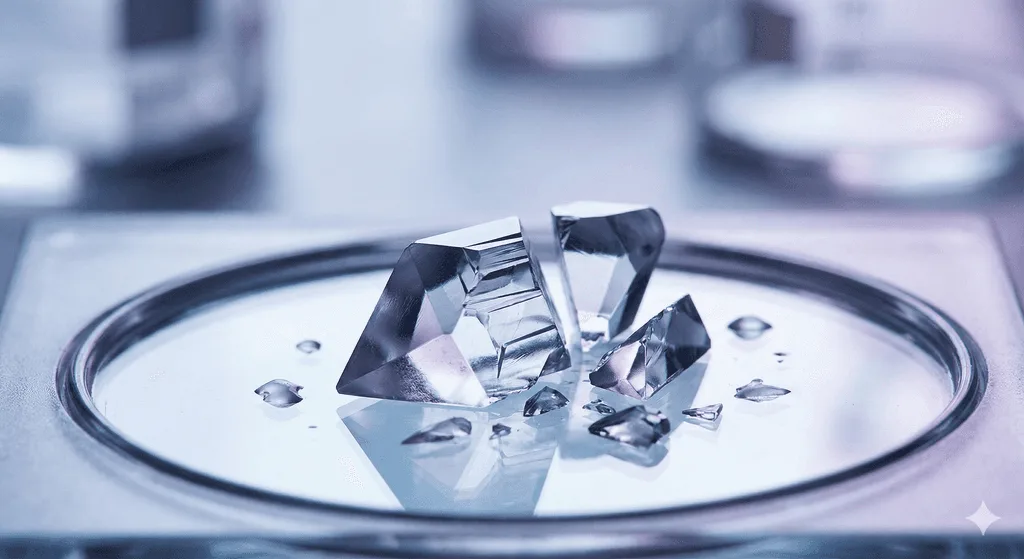
You've spent 6 months expressing and purifying your protein. The SEC-MALS looks perfect—monodisperse, no aggregates. Thermal stability is excellent. You set up 96-well crystallization screens. Two weeks later: clear drops. No crystals.
You try another screen. Then another. Different concentrations. Different buffers. Six months pass. Still nothing.
Welcome to the most frustrating bottleneck in structural biology: crystallization. It kills more structural projects than any other technical barrier, and the failure mechanisms are often invisible until you know exactly what to look for.
This is Part 1 of our crystallization troubleshooting guide. Here, we'll diagnose why proteins fail to crystallize. In Part 2, we'll cover how to fix each problem with modern computational tools.
Key Takeaways
-
70-80% of structural biology projects fail at the crystallization stage
-
Main culprits: Conformational flexibility (35%), surface entropy (25%), sample heterogeneity (20%), wrong construct boundaries (15%), aggregation (20%), missing cofactors (5%)
-
Cost of failure: $80-150K wasted per failed target (6-12 months of effort)
-
The solution: Understanding failure modes before setting up thousands of crystallization trials
-
Modern approach: AI-driven prediction identifies problems in minutes, not months
The Crystallization Crisis: By the Numbers
The Economic Reality
Academic structural biology:
-
Average time per structure: 12-24 months
-
Cost per failed target: $80-120K (postdoc salary + reagents + beamtime)
-
Success rate for "challenging" targets: 20-30%
-
Most common failure point: Crystallization (70% of failures)
Pharmaceutical/CRO structural biology:
-
Average cost per GPCR structure: $500K-1M
-
Timeline: 18-36 months
-
Failure at crystallization: $200-400K wasted
-
Opportunity cost: Delayed drug discovery programs (worth $50-100M)
The pattern: Crystallization isn't a "nice-to-have" skill. It's the rate-limiting step in structure determination for X-ray crystallography.
Failure Mode 1: Conformational Flexibility (35% of Failures)
What it means: Your protein has flexible regions (loops, termini, linkers) that move and prevent the tight, ordered packing required for crystal lattice formation.
Why crystals need rigidity:
-
Crystallization requires identical packing of every protein molecule
-
Flexible regions adopt different conformations in each molecule
-
No single, repeatable lattice can form
-
Result: Protein stays in solution (clear drops)
How to Diagnose
1. AlphaFold pLDDT scores:
-
Regions with pLDDT < 70 (orange/red) = disordered/flexible
-
These regions will prevent crystallization
-
Check your AlphaFold model: Are there long orange loops?
2. Limited proteolysis:
-
Treat purified protein with low protease (trypsin 1:1000, 30 min)
-
Run SDS-PAGE: Flexible loops are cleaved first
-
Mass spec the stable fragments: These are your structured core
3. Hydrogen-deuterium exchange (HDX-MS):
-
Flexible regions exchange faster (high deuteration %)
-
Expensive but definitive
-
Identifies exact residues that are flexible
Common Flexible Regions
N- and C-terminal tails:
-
Most proteins have 10-50 residue disordered termini
-
These "wiggle" in solution, blocking crystal contacts
-
Impact: Proteins with >20% disordered residues have <5% crystallization success
Surface loops (especially in GPCRs):
-
Intracellular loop 3 (ICL3) in GPCRs: 20-60 residues, highly flexible
-
Extracellular loops (ECL2, ECL3): Glycosylated, heterogeneous
-
Famous example: GPCR ICL3 replacement with T4 lysozyme enabled first β2-AR structure (2007)
Interdomain linkers:
-
Flexible hinges between domains
-
Allow domain motion (biologically important, structurally problematic)
The numbers:
-
Removing disordered termini: 3-5× improvement in crystallization success
-
GPCR loop replacement: Enabled >100 GPCR structures since 2007
Failure Mode 2: Surface Entropy (25% of Failures)
What it means: High-entropy surface residues (long, flexible side chains like Lys, Glu, Arg) prevent tight crystal packing.
The Mechanism
Entropy cost of crystallization:
-
In solution: Lys, Glu, Arg side chains are flexible (many conformations = high entropy)
-
In crystal: These side chains must adopt fixed conformations (low entropy)
-
Entropy loss opposes crystallization (ΔG = ΔH - TΔS; large negative ΔS makes ΔG unfavorable)
Crystal contacts require specificity:
-
Good crystal contacts: Complementary surfaces with specific interactions (H-bonds, salt bridges)
-
Bad crystal contacts: Floppy residues that can't form stable interfaces
-
High-entropy residues create "entropic barriers" to crystallization
How to Diagnose
1. Surface composition analysis:
-
Calculate % of surface area occupied by Lys, Glu, Arg, Gln
-
>30% = high entropy, poor crystallization propensity
-
Tool: PISA (protein surface analysis)
2. B-factor analysis (if you have homolog structures):
-
High B-factors (>80 Ų) on surface residues = flexible
-
These residues will resist crystallization
3. Crystallization propensity prediction:
-
XtalPred, ParCrys: Predict crystallization likelihood from sequence
-
Low scores (<0.3) often correlate with high surface entropy
Classic Example: T4 Lysozyme
Wild-type: Difficult to crystallize (small crystals, poor diffraction) SER mutant: K60A, E62A, K65A (three surface mutations) Result: Larger crystals, better diffraction (2.5 Å → 1.8 Å resolution)
Success rates:
-
SER applied to 30+ proteins: 60% showed improved crystallization
-
20% achieved first-ever crystals
-
Average resolution improvement: 0.3-0.5 Å
Failure Mode 3: Sample Heterogeneity (20% of Failures)
What it means: Your "pure" protein is actually a mixture of conformations, oligomeric states, or post-translational modifications. Crystals require homogeneity—every molecule identical.
Source 1: Post-Translational Modifications (PTMs)
The problem:
-
N-glycosylation: Produces heterogeneous glycan structures (different sizes, branching)
-
Each glycoform behaves differently in crystallization
-
Result: 10-20 different species in "pure" sample
Example: GPCR N-glycosylation
-
Typical GPCR has 2-4 N-glycosylation sites
-
Each site can have 5-10 different glycan structures
-
Total glycoforms: 5² to 10⁴ = 25 to 10,000 distinct species
-
Crystallization: Impossible with this heterogeneity
How to detect:
-
SDS-PAGE: Glycosylated proteins run as smear (not sharp band)
-
Mass spectrometry: Multiple peaks separated by ~200-300 Da (sugar units)
-
Lectin binding: ConA, WGA bind glycans (confirms glycosylation)
Source 2: Conformational Heterogeneity
The problem: Protein exists in multiple conformational states (open/closed, active/inactive, apo/holo).
Example: Kinases
-
DFG-in (active) vs DFG-out (inactive)
-
Your sample is a mixture (60% DFG-in, 40% DFG-out)
-
Neither conformation can form ordered crystals alone
Source 3: Oligomeric State Heterogeneity
The problem: Protein exists as mixture of monomers, dimers, tetramers.
How to detect:
-
SEC-MALS: Multiple peaks (monomer at 50 kDa, dimer at 100 kDa)
-
Native PAGE: Multiple bands
-
AUC (analytical ultracentrifugation): Gold standard
The numbers:
-
Removing N-glycosylation: 5-10× improvement in GPCR crystallization success
-
Ligand stabilization: 3-5× improvement (kinases, GPCRs, transporters)
-
Monodisperse sample (>95% monomer): 2× improvement in crystallization
Failure Mode 4: Wrong Construct Boundaries (15% of Failures)
What it means: You've included too much (disordered regions that prevent packing) or too little (removed essential domains).
The Goldilocks Problem
Too long: Includes flexible termini or loops → prevents crystallization Too short: Removes stabilizing domains → protein unfolds or aggregates Just right: Structured core with minimal disorder
How to Diagnose
1. Check AlphaFold confidence (pLDDT):
-
Your construct includes regions with pLDDT < 50 (low confidence)
-
These disordered regions will block crystallization
-
Need to truncate
2. Limited proteolysis:
-
Native protein is proteolyzed to stable core
-
Run mass spec: Identify boundaries of stable fragment
-
This is your crystallization construct
3. Homolog comparison:
-
Find crystal structures of homologs in PDB
-
Check what boundaries they used
-
Often crystallized constructs are truncated versions
Common Boundary Mistakes
Including disordered N/C-termini:
-
Example: Your construct is residues 1-350
-
AlphaFold shows residues 1-25 and 320-350 are disordered (pLDDT < 50)
-
Better construct: residues 26-319
Removing structured domains:
-
Example: You truncate to "just the catalytic domain" (residues 100-250)
-
But residues 250-300 are a stabilizing helix
-
Protein without this helix aggregates
-
Better construct: Include 100-300
Not removing flexible loops in GPCRs:
-
ICL3 (intracellular loop 3): Highly flexible, 20-60 residues
-
Blocks crystallization (prevents ordered packing)
-
Solution: Replace ICL3 with T4 lysozyme (fusion protein)
Failure Mode 5: Aggregation Propensity (20% of Failures)
What it means: Your protein has surface-exposed hydrophobic patches that cause aggregation at crystallization concentrations (5-20 mg/mL).
The Concentration Problem
During purification:
-
Protein at 0.5-2 mg/mL: Soluble, monodisperse
-
SEC-MALS looks perfect
During crystallization:
-
Concentrate to 10-20 mg/mL
-
Protein aggregates (oligomers form)
-
Aggregates precipitate or form amorphous aggregates (not crystals)
Why aggregation blocks crystallization:
-
Aggregates are heterogeneous (different sizes)
-
Cannot form ordered lattice
-
Often irreversible (once aggregated, cannot dissociate)
How to Diagnose
1. DLS (Dynamic Light Scattering):
-
At 1 mg/mL: Monodisperse (Rh = 3.5 nm, single peak)
-
At 10 mg/mL: Polydisperse (two peaks: 3.5 nm and 15 nm)
-
Conclusion: Concentration-dependent aggregation
2. SEC-MALS at different concentrations:
-
Run at 0.5, 2, 5, 10 mg/mL
-
If higher-molecular-weight species appear at high concentration → aggregation
3. Thermal shift assay with aggregation dye:
-
SYPRO Orange (standard) detects unfolding
-
Aggregation dyes (ProteoStat, ThT) detect aggregates
-
If aggregation curve appears before unfolding → aggregation-prone
Failure Mode 6: Missing Cofactors or Binding Partners (5% of Failures)
What it means: Your protein requires a cofactor (metal ion, heme, nucleotide) or binding partner to fold correctly or stabilize. Without it, the protein is unstable or heterogeneous.
Common Missing Cofactors
Metal ions:
-
Zinc (Zn²⁺): Zinc finger domains, metalloproteases
-
Magnesium (Mg²⁺): Kinases, phosphatases, nucleic acid-binding proteins
-
Calcium (Ca²⁺): EF-hand domains, some proteases
-
Iron (Fe²⁺/Fe³⁺): Heme proteins, iron-sulfur clusters
Organic cofactors:
-
Heme: Cytochromes, peroxidases, hemoglobin
-
FAD/FMN: Flavoproteins, oxidoreductases
-
NAD/NADP: Dehydrogenases
-
ATP/ADP: Kinases, ATPases
How Cofactors Affect Crystallization
Without cofactor:
-
Binding pocket is "empty" and flexible
-
Conformational heterogeneity (multiple states)
-
Lower thermal stability (Tm drops 5-15°C)
-
Result: Won't crystallize
With cofactor:
-
Binding pocket occupied and rigid
-
Homogeneous conformation
-
Stabilized structure
-
Result: Crystals form
How to Diagnose
1. Predict cofactor requirements:
-
Check UniProt: Known cofactors for homologs
-
Literature: What cofactors do family members use?
-
Orbion: Predicts metal-binding sites, cofactor requirements
2. Thermal shift with cofactor:
-
Measure Tm without cofactor: 52°C
-
Measure Tm with Zn²⁺: 64°C (+12°C increase)
-
Conclusion: Zinc is required for stability
3. Activity assays:
-
If enzyme, measure activity ± cofactor
-
If no activity without cofactor → it's essential
Case Study: Kinase Crystallization
Target: Novel kinase, full-length
Attempt 1: Apo kinase (no ligands)
-
Purification: Monodisperse
-
Tm: 48°C (low)
-
Crystallization: No crystals (6 months, 2,000 conditions)
Attempt 2: Kinase + Mg²⁺ + ATP analog (AMP-PNP)
-
Add 5 mM MgCl₂ and 2 mM AMP-PNP during purification
-
Tm: 58°C (+10°C)
-
Crystallization: Crystals in 3 weeks
-
Diffraction: 2.4 Å resolution
Lesson: Many enzymes absolutely require cofactors/ligands for crystallization.
Understanding Your Failure Mode: Quick Diagnostic
Before you set up 2,000 more crystallization conditions, determine which failure mode you're facing:
| Symptom | Likely Failure Mode | Quick Test |
|---|---|---|
| AlphaFold has long orange/red regions | Flexibility | Check pLDDT plot |
| High % of surface Lys/Glu/Arg | Surface entropy | Calculate surface composition |
| SDS-PAGE shows smear (not band) | PTM heterogeneity | Mass spec |
| SEC-MALS shows multiple peaks | Oligomeric heterogeneity | AUC or native PAGE |
| Construct includes disordered termini | Wrong boundaries | Compare to homolog structures |
| Aggregates at >5 mg/mL | Aggregation | DLS at multiple concentrations |
| Low Tm (<50°C) | Missing cofactors | Thermal shift ± cofactors |
Key Takeaway
Crystallization failure isn't random bad luck. It's a predictable engineering problem with known failure modes:
-
Flexibility (35%): Disordered regions prevent packing
-
Surface entropy (25%): Flexible surface residues oppose crystallization
-
Heterogeneity (20%): PTMs, conformational states, oligomers
-
Wrong boundaries (15%): Too much or too little protein
-
Aggregation (20%): Concentration-dependent oligomerization
-
Missing cofactors (5%): Protein unstable without ligands
Understanding your failure mode is the first step to solving it.