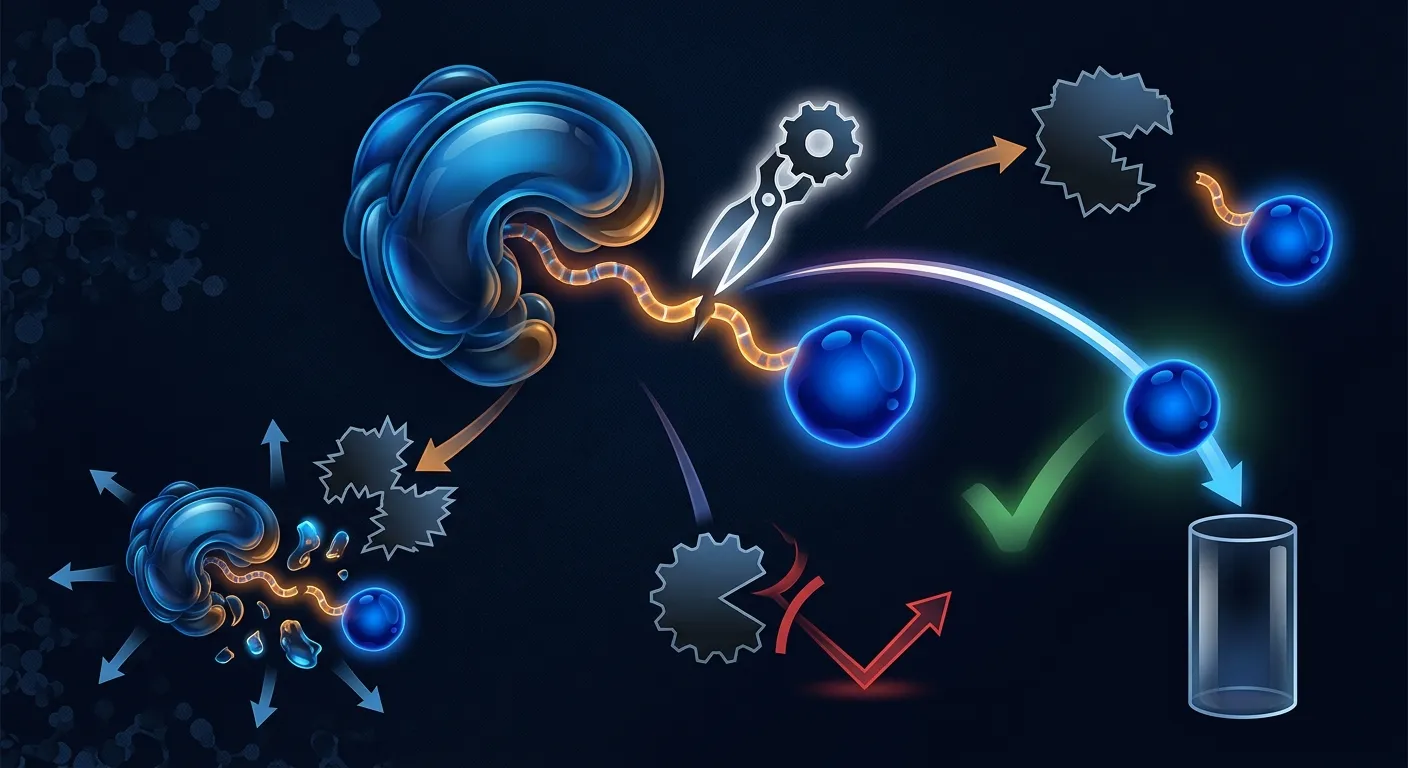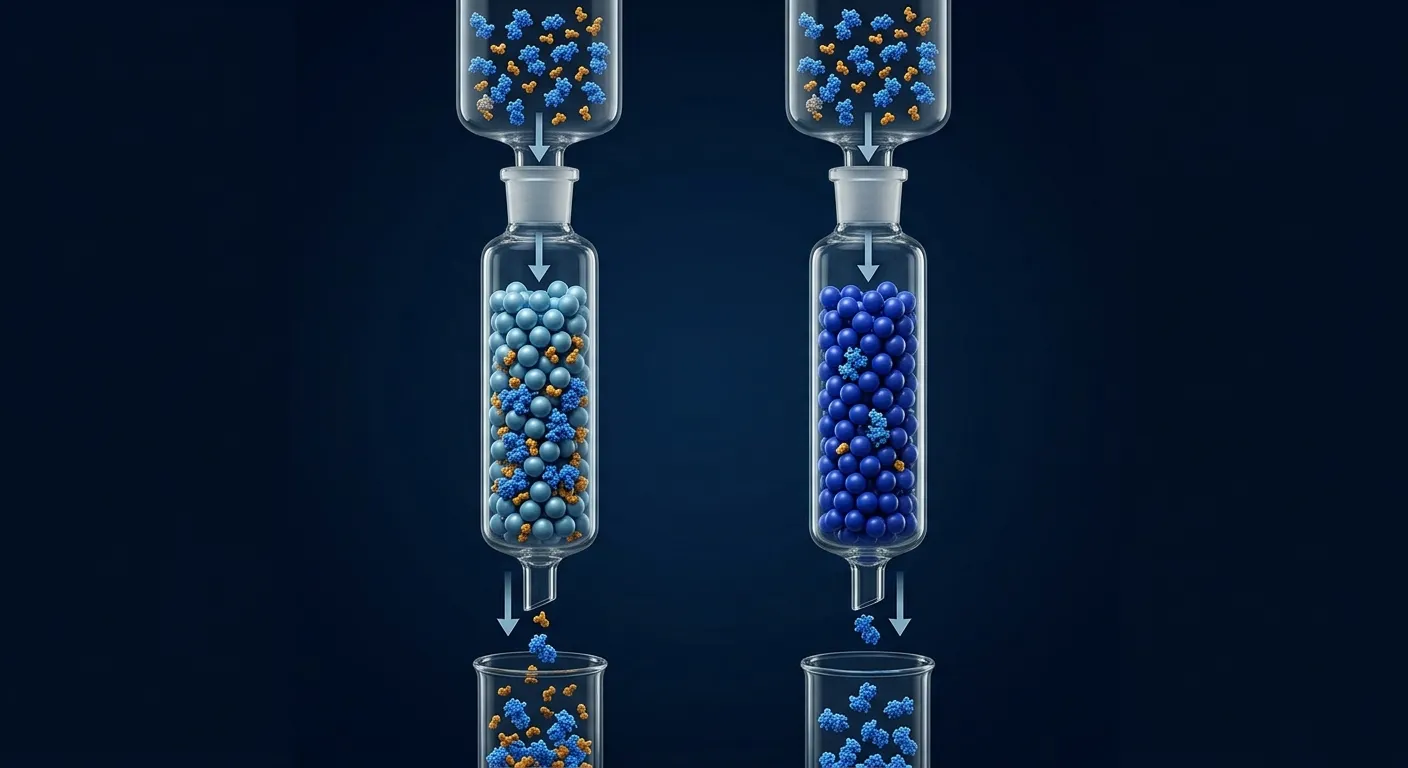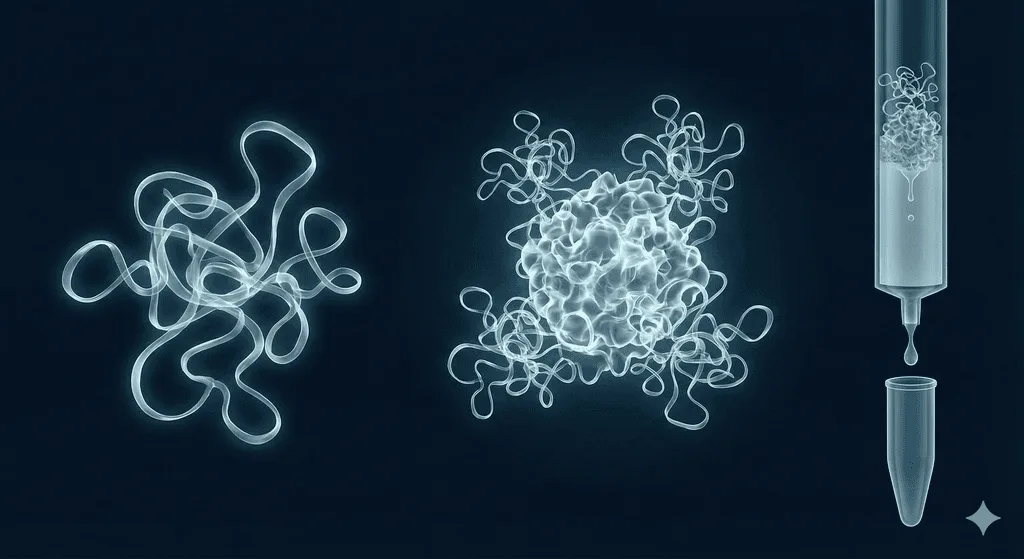
Your protein looked perfect after affinity chromatography. Eluted as a single peak. Then you concentrated it for crystallization trials, walked away for lunch, and came back to a cloudy tube. By the time you ran the gel filtration, half your protein had vanished into the void volume—aggregated, irreversibly.
The frustrating part: this was predictable. The aggregation wasn't random. It was written into the sequence, hidden in the interplay between three properties that most researchers analyze separately but are fundamentally connected: disorder, aggregation propensity, and membrane topology.
Key Takeaways
-
Disorder exposes aggregation-prone regions that are normally buried in folded proteins
-
Disordered termini are the #1 cause of post-purification aggregation
-
Membrane proteins misbehave because their hydrophobic TM helices are aggregation hotspots outside the bilayer
-
The same hydrophobic patches that drive aggregation also drive membrane insertion—they're two sides of the same coin
-
Unified analysis of all three properties reveals rescue strategies that single-property predictions miss
The Hidden Connection
Most prediction tools treat disorder, aggregation, and membrane topology as separate problems:
-
Use IUPred for disorder
-
Use AGGRESCAN for aggregation
-
Use TMHMM for topology
But in the biophysics of your protein, these aren't separate. They're deeply connected through one principle: hydrophobicity and its exposure to water.
The Triangle of Trouble
The connections:
-
Disorder exposes hydrophobic regions → aggregation
-
Membrane proteins have hydrophobic TM helices → aggregate when extracted from membrane
-
Disordered regions in membrane proteins → especially problematic
Understanding this triangle explains why your purification failed—and how to fix it.
Part 1: How Disorder Drives Aggregation
The Protective Role of Folding
In a well-folded protein:
-
Hydrophobic residues (Ile, Leu, Val, Phe, Met) are buried in the core
-
The surface is mostly hydrophilic (Lys, Arg, Glu, Asp, Ser, Thr)
-
Water interacts with the hydrophilic surface
-
Protein stays soluble
Folding is a defense mechanism against aggregation.
What Happens When Regions Are Disordered
About 30-40% of eukaryotic proteins contain significant disordered regions (>50 residues), and disorder is present in some form in ~70% of all proteins (Dunker et al., 2008). These intrinsically disordered regions (IDRs) don't have stable tertiary structure, which means:
-
Hydrophobic residues aren't stably buried
-
They transiently expose to solvent
-
Exposed hydrophobic patches stick to each other
-
Aggregation nucleates
The paradox: IDRs are often functional in the cell (protein-protein interactions, signaling, localization). But in a test tube, without their binding partners, they become aggregation liabilities. IDPs are notably overrepresented in protein aggregates associated with neurodegenerative diseases (Vendruscolo, 2022).
The Terminal Problem
The most common disorder-driven aggregation involves N- and C-terminal tails:
Why termini are often disordered:
-
Termini are frequently regulatory regions
-
They mediate protein-protein interactions
-
They contain localization signals
-
They're evolutionarily flexible
Why this causes aggregation:
-
No binding partner in your purification buffer
-
Disordered termini wave around, exposing hydrophobic patches
-
Concentration increases → more collisions → aggregation
The data:
-
30-40% of eukaryotic proteins have disordered termini (>20 residues)
-
Truncating disordered termini improves solubility in 60-70% of aggregation-prone proteins
-
This is the single most effective intervention for post-purification aggregation
Case Example: Kinase Regulatory Domains
Many kinases have:
-
Disordered N-terminal region (50-100 residues)
-
Well-folded catalytic domain (250-300 residues)
-
Disordered C-terminal tail (20-50 residues)
In the cell:
-
N-terminus binds regulatory partners
-
C-terminus contains phosphorylation sites for regulation
-
Both are functional
In your purification:
-
N-terminus has no partners → aggregates
-
C-terminus has no phosphatases → aggregates
-
Catalytic domain is dragged along
The fix:
-
Express just the catalytic domain
-
Lose the disordered regions
-
Gain a soluble, crystallizable protein
Part 2: The Membrane Protein Aggregation Problem
Why Membrane Proteins Are Aggregation Machines
Transmembrane (TM) helices have a specific job: span the hydrophobic core of the lipid bilayer. To do this, they're composed almost entirely of hydrophobic residues.
A typical TM helix:
-
20-25 residues long
-
80%+ hydrophobic (Leu, Ile, Val, Ala, Phe)
-
Designed to be buried in lipid
What happens during purification:
-
You lyse cells → membrane is disrupted
-
TM helices are exposed to aqueous buffer
-
Hydrophobic surfaces find each other
-
Aggregation—often within seconds
The numbers:
-
60-70% of membrane protein purifications fail
-
Primary cause: aggregation during detergent extraction
-
GPCRs, ion channels, transporters are all affected
Detergents: A Temporary Fix
Detergents solubilize membrane proteins by:
-
Coating the hydrophobic TM regions
-
Creating a micelle that mimics the membrane
-
Keeping the protein in solution
But detergents are imperfect:
-
They're not lipids—structure may distort
-
They don't stabilize the same way membranes do
-
Concentration matters: too little → aggregation; too much → denaturation
-
Many proteins are unstable even in optimal detergent
The Aggregation-Topology Connection
Here's where it gets interesting: the same residues that make a helix "transmembrane" make it "aggregation-prone."
Prediction tools use hydrophobicity to identify:
-
TM helices (sustained hydrophobicity = membrane span)
-
Aggregation hotspots (hydrophobic patches = aggregation risk)
They're detecting the same underlying property from different angles.
This means:
-
Every TM helix is a potential aggregation hotspot
-
Membrane proteins have multiple aggregation hotspots (one per TM helix)
-
The more TM helices, the harder the purification
Example: GPCRs
G-protein coupled receptors have 7 TM helices = 7 aggregation hotspots:
-
In membrane: stable, functional receptor
-
In detergent: marginally stable, activity decays over hours
-
Without detergent: instant aggregation
This is why GPCR structural biology required heroic stabilization efforts (thermostabilizing mutations, nanobody stabilization, lipidic cubic phase crystallization).
Part 3: When Disorder Meets Membrane Topology
The Worst-Case Scenario
Some proteins have both:
-
Transmembrane topology
-
Disordered cytoplasmic loops or termini
Example: Multi-pass transporters
A typical transporter might have:
-
12 TM helices
-
Large disordered N-terminus (regulatory)
-
Long disordered loops between TM helices
-
Disordered C-terminus
The aggregation vulnerability:
-
TM helices aggregate if detergent coverage is imperfect
-
Disordered loops don't fold → expose hydrophobic residues
-
Disordered termini flail around → nucleate aggregation
-
Multiple failure modes compound
Result: 90%+ failure rate without extensive optimization
Loop Regions: The Underappreciated Problem
Between TM helices, membrane proteins have loops that face either:
-
Extracellular space
-
Cytoplasm
Loop characteristics:
-
Often flexible (some disorder)
-
May contain hydrophobic residues (for partner binding or membrane association)
-
Variable length (from 5 to 100+ residues)
The aggregation issue:
-
Long loops with hydrophobic character aggregate
-
Short loops constrain TM helix packing → destabilize the fold
-
Loop mutations often designed to stabilize (T4L, BRIL insertions in GPCRs)
Part 4: Reading AlphaFold for Aggregation Risk
AlphaFold doesn't predict aggregation directly, but it tells you a lot about disorder and topology—and now you know these connect to aggregation.
Using pLDDT as a Disorder Signal
pLDDT < 50: Very likely disordered
-
These regions will aggregate in vitro if they contain hydrophobic patches
-
First candidates for truncation or removal
pLDDT 50-70: Conditionally structured
-
May fold with binding partner
-
May be stable in membrane context
-
Will likely misbehave in isolation
pLDDT > 70: Likely structured
-
Not necessarily aggregation-proof (surface hydrophobic patches still matter)
-
But less likely to expose hydrophobic residues transiently
Identifying Membrane Topology from Structure
AlphaFold predicts 3D structure, but you need to infer:
-
Which helices are transmembrane
-
Where the membrane boundaries are
-
Which loops are intra- vs extracellular
Visual clues:
-
Bundle of parallel hydrophobic helices = TM region
-
Flat "band" of hydrophobic residues = membrane plane
-
Loops protruding from bundle = connecting loops
Automated tools:
-
PPM server (positions protein in membrane)
-
TMHMM on sequence (predicts TM helices)
-
OPM database (oriented proteins in membrane)
The Integrated Assessment
For any protein, assess:
-
Where are the disordered regions? (pLDDT < 50)
-
Termini? → Consider truncation
-
Loops? → May need fusion proteins or nanobody stabilization
-
-
Is it a membrane protein? (Hydrophobic helix bundle, TM predictions)
-
How many TM helices? → More = harder
-
What expression system? → Native membrane may be required
-
-
Where are the hydrophobic patches? (Surface analysis)
-
In disordered regions? → High aggregation risk
-
In TM helices? → Need detergent/lipid for solubilization
-
Part 5: Rescue Strategies
Strategy 1: Truncate Disordered Termini
When to use: pLDDT shows low-confidence termini
How to do it:
-
Identify disorder boundaries (where pLDDT rises above 70)
-
Design constructs that start/end at structured regions
-
Make 2-3 truncations at different boundaries
-
Test expression and solubility
Success rate: 60-70% of aggregation-prone proteins become soluble with terminal truncation
Example:
-
Full-length kinase (1-450): Aggregates at 2 mg/mL
-
Truncated kinase (51-420): Soluble at 20 mg/mL
-
Truncated 70 disordered residues, removed 2 aggregation hotspots
Strategy 2: Fuse Soluble Domains to Mask Aggregation
When to use: Disordered regions are functionally required
Common fusions:
-
MBP (maltose binding protein): Highly soluble, masks hydrophobic patches
-
SUMO: Improves folding, clean cleavage
-
Thioredoxin: Good for small proteins with aggregation issues
-
T4 Lysozyme (for GPCRs): Stabilizes TM helices by replacing flexible loops
Where to fuse:
-
N-terminus: Standard, usually least disruptive
-
C-terminus: If N-terminus is functionally important
-
Internal (loop replacement): For membrane proteins, replaces disordered loops
Strategy 3: Stabilizing Mutations
When to use: You need the full-length protein but it aggregates
Target selection:
-
Identify surface hydrophobic residues
-
Prioritize those in or near disordered regions
-
Mutate to hydrophilic residues (L→S, I→T, V→E)
Caution:
-
Don't mutate functional residues
-
Don't destabilize the fold (check ΔΔG)
-
Don't remove essential PTM sites
Success rate: 40-60% improvement with 2-3 mutations
Strategy 4: Optimize Solution Conditions
When to use: First-line intervention while planning construct redesign
Variables to screen:
-
pH: 0.5-1 unit away from pI (reduces aggregation)
-
Salt: 150-500 mM (increases ionic strength, reduces non-specific interactions)
-
Additives:
-
Arginine (100-500 mM): Disrupts hydrophobic interactions
-
Glycerol (10-20%): Stabilizes native state
-
Detergents (0.01-0.1%): For membrane proteins
-
Success rate: 20-30% of aggregating proteins can be rescued with buffer optimization alone
Strategy 5: Change Expression System
When to use: E. coli produces inclusion bodies despite optimization
The expression ladder:
-
E. coli: If this fails...
-
Pichia pastoris (yeast): Slower folding, eukaryotic chaperones
-
Sf9/Sf21 (insect): Better membrane protein handling
-
HEK293/CHO (mammalian): Native-like folding environment
Why switching helps:
-
Eukaryotic cells have better chaperone machinery
-
Membrane protein insertion is native
-
PTMs that aid folding are present
Case Study: Rescuing a Triple-Threat Protein
The Target
Human transporter protein:
-
12 TM helices
-
80-residue disordered N-terminus
-
Long disordered loop between TM6 and TM7
-
Critical for drug transport—needed for pharmacology studies
Initial Attempt
Expression: Sf9 insect cells Purification: DDM extraction, His-tag purification Result: Protein extracted, but aggregated within 4 hours at 4°C
Diagnosis
Analysis revealed:
-
Disorder: N-terminus (1-80) and loop (residues 320-380) show pLDDT < 40
-
Aggregation hotspots: Both disordered regions contain hydrophobic patches
-
TM instability: 12 TM helices require constant detergent coverage
The triple threat: Disorder + membrane topology + aggregation propensity
The Solution
Step 1: Truncate N-terminus
-
Removed residues 1-75
-
Kept 5 residues before first TM helix
Step 2: Replace disordered loop
-
Inserted T4 lysozyme (T4L) between TM6 and TM7
-
Rigid insertion stabilizes TM packing
-
Standard GPCR engineering strategy applied to transporter
Step 3: Optimize detergent
-
DDM → LMNG (longer chain, better coverage)
-
Added CHS (cholesterol hemisuccinate) for membrane stability
Step 4: Add nanobody
-
Raised nanobody against stable conformation
-
Nanobody binding further stabilizes the fold
The Result
-
Before: 4-hour stability, aggregates at 2 mg/mL
-
After: 48-hour stability, soluble at 5 mg/mL
-
Cryo-EM structure: Solved at 3.2 Å resolution
Key insight: All three problems (disorder, topology, aggregation) were addressed together. Fixing only one wouldn't have worked.
The Unified Prediction Approach
Why Separate Tools Miss the Picture
Traditional workflow:
-
Run IUPred → find disorder
-
Run AGGRESCAN → find aggregation hotspots
-
Run TMHMM → find TM helices
-
Try to integrate manually
The problem:
-
Tools don't talk to each other
-
Same residue might be flagged differently by each tool
-
Integration requires expert knowledge
-
Easy to miss connections
The Integrated Assessment
What you actually need:
-
Disorder prediction that considers aggregation consequences
-
Aggregation prediction that accounts for membrane context
-
Membrane topology with disorder and stability implications
-
All three overlaid on the structure
Questions an integrated analysis answers:
-
Is this disordered region a liability (aggregation-prone) or neutral (hydrophilic)?
-
Are these TM helices stable in detergent, or do they need specific lipids?
-
Will truncating this terminus destabilize the fold?
-
Which combination of interventions will work?
Practical Decision Tree
The Bottom Line
Disorder, aggregation, and membrane topology aren't three separate problems. They're manifestations of the same underlying biophysics: hydrophobic residues and their exposure to water.
| Property | What It Means | Consequence |
|---|---|---|
| Disorder | No stable structure | Hydrophobic residues transiently exposed |
| Aggregation propensity | Hydrophobic surface patches | Proteins stick to each other |
| Membrane topology | Hydrophobic TM helices | Aggregate outside membrane |
The unified principle: Anything that exposes hydrophobic residues to water is an aggregation risk.
Understanding this connection transforms troubleshooting:
-
Not "my protein is disordered" but "my protein exposes aggregation hotspots"
-
Not "my protein needs detergent" but "my TM helices aggregate without membrane mimetics"
-
Not "three separate problems" but "one problem with three manifestations"
Unified Analysis for Aggregation Rescue
For researchers dealing with aggregation-prone proteins, platforms like Orbion provide integrated analysis of disorder, aggregation propensity, and membrane topology from a single prediction. This unified view reveals:
-
Which disordered regions are actually aggregation liabilities
-
How membrane topology contributes to purification difficulty
-
Where to truncate, mutate, or fuse to rescue your protein
-
What expression system and purification conditions to prioritize
The goal is to see the connections between these properties before you start purifying—so you can design constructs that avoid the aggregation trap entirely, rather than troubleshooting it for months afterward.
References
-
Dunker AK, et al. (2008). Function and structure of inherently disordered proteins. Current Opinion in Structural Biology, 18(6):756-764. PMC2443096
-
Vendruscolo M, et al. (2022). Intrinsically disordered proteins identified in the aggregate proteome serve as biomarkers of neurodegeneration. Frontiers in Neuroscience, 15:780567. PMC8748380
-
Uversky VN. (2013). Intrinsic disorder-based protein interactions and their modulators. Current Pharmaceutical Design, 19(23):4191-4213. Link
-
Chiti F & Dobson CM. (2017). Protein Misfolding, Amyloid Formation, and Human Disease: A Summary of Progress Over the Last Decade. Annual Review of Biochemistry, 86:27-68. Link
-
Krogh A, et al. (2001). Predicting transmembrane protein topology with a hidden Markov model: application to complete genomes. Journal of Molecular Biology, 305(3):567-580. Link
-
Fernandez-Escamilla AM, et al. (2004). Prediction of sequence-dependent and mutational effects on the aggregation of peptides and proteins. Nature Biotechnology, 22(10):1302-1306. Link