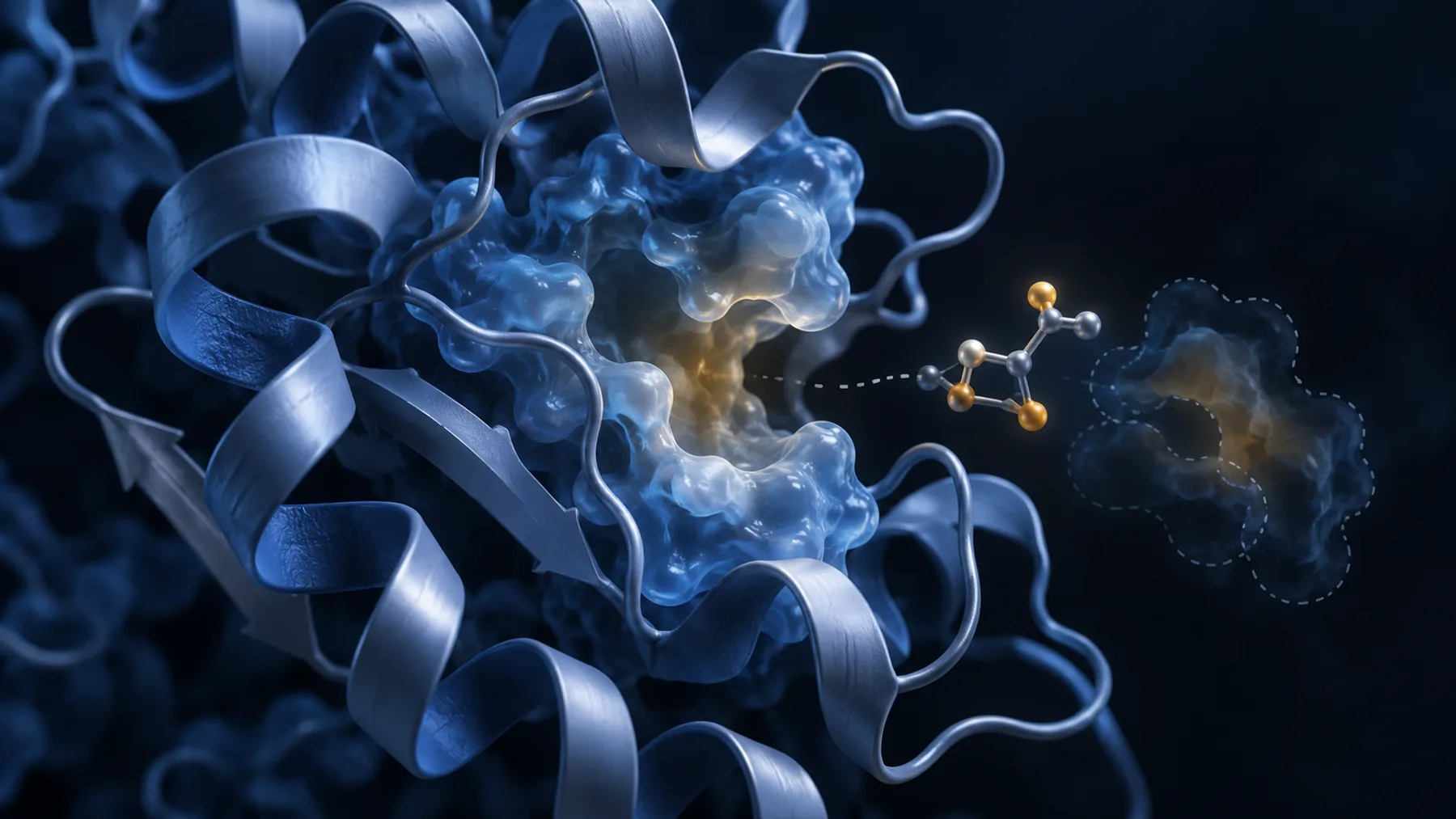
You designed a PROTAC with two strong binders — a sub-nanomolar warhead for your target, a clean VHL ligand, and a linker that looked reasonable in the model. The compound recruits the E3 ligase. It forms the ternary complex by SPR. And it barely degrades anything in cells. Meanwhile, a structurally similar analog with weaker individual affinities degrades the target completely.
Targeted protein degradation has moved from academic curiosity to a clinical modality with dozens of programs in trials, yet the central object that drives it — the E3 ligase–degrader–target ternary complex — remains one of the hardest things in structural biology to predict from first principles. This is the degrader problem.
Key Takeaways
- The ternary complex, not binary affinity, determines degradation. Cooperativity (α) can rescue weak binders or kill strong ones, and you cannot read it off either binary Kd.
- AlphaFold-Multimer and AlphaFold3-class co-folding tools fail on degrader interfaces more often than they succeed. A 2025 benchmark put AlphaFold3 at a ~51% success rate for the protein–protein interface and ~33% for recovering the molecular glue itself — and most hits traced to memorized structures.
- The small molecule at the interface is the core difficulty. Degrader-induced interfaces are shallow, glue-dependent, and often have no evolutionary signal for an MSA-based model to learn from.
- Physics-based docking (Rosetta, restrained MD) still earns its place. Methods like PRosettaC produce near-native ternary poses by sampling protein–protein and ligand conformational space explicitly, but they need a known binary pose and significant compute.
- Experimental validation stays non-negotiable. Crystallography, cryo-EM, and biophysics (ITC/SPR cooperativity) remain the ground truth; computation narrows the field, it does not replace the structure.
Why Ternary Complexes Break the Standard Playbook
For a conventional drug, structure-based design has a clean loop: get the target structure, dock the ligand, optimize the pose, measure affinity. A bifunctional degrader breaks every step of that loop because the thing you are trying to model does not exist until three partners come together.
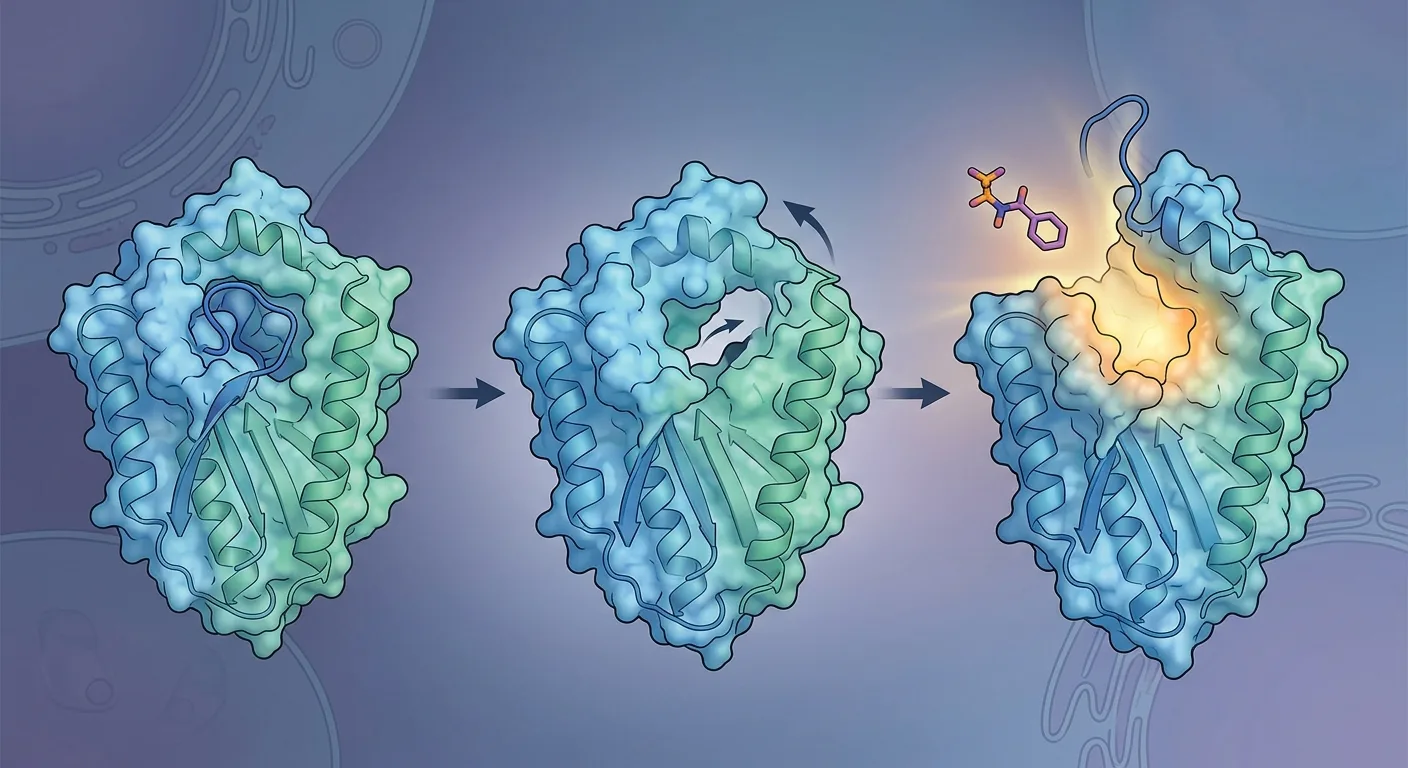
A PROTAC is a heterobifunctional molecule: one end binds the target (the protein of interest, or POI), the other binds an E3 ubiquitin ligase, and a linker tethers them. A molecular glue is smaller and subtler — a monovalent compound that reshapes the surface of one partner just enough to recruit the other. Thalidomide analogs binding cereblon are the canonical example. In both cases, degradation depends on forming a productive ternary complex that positions target lysines for ubiquitin transfer.
The core tension: the two binary binding events you can measure and design for do not predict the ternary complex you actually need. A degrader assembles a new protein–protein interface that neither partner evolved to form. That interface — its area, its contacts, its geometry — is what governs whether ubiquitin gets transferred and the target gets degraded.
Cooperativity Is the Variable You Can't Ignore
Cooperativity (α) quantifies how much the ternary complex is stabilized or destabilized relative to what you'd expect from the two binary interactions alone. α > 1 is positive cooperativity: the target and E3 like being near each other once the degrader bridges them, often because the compound induces favorable protein–protein contacts. α < 1 is negative: the proteins clash, and the ternary complex is weaker than the binary affinities predict.
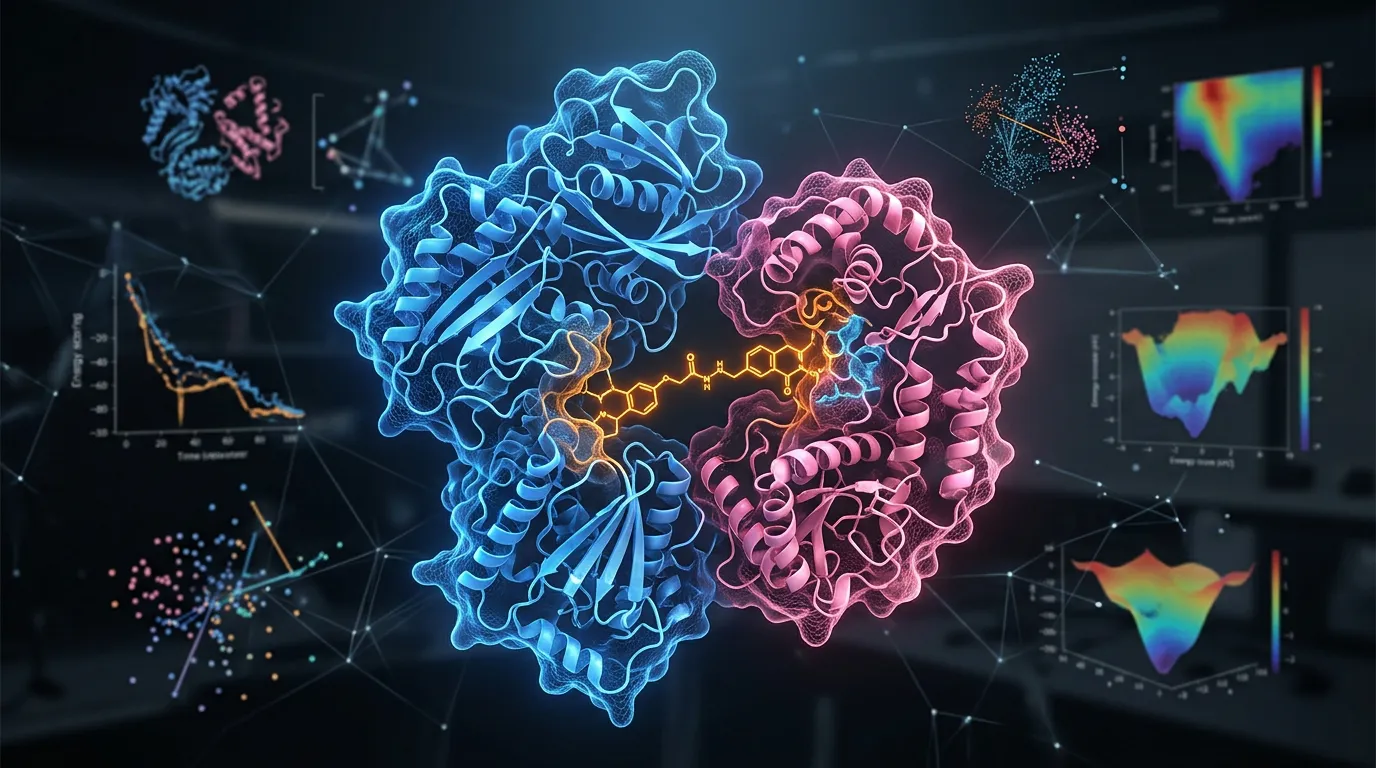
This is not a second-order correction. In the first crystal structure of a PROTAC ternary complex — the BRD4-degrader MZ1 bound to VHL and the BRD4 bromodomain — the compound is sandwiched between the two proteins, nucleating extensive new hydrophobic and electrostatic contacts that drive marked isoform selectivity (Gadd et al., 2017). The degrader doesn't just hold two proteins together; it builds an interface. Ternary complex affinity and cooperativity correlate with degradation potency far better than either binary Kd does (Wurz et al., 2023).
So when your strong-binder PROTAC fails and your weak-binder analog works, cooperativity is usually the culprit — and it is exactly the quantity that binary-affinity-driven design is blind to.
What Structure Prediction Can and Cannot Do Here
The obvious move in 2026 is to point a co-folding model at the problem: feed it the target, the E3, and the ligand, and ask for a ternary structure. Let's be precise about where that works and where it doesn't.
AlphaFold-Multimer: Built for Protein–Protein, Blind to the Glue
AlphaFold-Multimer was trained specifically on multimeric inputs and substantially improved interface accuracy over single-chain AlphaFold adapted to complexes (Evans et al., 2022). It is genuinely good at protein–protein assemblies with an evolutionary signal — complexes whose partners co-evolved, leaving correlated mutations the MSA can exploit.
What AlphaFold-Multimer can do for ternary complexes:
- Predict each partner's fold (target domain, E3 substrate-receptor) at high confidence
- Model the protein–protein interface when the two proteins have a genuine, evolutionarily supported interaction
- Provide inter-chain PAE as a confidence signal for relative domain placement
What AlphaFold-Multimer cannot do:
- Place the small-molecule degrader — it has no ligand in its input or output
- Capture an interface that exists only because of the glue, with no co-evolutionary history
- Distinguish a cooperative pose from a sterically clashing one without the compound present
That last point is the killer. Degrader interfaces are, by construction, non-evolved. Two proteins that never interact in nature are forced together by a synthetic molecule. There is no MSA signal for "BRD4 binds VHL," because they don't — until MZ1 makes them.
AlphaFold3-Class Co-Folding: Better on Paper, Still Failing on Degraders
AlphaFold3, Boltz-1/2, Chai-1, Protenix, and RoseTTAFold All-Atom can take ligands as input and co-fold protein + small molecule in one shot. This is the right shape of tool for the degrader problem. The results, so far, are sobering.
A 2025 benchmark of these co-folding methods on molecular glue ternary complexes found AlphaFold3 led the pack — and still landed at only a 50.6% success rate for the protein–protein interface and 32.9% for recovering the molecular glue–protein interaction (Liao et al., 2025). Worse, a homology analysis showed most successful predictions stemmed from memorization: the model had seen close relatives of the test structures during training. Strip out the memorized cases and accuracy on genuinely novel interfaces collapses.
Diagnostic question: Is your target–E3 pair (or a close homolog) already in the PDB as a ternary complex? If yes, a co-folding model may reproduce it. If no, treat any single co-folded pose as a hypothesis, not an answer.
Why the Small Molecule at the Interface Is So Hard
Several properties of degrader interfaces conspire against current models:
- No co-evolutionary signal. MSA-based models lean on evolutionary coupling. Synthetic, induced interfaces have none.
- Shallow, flat protein–protein interfaces. Degrader-induced PPIs are often small and polar rather than deep hydrophobic pockets. BRD4-BD2:VHL complexes, for instance, bind nearly parallel through a few mostly polar residues, giving low buried surface area but strong cooperativity from end-to-end locking (Gadd et al., 2017).
- The ligand defines the geometry. The linker length, exit-vector geometry, and glue conformation set the relative orientation of the two proteins. Get the ligand pose wrong and the whole complex is wrong.
- Multiple poses and a conformational ensemble. A single PROTAC often samples several ternary geometries; productive ubiquitination may require only a subset. A single static prediction misrepresents an ensemble.
This is why co-folding a small molecule into an induced ternary interface remains an open research problem. The newest specialized models — guided-diffusion approaches like YDS-GlueFold, reported to predict novel glue interfaces at RMSD as low as ~1.3 Å across eight test systems (Che et al., 2024) — show the direction of travel, but they are early-stage, narrow in scope, and not yet a general solution.
Where Docking and MD Still Win
Before deep learning, the ternary modeling field was built on physics-based sampling, and that toolkit has not been retired — it remains the most reliable route when you have binary structures in hand.
Restrained Protein–Protein Docking
If you have the crystal structures of the target–warhead and E3–ligand binary complexes, you can dock the two proteins under the constraint that the ligand exit vectors must connect. PRosettaC formalized this: it alternates between sampling the protein–protein interaction space and the PROTAC's conformational space, and on a benchmark of known ternary complexes it produced near-native predictions — often atomic-accuracy placement of the protein chains and the PROTAC binding moieties (Zaidman et al., 2020).
When to use it: you have both binary poses and want a physically grounded ensemble of ternary candidates to rank.
Tradeoffs:
- Pro: explicitly models the ligand and linker; produces ensembles, not a single guess; physically interpretable
- Con: requires known binary structures; compute-heavy; linker conformational sampling is the bottleneck and degrades for long, flexible linkers
Molecular Dynamics for Stability and Ensembles
Co-folding and docking give you candidate poses; MD tells you which ones survive. Restrained or unrestrained MD assesses whether a predicted ternary geometry is stable, how the linker behaves, and how the conformational ensemble is distributed. Free-energy methods can estimate relative cooperativity across analogs. The cost is real — long simulations, careful force-field choices for the ligand — but MD is often the difference between a plausible-looking pose and a productive one.
A Realistic Hybrid Workflow
No single method is sufficient. The teams getting this right chain methods together:
START: Do you have binary co-crystal structures (target+warhead, E3+ligand)?
│
├─ YES → Restrained docking (PRosettaC-style) to build a ternary ensemble
│         └─ Rank poses by buried surface area + interface complementarity
│             └─ MD on top poses → stability + cooperativity estimate
│                 └─ Validate top candidate experimentally (crystallography / cryo-EM / SPR α)
│
└─ NO → Predict binary folds (AlphaFold2 / Multimer) for each partner
          └─ Co-fold ligand (AlphaFold3 / Boltz / Chai) — treat as HYPOTHESIS
              └─ Is target–E3 pair (or homolog) already in PDB?
                  ├─ YES → Prediction may be reliable; still validate
                  └─ NO → Low confidence; prioritize experimental structure early
The decision that matters most is the first one. Without binary structures, you are extrapolating; with them, you are interpolating — and interpolation is where these methods are trustworthy.
Case Study: When the Better Binder Degrades Worse
Problem: A medicinal chemistry team developing VHL-based PROTACs against a BET-family bromodomain target observed a counterintuitive structure–activity relationship. Their highest-affinity warhead, paired with a high-affinity VHL ligand, formed a detectable ternary complex by SPR but degraded the target poorly in cells. A lower-affinity analog degraded efficiently at the same concentration.
Analysis: Binary affinities pointed the wrong way, so the team modeled the ternary complexes. The structural and biophysical literature on this exact class is unusually rich: the MZ1–VHL–BRD4 system showed that productive degradation depends on the degrader nucleating a cooperative protein–protein interface, and that ternary affinity and cooperativity — not binary Kd — track with degradation potency (Gadd et al., 2017; Wurz et al., 2023). Restrained docking of the two analogs produced different dominant ternary geometries: the high-affinity compound favored a pose with steric clash at the induced interface (negative cooperativity, α < 1), while the lower-affinity analog adopted a complementary pose with higher buried surface area and favorable polar contacts (positive cooperativity, α > 1).
Solution: Rather than chasing more binary potency, the team optimized the interface. They adjusted linker length and exit-vector geometry to favor the cooperative pose, using the buried-surface-area ranking from docking to triage analogs before synthesis, and confirmed the predicted geometry by co-crystallography.
Outcome: The redesigned series recovered cellular degradation, and the modeling-plus-crystallography loop cut the number of analogs synthesized to find a productive linker. The lesson generalizes: when degradation and binary affinity disagree, the answer is in the ternary interface, and you find it by modeling cooperativity — then proving it with a structure.
Pre-Flight Checklist Before You Trust a Ternary Prediction
Before you let a predicted ternary complex drive a synthesis campaign, verify:
- You have, or can get, the two binary co-crystal structures. Predictions without them are extrapolation.
- You checked the PDB for the target–E3 pair (or a close homolog). Co-folding success often means memorization, not generalization.
- You generated an ensemble, not a single pose. One static structure misrepresents a conformational ensemble.
- You ranked by interface metrics (buried surface area, contact complementarity, hydrophobic vs polar balance), not just by the model's confidence score.
- You estimated cooperativity — computationally (MD/free energy) and ideally experimentally (ITC/SPR α).
- You have an experimental validation path (crystallography, cryo-EM, or at minimum biophysical ternary characterization) before committing the campaign.
- For molecular glues specifically, you treated the glue pose as the highest-risk variable. The induced interface is defined by where the small molecule sits.
The Economics: Method vs. Reality
| Approach | Time to Result | Compute / Cost | Reliability on Novel Degrader Interface |
|---|---|---|---|
| AlphaFold-Multimer (proteins only) | Hours | Low (GPU) | Good for evolved PPIs; blind to the glue |
| AlphaFold3 / Boltz / Chai co-folding | Hours | Low–moderate (GPU) | ~33–51%, much of it memorization (Liao et al., 2025) |
| Restrained docking (PRosettaC-style) | Days | Moderate–high (CPU cluster) | Near-native with binary structures (Zaidman et al., 2020) |
| Docking + MD ensemble | Days–weeks | High | Best computational estimate of cooperativity |
| X-ray / cryo-EM ternary structure | Weeks–months | High (beamline / EM time) | Ground truth |
ROI consideration: A wasted degrader campaign is not cheap — months of medicinal chemistry chasing the wrong SAR. Spending days on a docking-plus-MD ensemble, or weeks on a single ternary crystal structure, is cheap insurance against synthesizing a hundred analogs that optimize the wrong thing. Computation's job here is triage: shrink the experimental search space, then let the structure decide.
Bottom Line
Structure prediction can model the protein–protein side of a ternary complex when the partners are well-folded and the interface has evolutionary or experimental precedent — but co-folding a small-molecule degrader into a novel induced interface is an unsolved problem, and any single predicted ternary pose is a hypothesis to validate, not a structure to trust. Cooperativity, not binary affinity, drives degradation, and finding it still takes physics-based sampling plus an experimental structure.
How Orbion Helps
Orbion does not claim to solve the degrader co-folding problem — no one has, and we won't pretend otherwise. What Orbion does support is the part of the ternary problem that current methods can handle well: the protein–protein assembly. When you submit a multi-chain entry, Orbion's Complexes support runs AlphaFold-Multimer and gives you the structural readout you need to reason about an induced interface.
For the protein–protein side of a degrader assembly — say, the substrate receptor of your E3 paired with your target domain — that means concrete, quantified interface analysis rather than a single opaque pose.
Relevant Orbion features:
- AlphaFold-Multimer complex prediction: multi-chain structure prediction for the protein partners of a ternary assembly, with per-chain folds you can inspect independently.
- Interface analysis: interface area, contact residues, hydrophobic contacts, and buried surface area — the same metrics that correlate with ternary affinity and cooperativity in the degrader literature, so you can rank candidate protein–protein geometries on physically meaningful numbers.
- Inter-chain PAE: confidence metrics for inter-chain positioning, so you know whether the model is actually confident about the relative orientation of the two proteins or guessing.
- Per-chain Characterization: each chain gets full single-protein characterization — disorder (AstraUNFOLD), binding sites (AstraBIND), and PTMs (AstraPTM) — useful for understanding which target lysines and surface features matter.
Be clear-eyed about the boundary: Orbion models the protein chains and their interface, not the small-molecule glue at the center of a degrader complex. For the ligand pose, the cooperativity estimate, and the final ternary geometry, you still need restrained docking, MD, and an experimental structure. Orbion gives you a rigorous starting point for the protein–protein half of the problem — and is honest about where that half ends.
References
-
Gadd MS, Testa A, Lucas X, Chan KH, Chen W, Lamont DJ, Zengerle M, Ciulli A. (2017). Structural basis of PROTAC cooperative recognition for selective protein degradation. Nature Chemical Biology, 13(5):514-521. https://doi.org/10.1038/nchembio.2329
-
Wurz RP, Rui H, Dellamaggiore K, Ghimire-Rijal S, Choi K, Smither K, Amegadzie A, Chen N, Li X, Banerjee A, Chen Q, Mohl D, Vaish A. (2023). Affinity and cooperativity modulate ternary complex formation to drive targeted protein degradation. Nature Communications, 14:4177. https://doi.org/10.1038/s41467-023-39904-5
-
Matyskiela ME, Clayton T, Zheng X, Mayne C, Tran E, Carpenter A, Pagarigan B, McDonald J, Rolfe M, Hamann LG, Lu G, Chamberlain PP. (2020). Crystal structure of the SALL4–pomalidomide–cereblon–DDB1 complex. Nature Structural & Molecular Biology, 27(4):319-322. https://doi.org/10.1038/s41594-020-0405-9
-
Békés M, Langley DR, Crews CM. (2022). PROTAC targeted protein degraders: the past is prologue. Nature Reviews Drug Discovery, 21(3):181-200. https://doi.org/10.1038/s41573-021-00371-6
-
Evans R, O'Neill M, Pritzel A, Antropova N, Senior A, Green T, Žídek A, Bates R, Blackwell S, Yim J, et al. (2022). Protein complex prediction with AlphaFold-Multimer. bioRxiv. https://doi.org/10.1101/2021.10.04.463034
-
Liao Y, Zhu J, Xie J, Lai L, Pei J. (2025). Benchmarking Cofolding Methods for Molecular Glue Ternary Structure Prediction. Journal of Chemical Information and Modeling, 65(20):11136-11148. https://doi.org/10.1021/acs.jcim.5c01860
-
Zaidman D, Prilusky J, London N. (2020). PRosettaC: Rosetta Based Modeling of PROTAC Mediated Ternary Complexes. Journal of Chemical Information and Modeling, 60(10):4894-4903. https://doi.org/10.1021/acs.jcim.0c00589
-
Mostofian B, Martin HJ, Razavi A, Patel S, Allen B, Sherman W, Izaguirre JA. (2023). Targeted Protein Degradation: Advances, Challenges, and Prospects for Computational Methods. Journal of Chemical Information and Modeling, 63(17):5408-5432. https://doi.org/10.1021/acs.jcim.3c00603
-
Che X, et al. (2024). YDS-GlueFold: Surpassing AlphaFold 3-Type Models for Molecular Glue-Induced Ternary Complex Prediction. bioRxiv. https://doi.org/10.1101/2024.12.23.630090