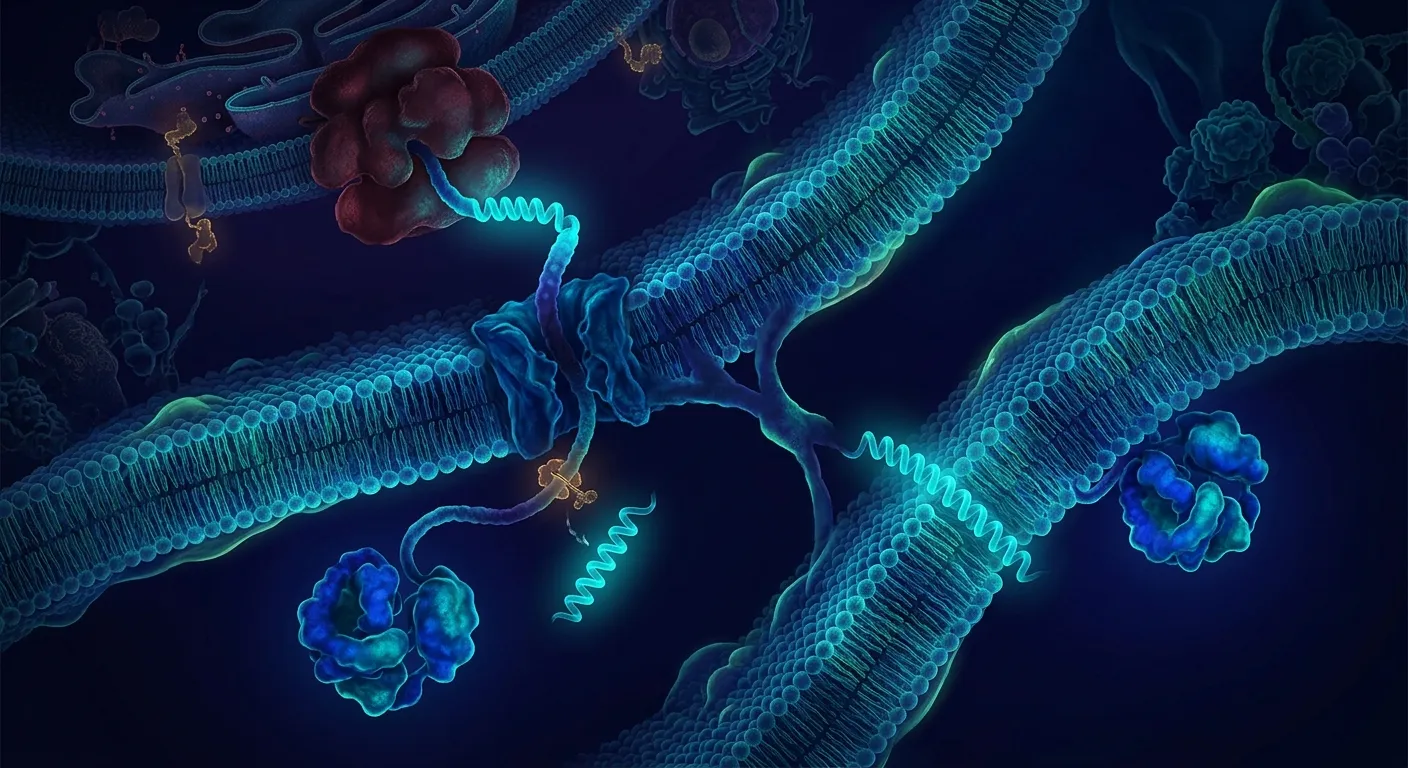
Ion channels are among the most consequential — and most treacherous — protein classes in drug discovery. They are validated targets across pain, epilepsy, arrhythmia, and inflammation; and one of them, the cardiac potassium channel hERG, is the most prominent anti-target in small-molecule development: off-target hERG block prolongs the QT interval and has pulled approved drugs from the market.
They are also hard to characterize computationally — pore-forming bundles with selectivity filters and voltage-sensor domains, transmembrane topologies ranging from single-pass auxiliary subunits to 24-transmembrane voltage-gated giants, and drug-binding sites buried in the conduction pathway rather than in a tidy orthosteric pocket. So the practical question is the usual one, with a safety edge: can AI say something about my channel — or my hERG liability — that I can trust?
To answer it, we ran the entire Astra AI Suite across 2,700 reviewed ion channels from UniProt Swiss-Prot and scored every output against established public experimental references. This volume reports five prediction areas — and is candid about the one we left out. The full per-model breakdown is the Ion Channels volume of the Orbion Model Performance Series, linked at the end.
Key Takeaways
-
2,700 ion channels, scored across five prediction areas.
-
Topology and family are strong: per-residue topology at AUROC 0.97 (F1 0.87); 84.6% correctly called multi-pass; 95.9% non-enzyme; GO function in the top-5 for 95.6%.
-
Binding-pocket prediction splits cleanly by biology — and the split is the point: on ligand-gated channels (discrete pockets) the model localizes the pocket; on voltage-gated channels, including the hERG safety case, it recovers the ligand identity but the pore-block site is structurally diffuse — read it as a ligand hypothesis set, not a contact map.
-
PTM sites: F1 up to 0.90 for disulfide bonds and 0.88 for N-glycosylation; phosphorylation is weak (0.45).
-
No thermostability volume: experimentally measured thermal shifts for intact channels don't exist, so we don't report a ΔTm number we can't validate.
The Benchmark
-
Cohort. 2,700 reviewed (Swiss-Prot) ion-channel proteins.
-
References. Swiss-Prot annotation for sequence-level features; PDB co-crystal contacts at 4 Å for ligand binding; Gene Ontology (with ancestor-closure matching) for function.
-
Reporting. Each capability is shown with its headline metric and its failure modes. This volume covers five models — thermostability is not included (see below).
Topology and Function: AUROC 0.97
The structural and functional calls are strong and broadly uniform.
-
Topology. Per-residue prediction agrees with UniProt-annotated transmembrane segments at AUROC 0.97, AUPRC 0.91, F1 0.87 (n=307); the disorder model reaches AUROC 0.89. 84.6% of the cohort is correctly classified as multi-pass membrane — the remainder are genuinely single-pass auxiliary subunits or soluble Ca²⁺-sensors, reflecting real topological diversity.
-
Function. 95.9% are correctly called non-enzyme; the GO molecular-function term is recovered in the top-5 for 95.6% of channels.
PTM Sites: Up to 0.90
On the strongest classes, PTM-site prediction reaches F1 up to 0.90 for disulfide bonds and 0.88 for N-linked glycosylation, across all 39 modification classes at two operating points. Phosphorylation is the weak spot here (0.45) — flagged plainly rather than buried.
Binding Pockets: A Clean Biological Split
This is the headline result, and it is a split rather than a single number. The aggregate — 56% ligand-identity recall and 56% pocket-success on the 181 channels with co-crystal data — masks a divide that matters more than the average:
-
On ligand-gated channels, which have discrete orthosteric pockets, the model localizes the pocket well.
-
On voltage-gated channels — including the hERG safety case — it recovers the ligand identity, but the pore-block site is structurally diffuse, lining the conduction pathway rather than sitting in a tidy pocket. There, the output should be read as a ligand hypothesis set, not a residue-level contact map.
This is pocket-level triage, not atomic-contact prediction — and knowing which regime you're in is the actionable part.
Why There's No Thermostability Volume
The other three volumes in this series report a thermostability (ΔTm) benchmark. This one does not — on purpose. Experimentally measured thermal shifts for intact ion channels were not available; the one channel with such data (CFTR) is measured on an isolated soluble domain, not the assembled channel. Rather than report a ΔTm number we couldn't validate against real experimental data, we left it out. The boundary of what we'll claim is set by the data, not the model.
Where It's Uneven
Classification and topology are strong but run a little lower than for the receptor classes — because the ion-channel set genuinely contains enzymatic proteins (CFTR has ATPase activity) and ligand-gated channels that are equally validly called receptors. And the binding-pocket result tracks the ligand-gated vs voltage-gated split above.
One Channel, End-to-End: hERG
The whitepaper walks the whole suite through a single target — the cardiac potassium channel hERG (KCNH2, UniProt Q12809) — to show what a program team does with the integrated output:
-
Resolve the channel's topology and domain architecture.
-
Flag the modification sites relevant to trafficking and surface expression.
-
Triage the pore-block / drug-binding region as a ligand hypothesis set.
-
Interpret channelopathy variants in the context of the predicted structure.
For hERG specifically, the value is safety triage — getting an early, structured read on a liability that can end a program late.
Why This Matters for Ion-Channel Programs
Ion channels carry both enormous therapeutic potential and a uniquely sharp safety profile. A correct read of a channel's topology, modification sites, and — crucially — which pocket-prediction regime applies is the difference between a confident campaign and a late, expensive surprise.
Read the Full Benchmark
The Ion Channels volume reports every model's headline performance, its failure modes, and the per-family breakdown behind the ligand-gated vs voltage-gated split.
→ Read the full Ion Channels benchmark: https://www.orbion.life/research/ion-channel-performance
Part of the Orbion Model Performance Series — alongside GPCRs, Transporters, and Enzymes.
References & Sources
-
Sanguinetti, M. C. & Tristani-Firouzi, M. hERG potassium channels and cardiac arrhythmia. Nature 440:463–469 (2006). doi:10.1038/nature04710 — hERG block and QT prolongation.
-
The UniProt Consortium. UniProt: the Universal Protein Knowledgebase in 2023. Nucleic Acids Research 51(D1):D523–D531 (2023). doi:10.1093/nar/gkac1052 — Swiss-Prot reference annotations.
-
Burley, S. K. et al. RCSB Protein Data Bank. Nucleic Acids Research 47(D1):D464–D474 (2019). doi:10.1093/nar/gky1004 — co-crystal ligand-contact references.
-
Ashburner, M. et al. Gene Ontology: tool for the unification of biology. Nature Genetics 25:25–29 (2000). doi:10.1038/75556 — functional reference (with QuickGO, Binns et al. 2009).
-
Full per-model methodology and metrics: Orbion, Astra AI on Ion Channels — Model Performance Series (2026) — https://www.orbion.life/research/ion-channel-performance