You purified a beautiful sample. SEC shows a single monodisperse peak. Negative stain looks textbook. So you book the microscope, prepare five grids—Quantifoil R 1.2/1.3, Quantifoil R 2/2, UltrAuFoil, continuous carbon, and graphene oxide—and apply the same sample to each. Twelve hours later, you have one grid with broken particles in too-thin ice, one with empty holes, one with aggregated junk on the support, one with preferred orientation pinning every particle face-on, and—if you're lucky—one usable square that yields a 3.4 Å reconstruction.
Welcome to cryo-EM grid optimization: the most underestimated bottleneck in single-particle analysis, where the same sample on the same microscope can give you a Nature paper or a hard drive full of garbage depending on what you spread it onto.
Key Takeaways
-
Grid choice is sample-specific, not a default; the "best" support depends on your particle's surface chemistry, size, and behavior at the air-water interface
-
The air-water interface is the enemy: most particles denature there, and your support choice largely determines how much exposure they get
-
UltrAuFoil reduces beam-induced motion dramatically over standard holey carbon, especially in the first few electron-dose fractions where high-resolution information lives
-
Graphene oxide rescues low-concentration samples (< 0.1 mg/mL) by adsorbing particles onto the support, but introduces preferred-orientation risk
-
Plasma treatment is not optional: the chemistry of glow discharge (Ar/O2 vs amylamine vs H2/O2) changes the surface hydrophilicity and dictates particle distribution
Grid Anatomy: What You're Actually Buying
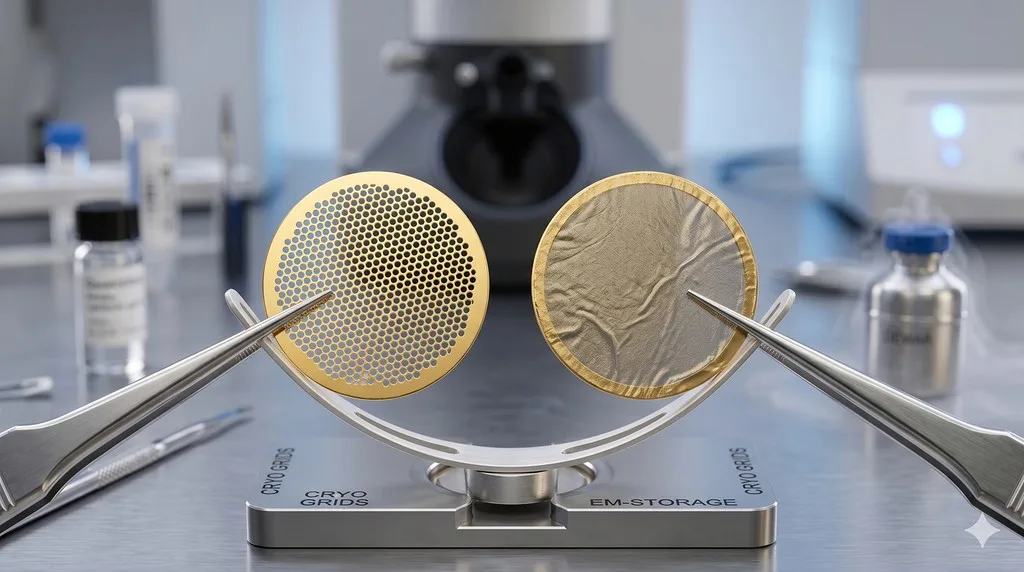
Before choosing a grid, understand what it physically is. A cryo-EM grid is a stack of three components, each with independent variables:
1. The Mesh
A thin metal disc, typically 3 mm in diameter, with a regular array of holes ("squares"). The mesh provides mechanical support.
Common mesh materials:
-
Copper: Cheap, conductive, slightly reactive (can oxidize at the edges). Standard for most samples.
-
Gold: Inert, biocompatible, dimensionally stable under electron beam. Recommended for samples sensitive to copper ions, and essential for the UltrAuFoil concept.
-
Molybdenum: Matches the thermal expansion coefficient of vitreous ice, reducing thermally-induced motion. Used in specialized workflows.
-
Nickel: Magnetic—generally avoided in modern cryo-EM because it interacts with the lens field.
Mesh size is given in lines-per-inch:
-
200 mesh: Larger squares (~125 μm), more particles per square, but more fragile film
-
300 mesh: Standard for most applications (~80 μm squares)
-
400 mesh: Smaller squares (~60 μm), more rigid film, more grid bars in the way
2. The Support Film
A thin film stretched across the mesh, into which holes are patterned (for "holey" grids) or which acts as the imaging surface (for "continuous" grids). This is where your sample actually sits.
Materials:
-
Amorphous carbon (~12-20 nm thick)
-
Gold (UltrAuFoil)
-
Silicon nitride
-
Graphene, graphene oxide
-
Polymer films (rare, mostly legacy)
3. The Hole Geometry
For holey supports, the pattern of holes is specified as R X/Y, where X is the hole diameter (μm) and Y is the spacing between holes (μm).
Common patterns:
-
R 1.2/1.3: 1.2 μm holes spaced 1.3 μm apart. The workhorse pattern. Small holes mean thin ice and many particles per micrograph.
-
R 2/2: 2 μm holes spaced 2 μm apart. Larger holes good for big complexes and ribosomes.
-
R 2/4: 2 μm holes spaced 4 μm apart. More carbon support area between holes—useful for orientation bias studies and when you want a clear reference for autofocus.
-
R 0.6/1: Very small holes. Rarely used; ice can vary unpredictably.
Standard Quantifoil Holey Carbon
Quantifoil grids—amorphous carbon film with regularly patterned holes on a copper mesh—are the default starting point. If you've never worked with cryo-EM, you've probably been told to start here.
Why Quantifoil Works
-
Predictable hydrophilicity after standard glow discharge
-
Hole geometry is regular (photolithography-defined), so ice thickness across a square is uniform-ish
-
Cheap: ~€8-12 per grid, manageable for screening
-
Compatible with every protocol you'll find published
When to Use Each Quantifoil Variant
| Sample type | Recommended pattern | Rationale |
|---|---|---|
| Small particles (50-200 kDa) | R 1.2/1.3 | Thin ice maximizes contrast |
| Standard targets (200 kDa - 1 MDa) | R 1.2/1.3 or R 2/2 | Either works; R 2/2 if you need more particles/hole |
| Large complexes (> 1 MDa, ribosomes) | R 2/2 or R 2/4 | Bigger holes accommodate bigger particles without edge effects |
| Very small particles (< 80 kDa) | R 1.2/1.3 + GO overlay | Carbon film alone usually insufficient |
| Filaments | R 2/2 | Long objects need room to lie flat |
Limitations of Standard Carbon
Quantifoil is a baseline, not a solution. Three problems show up repeatedly:
-
Beam-induced motion: The carbon film flexes under the electron beam, smearing high-resolution information across the first 2-4 e⁻/Ų of exposure. This is the "doming" phenomenon described by Brilot, Glaeser, and others—the film bows in response to localized heating and charging, and the particles ride along with it.
-
Charging: Carbon is a semiconductor at best. Under prolonged exposure, it accumulates electrostatic charge that produces beam-induced specimen drift and astigmatism artifacts in the recorded images.
-
The air-water interface: Most particles in a Quantifoil hole adsorb to the air-water interface during the millisecond between blotting and plunging, often with severe consequences for structural integrity. Noble and colleagues showed that for many targets, 80-100% of particles contact at least one of the two air-water interfaces in a thin-film hole, often leading to partial unfolding, preferred orientation, or both (Noble et al., Nat Methods 2018).
These motivate every other grid type discussed below. If your sample works well on Quantifoil, count yourself fortunate—and stick with it. Most do not.
A Note on Manufacturing Variation
Even within a single SKU, Quantifoil grids vary. Different lots have slightly different hole sizes, carbon thicknesses, and contamination profiles. When you find a lot that works for your sample, buy enough for the project. When troubleshooting unexpectedly bad grids, the manufacturing lot is often the unidentified variable.
UltrAuFoil: Gold Support and the Russo-Passmore Solution
In 2014, Russo and Passmore at the MRC LMB demonstrated that replacing the carbon support with an all-gold support film produced a dramatic reduction in beam-induced motion (Russo & Passmore, Science 2014). The motion in the first 4 e⁻/Ų—where the highest-resolution information is preserved before radiation damage destroys it—dropped by more than an order of magnitude.
Why Gold Works
Three mechanisms:
-
Mechanical rigidity: The gold film is dimensionally more stable under thermal and beam-induced stress than amorphous carbon
-
Thermal expansion matching: Gold's expansion coefficient is closer to vitreous ice than carbon's, so cooling-induced strain is reduced
-
Charge dissipation: Gold is metallic; charges don't accumulate the way they do on insulating carbon
UltrAuFoil in Practice
When to use:
-
High-resolution targets where you want every Å of resolution
-
Samples that have been "stuck" at 3-4 Å despite good particle quality
-
Beam-sensitive specimens (membrane proteins in nanodiscs, lipid-rich complexes)
-
Any project where motion correction is leaving residual blur
When NOT to use:
-
Initial screening (cost is ~3-4× Quantifoil)
-
Samples that haven't been optimized for ice thickness/concentration yet
-
When you have so little sample that you need to maximize partial successes (gold grids fail more dramatically when they fail)
Gotcha: UltrAuFoil grids glow discharge differently than carbon. The gold surface is more hydrophobic out of the box, and reaches optimal hydrophilicity faster but degrades faster after treatment. Use within 30-60 minutes of glow discharge, not the 2-4 hours you might get away with on carbon.
Another gotcha: UltrAuFoil grids are mechanically more fragile to handle than Quantifoil despite being more rigid optically. The gold film is brittle in the way that thin metal films are—bend it sharply and you crack the film. Tweezer scratches are catastrophic. Train your hands on cheap Quantifoils before burning UltrAuFoils.
Resolution Gains, Quantified
The Russo & Passmore data, replicated by many groups since, show that for typical protein samples:
-
Motion in the first 4 e⁻/Ų drops from ~3-10 Å on Quantifoil to < 1 Å on UltrAuFoil
-
Achievable resolution often improves by 0.3-0.7 Å for the same sample
-
High-resolution shells (beyond Nyquist/2) gain disproportionately
For a sample stuck at 3.4 Å on Quantifoil, moving to UltrAuFoil with otherwise identical conditions commonly produces 2.9-3.1 Å. For a sample at 5 Å, you're more likely sample-limited than support-limited, and switching grids won't help as much.
Continuous Carbon: When the Holes Don't Help
A continuous carbon film covers the entire square—no holes. The sample is applied directly onto carbon, which becomes the imaging surface.
When You Need Continuous Carbon
Low concentration samples (< 0.1 mg/mL): With holey grids, your particles need to be at sufficient concentration to populate the thin ice in the holes. Below ~0.5 μM, you simply don't have enough particles per hole for efficient data collection. Continuous carbon concentrates particles by adsorption.
Preferred-orientation problems (counterintuitively): Sometimes a continuous carbon layer randomizes orientations, because the particle adsorbs to the carbon rather than the air-water interface, and the carbon may impose a different (or no) orientation preference.
Filaments and tubes: Long objects need a substrate to lie flat against. Holes are too small.
Negative stain transitions: When moving from negative stain to cryo, continuous carbon offers continuity in your imaging conditions.
The Cost of Continuous Carbon
-
Reduced contrast: The carbon film adds to the inelastic mean free path. A 10-15 nm continuous carbon film visibly reduces SNR
-
Higher minimum thickness: Combined ice + carbon thickness is at least 15-20 nm
-
Background noise: The carbon film has its own structure that contributes to the background
For modern high-resolution work, continuous carbon is usually a step on the way to a better support (graphene oxide, often), not a destination.
Graphene Oxide: The Surface Chemistry Revolution
Graphene oxide (GO) is a single-atom-thick sheet of graphene functionalized with oxygen-containing groups (hydroxyl, epoxide, carboxyl) that make it hydrophilic. When deposited as a monolayer over a holey grid (typically Quantifoil R 1.2/1.3), it provides an ultra-thin, conducting support that lies across the holes (Pantelic et al., JSB 2014).
What Graphene Oxide Solves
Air-water interface protection: This is the single biggest reason to use GO. Particles adsorb to the GO surface rather than to the air-water interface, where they would otherwise spend the millisecond before vitrification getting denatured. For air-water-sensitive proteins, this can be the difference between particles and rubble.
Low concentration rescue: Particles concentrate on the GO surface. Samples that would never populate holey carbon at 50 nM can yield usable density on GO.
Higher contrast than continuous carbon: GO is ~1 nm thick, vs. ~15 nm for continuous carbon. Less inelastic scattering, more particles per useful area.
Reduced beam-induced motion: GO is rigid and conducting. It behaves more like UltrAuFoil than like Quantifoil in this regard.
The Downsides Nobody Talks About Enough
Preferred orientation amplification: Because particles bind GO via their most chemically complementary surface, GO supports often increase orientation bias compared to free particles in ice. If your particle has one charged face and one hydrophobic face, GO will pin it in one orientation.
Variable surface chemistry: GO is made by oxidizing graphite. Batch-to-batch variation in the density and distribution of oxygen-containing groups translates directly into variable surface behavior.
Coating is a craft: Producing reliable GO grids requires either commercial supply (variable QC across vendors) or a well-developed in-house protocol. Coverage holes, multilayers, and contamination are common.
Charging effects at high doses: Despite being conducting, GO can still develop local charging artifacts in long exposures.
When GO Is The Answer
-
Low-concentration samples
-
Air-water-interface-sensitive samples (most membrane proteins, many transcription factors)
-
Targets where you've screened Quantifoil + UltrAuFoil and orientation is still random enough
-
Small particles (< 100 kDa) where every bit of contrast matters
When GO Will Hurt You
-
Targets with severe inherent preferred orientation (GO often makes it worse)
-
High-concentration samples that work fine on Quantifoil (you're adding a variable for no gain)
-
Time-sensitive screening (GO grids require careful prep and aging effects matter)
Practical GO Preparation Notes
If you're making your own GO grids rather than buying them, the variables that matter most:
-
GO concentration: 0.1-0.4 mg/mL aqueous suspension. Higher concentrations give multilayers; lower gives partial coverage.
-
Application volume: 3-4 μL applied to a freshly glow-discharged Quantifoil grid is standard.
-
Sonication: Brief bath sonication (30-60 s) before application breaks up GO flake aggregates.
-
Aging: Newly-prepared GO grids often have residual contamination. Many groups age them overnight in a vacuum desiccator before use.
-
Sub-monolayer vs full coverage: Some workflows deliberately under-coat to create both supported (GO-covered) and unsupported (open hole) regions on the same grid for direct comparison (Naydenova et al., PNAS 2019).
Commercial GO grids from various vendors are improving in QC but still vary; buy a small batch first, validate, then scale.
Functionalized Supports: Engineered Surface Chemistry
Beyond passive supports, several engineered surfaces target specific samples:
Streptavidin-Affinity Grids
A 2D crystalline streptavidin lattice on a lipid monolayer, capable of binding biotinylated samples through their tagged surface. Pioneered by Crowther and colleagues and developed further by Han, Walz, and others (Han et al., JSB 2012).
Use case: When you have a biotinylated bait protein and want to tether it specifically. Particularly useful for capturing transient or weak complexes by anchoring one partner. Also avoids the air-water interface by binding particles to the substrate.
Constraints: Requires biotinylation, the streptavidin lattice produces strong background features that must be subtracted, and the crystalline support contributes its own diffraction.
Nickel-NTA Lipid Grids
A lipid monolayer with Ni-NTA head groups that bind His-tagged proteins. Allows specific affinity capture of any His-tagged target without modifying the protein.
Use case: Targets where surface-exposed His tags are tolerable, low-concentration samples, and avoidance of the air-water interface.
Constraints: Tag must be solvent-accessible, lipid monolayers are fragile, and the His-tag orientation can bias particle orientation.
Antibody-Functionalized and Aptamer Grids
A growing set of approaches use surface-immobilized antibodies, nanobodies, or aptamers to capture untagged targets directly. These are still in the "for specialized labs" category, but they're the right answer when nothing else is working and you have a high-affinity, well-characterized binder for your target.
Glow Discharge and Plasma Cleaning: The Underrated Variable
The surface chemistry of a freshly-made grid is rarely useful as-is. Glow discharge—exposing the grid to a low-pressure plasma—modifies the surface to control hydrophilicity, remove contaminants, and tune particle distribution.
The Two Categories
Hydrophilic treatments (most common):
-
Air plasma: Standard, cheap, makes carbon negatively charged and hydrophilic. Default for almost everything.
-
Argon/oxygen plasma: Cleaner than air, more reproducible, gold-standard for high-resolution work
-
Hydrogen/oxygen plasma: Used in the Gatan Solarus and similar instruments; very clean and reproducible
Hydrophobic treatments (specialized):
-
Amylamine: Vapor-deposited amine groups make the surface hydrophobic and positively charged. Used historically for negative stain; in cryo-EM, occasionally used to flip orientation bias.
-
Chloroform: Older method, still sometimes useful for orientation manipulation.
A Plasma Treatment Matrix
| Plasma | Surface charge | Hydrophilicity | Best for | Cautions |
|---|---|---|---|---|
| Air, 15 mA, 30 s | Negative | High | Default for Quantifoil | Variable across instruments |
| Ar/O2, 25 W, 60 s | Negative | High, clean | UltrAuFoil, high-res work | Requires gas-mix glow discharger |
| H2/O2 (Solarus) | Negative | High, very clean | Reproducibility | Expensive instrument |
| Air, 30 s + amylamine | Positive | Moderate | Flipping orientation | Toxic, less reproducible |
| Air, 15 mA, 10 s | Negative (mild) | Moderate | Reducing adsorption | For very sticky samples |
Practical Rules
-
Time-limit your treatment: Hydrophilicity decays over minutes-to-hours after glow discharge. Use within the window your protocol specifies (30 min - 2 hr is typical).
-
Be consistent: Power, time, gas, pressure all matter. Document them.
-
Glow discharge polarity matters: Most instruments produce a negative grid surface. Flipping polarity (positive surface) using an amine treatment is one of the few reliable ways to address orientation bias.
-
For UltrAuFoil, treat shorter: Gold reaches optimal hydrophilicity faster than carbon. Standard carbon protocols can over-treat gold.
Sample-Specific Optimization: The Variables You Actually Tune
Even with the right grid and the right glow discharge, four variables decide whether you get usable ice:
Ice Thickness Control
Ice thickness is the single biggest determinant of usable data. Too thick and contrast collapses; too thin and particles are excluded, denatured, or partially embedded.
Target thickness:
-
~20-40 nm for small particles
-
~40-60 nm for medium particles
-
~60-100 nm for large complexes
-
~100-200 nm for very large assemblies (ribosomes, viruses)
How to control it:
-
Blot time (1-6 seconds typically)
-
Blot force (Vitrobot setting, ranges -25 to +25 in arbitrary units)
-
Wait time before blot (lets sample equilibrate)
-
Drain time after blot (additional thinning)
-
Humidity (95-100% to prevent evaporation)
-
Temperature (4-22 °C; lower preserves sample but increases viscosity)
Sample Concentration
The right concentration depends on grid choice:
-
Quantifoil holes: 0.5-2 mg/mL for most particles
-
UltrAuFoil: similar to Quantifoil
-
Continuous carbon: 0.05-0.5 mg/mL
-
Graphene oxide: 0.05-0.5 mg/mL
If your concentration is fixed and lower than ideal for holey grids, switch supports rather than concentrate (which can drive aggregation).
Buffer Composition
-
Salt: Higher salt (> 300 mM) often degrades contrast and can cause crystallization artifacts. Use as little as your protein tolerates.
-
Detergent: Above CMC, detergent micelles populate the holes and degrade contrast. Mild detergents (DDM, LMNG) at near-CMC concentrations are usually tolerable.
-
Glycerol: A common stabilizer in purification—but a contrast killer in cryo-EM. Exchange to glycerol-free buffer before grid prep if possible.
-
Reducing agents: TCEP > DTT for cryo-EM; volatility differs.
Blotting and Plunging
The Vitrobot and similar instruments expose multiple variables. The under-discussed ones:
-
Pre-blot wait: How long the sample sits on the grid before blotting. Longer waits mean more particle adsorption to the support (potentially good for GO, potentially bad for Quantifoil)
-
Blot offset: Asymmetric blotting (one paper, not two) can produce gradient ice with both thin and thick regions on one grid
-
Plunge speed: Faster plunge = more vitrification, less hexagonal ice; modern instruments handle this automatically
Grid Type Comparison: The Decision Table
| Grid type | Cost (€/grid) | Best for | Typical particle size | Success rate (good prep) | Common failure modes |
|---|---|---|---|---|---|
| Quantifoil R 1.2/1.3 | 8-12 | Default; standard targets | 100 kDa - 1 MDa | 60-70% | Air-water interface damage, beam motion |
| Quantifoil R 2/2 | 8-12 | Large complexes, ribosomes | > 500 kDa | 50-65% | Variable ice thickness across hole |
| Quantifoil R 2/4 | 8-12 | Orientation studies | > 500 kDa | 40-60% | Fewer particles per micrograph |
| UltrAuFoil 1.2/1.3 | 30-45 | High-resolution work, motion-sensitive | 100 kDa - 1 MDa | 65-80% | Hydrophilicity decay, more brittle |
| Continuous carbon | 10-15 | Low concentration, filaments | Any | 50-65% | Low contrast, high background |
| Graphene oxide on Quantifoil | 25-40 | Air-water-sensitive, low conc | 50 kDa - 1 MDa | 50-75% | Preferred orientation, variable coverage |
| Streptavidin affinity | 50-80 | Biotinylated, transient complexes | 200 kDa - 5 MDa | 40-60% | Lattice background, requires biotinylation |
| Ni-NTA lipid | 60-100 | His-tagged, low concentration | Any tagged | 30-50% | Tag must be exposed, fragile film |
Success rates assume you've optimized concentration, buffer, and plasma treatment. First-time grids on any support type typically achieve 10-30% of this rate.
Optimization Workflow: The Practical Sequence
For an unknown sample, a sensible escalation:
-
Screen 1: Quantifoil R 1.2/1.3, copper, air plasma, default blot. Three grids, three blot conditions. Goal: any particles visible.
-
Screen 2: If particles visible but degraded: switch to UltrAuFoil and/or GO. If preferred orientation: try R 2/2 or amylamine.
-
Screen 3: Optimize the winning support with finer-grained variation in blot time, concentration, and plasma duration.
-
Production: Use the optimized condition for a full data collection.
Skipping steps is tempting—and usually costs more in microscope time than it saves in screening. A typical reasonable budget is 5-10 grids of optimization for any new project before committing microscope hours.
Interpreting Screening Results
A few patterns to recognize:
-
Empty holes everywhere: Either concentration is too low, or particles are sticking to the carbon support film rather than entering the holes. Try increasing concentration 2-5× or extending pre-blot wait time.
-
Particles only on the carbon, not in the holes: Surface chemistry mismatch. Re-glow-discharge, try shorter blot times, or switch to a support where the particles want to be (GO often rescues this).
-
Particles in holes but only on the support boundary: Carbon edge effects. Particles are accumulating at the meniscus during blotting. Try longer blot times or different blot force.
-
Particles in holes but only in one orientation: Air-water interface adsorption with orientation preference. Try GO, affinity grids, tilted data collection, or surfactants.
-
Beautiful particles but broken: Air-water interface denaturation. Move to GO or affinity capture.
-
Ice too thick at edges, too thin at center: Asymmetric blotting or grid bend. Replace tweezers, re-tension blotting paper, or try single-sided blot.
-
Variable ice thickness across grid squares: Mesh issue, possibly grid bend during glow discharge. Discard the lot or be more careful with handling.
How Many Grids Per Microscope Session?
A practical rule for screening:
-
Screening session (200 kV cryo-TEM or autoloader screening): 6-12 grids in a half-day
-
Optimization session: 3-6 grids in a half-day, each with multiple squares assessed
-
Production data collection: One grid per microscope day, ideally with backup grids loaded
Microscope time is expensive; grid prep is cheap. Always prepare more grids than you think you need.
The Bottom Line
| Sample challenge | First-line grid | If that fails |
|---|---|---|
| Standard well-behaved target | Quantifoil R 1.2/1.3 | UltrAuFoil for resolution |
| Small particle (< 100 kDa) | Quantifoil R 1.2/1.3 | Graphene oxide |
| Large complex (> 1 MDa) | Quantifoil R 2/2 | UltrAuFoil R 2/2 |
| Low concentration (< 0.1 mg/mL) | Graphene oxide | Continuous carbon or affinity grid |
| Membrane protein in detergent | UltrAuFoil 1.2/1.3 | Graphene oxide |
| Membrane protein in nanodisc | UltrAuFoil 1.2/1.3 | Quantifoil with reduced blot |
| Severe preferred orientation | Tilt + amylamine GD | Affinity grid (streptavidin/NTA) |
| Particles destroyed at A-W interface | Graphene oxide | Affinity grid |
| Filamentous sample | Quantifoil R 2/2 or continuous carbon | Variable ice protocol |
| Transient/weak complex | Streptavidin affinity grid | GraFix + Quantifoil |
| Pushing resolution past 3 Å | UltrAuFoil | Optimized GO on UltrAuFoil |
The general principle: start with the cheapest support that has any chance of working, escalate to engineered supports when you have a defined problem to solve. Never use UltrAuFoil or affinity grids for initial screening unless you already know exactly why you need them.
Where Computational Tools Fit Into Grid Optimization
Most grid optimization is empirical, and that won't change. But the prior you start with—your expectation of how a particle will behave on a support—is informed by what you can infer about its surface chemistry before you ever touch a grid. This is where structural prediction can save you screening time.
Orbion's AstraUNFOLD module characterizes surface properties—hydrophobicity patches, charge distribution, predicted disorder—across the protein's accessible surface. A particle with a single large hydrophobic patch will dock to graphene oxide in a near-deterministic orientation and is a candidate for orientation problems on GO before you ever spread one. A predicted-disordered terminal region of 60+ residues will denature at the air-water interface regardless of grid choice, telling you to start with GO or an affinity grid from grid #1. AstraBIND identifies surface binding sites that may interact with the support itself, and the Bench module generates plasma treatment, blotting, and buffer protocols based on the predicted surface signature. None of this replaces empirical screening—but it tells you where to start rather than burning a microscope session figuring out that your sample has a hydrophobic face that pins it on carbon. For new targets, that bias toward the right starting condition often shortens optimization from weeks to days.
References
-
Russo CJ & Passmore LA. (2014). Ultrastable gold substrates for electron cryomicroscopy. Science, 346(6215):1377-1380. DOI: 10.1126/science.1259530
-
Pantelic RS, Suk JW, Magnuson CW, Meyer JC, Wachsmuth P, Kaiser U, Ruoff RS, Stahlberg H. (2011). Graphene: substrate preparation and introduction. Journal of Structural Biology, 174(1):234-238. PMC3119378
-
Naydenova K, Peet MJ, Russo CJ. (2019). Multifunctional graphene supports for electron cryomicroscopy. PNAS, 116(24):11718-11724. PMC6575141
-
Han BG, Walton RW, Song A, Hwu P, Stubbs MT, Yannone SM, Arbeláez P, Dong M, Glaeser RM. (2012). Electron microscopy of biotinylated protein complexes bound to streptavidin monolayer crystals. Journal of Structural Biology, 180(1):249-253. DOI: 10.1016/j.jsb.2012.04.025
-
Passmore LA & Russo CJ. (2016). Specimen preparation for high-resolution cryo-EM. Methods in Enzymology, 579:51-86. DOI: 10.1016/bs.mie.2016.04.011
-
Noble AJ, Wei H, Dandey VP, Zhang Z, Tan YZ, Potter CS, Carragher B. (2018). Reducing effects of particle adsorption to the air-water interface in cryo-EM. Nature Methods, 15(10):793-795. PMC6168395