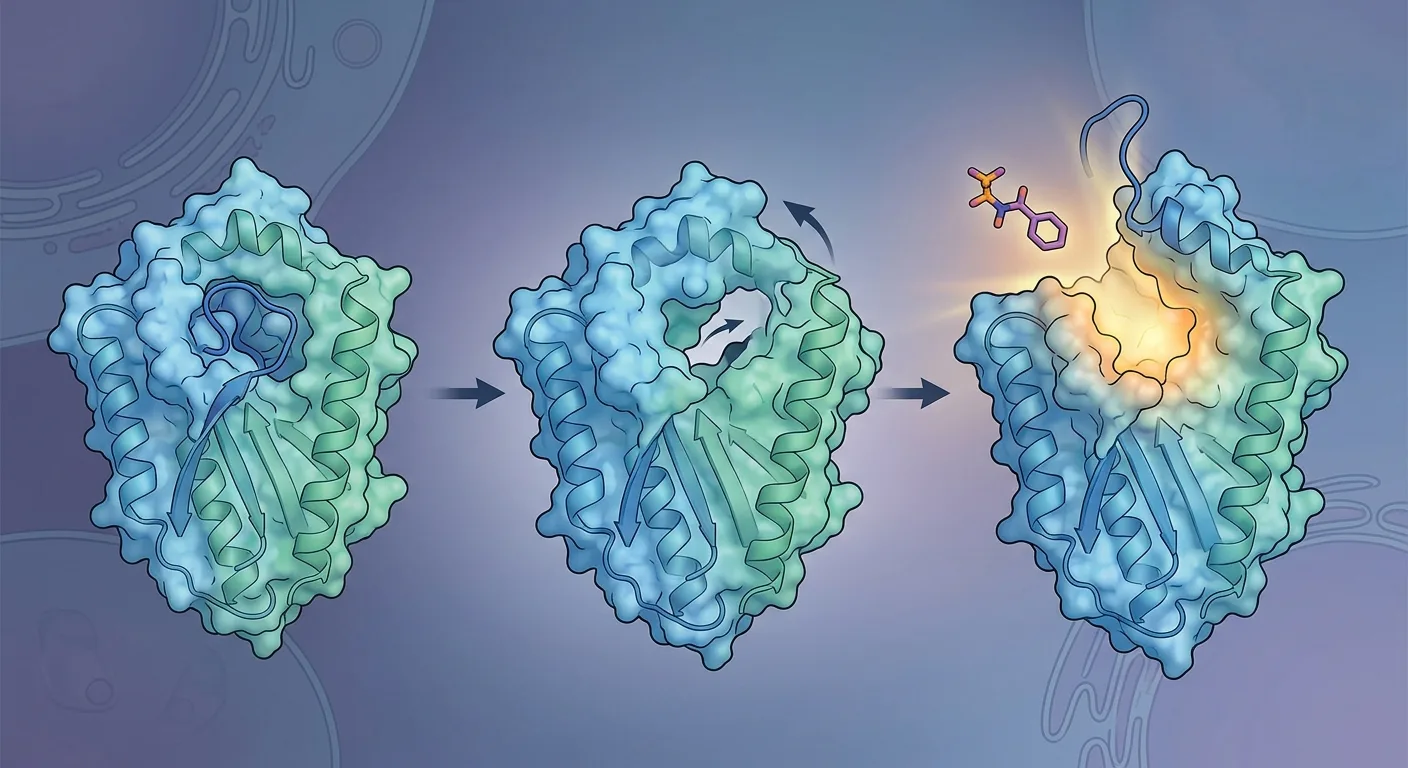
You have purified protein at 20 mg/mL. It is monodisperse by SEC-MALS, runs as a single band on SDS-PAGE, and shows clean Tm transitions by DSF. You have screened 1,536 conditions across five commercial sparse matrices, run additives, varied temperature, tried seeding, and used three protein constructs. Nothing. Not a single ordered crystal—only clear drops, precipitate, and the occasional spherulite. The protein refuses to crystallize, and your beamtime allocation is running out.
This is one of the most demoralizing scenarios in structural biology, and it is often not a problem of conditions. It is a problem of the protein surface. Surface entropy reduction (SER) mutagenesis is the most systematic way to address it.
Key Takeaways
-
Long flexible side chains poison crystal contacts: Lysine and glutamate carry high conformational entropy that resists immobilization in a lattice
-
SER targets clustered Lys/Glu/Gln patches: Mutating two or three adjacent high-entropy residues to alanine (or tyrosine/threonine) creates a low-entropy patch where crystal contacts can form
-
The Goldschmidt SERp server ranks candidate clusters using sequence, predicted secondary structure, and conservation
-
AstraDDG stability checks are non-negotiable: A "successful" SER mutant that destabilizes the fold by more than 2 kcal/mol will aggregate before it crystallizes
-
Reported success rates of 30–50%: SER is one of the highest-yield rational interventions when sparse-matrix screening has failed, and it is dramatically faster than waiting for serendipity
Why Surfaces Block Crystallization
Crystals Are Lattices of Ordered Contacts
A protein crystal is a periodic arrangement of molecules held together by a small number of intermolecular contacts—typically 4–8 per monomer, covering 1,000–3,000 Ų of total interface. These contacts are weak: a few hydrogen bonds, a salt bridge or two, and modest hydrophobic surface burial. Compared to a biological interface, a crystal contact is fragile and entropically expensive.
The thermodynamics of crystallization are well-described by Vekilov (2010): the free energy of crystallization is dominated by the loss of translational and rotational entropy of the protein, plus the configurational entropy lost by surface side chains as they are pinned into specific rotamers. The enthalpic gain from a handful of weak contacts must offset all of that entropic cost.
The Lysine Problem
Lysine side chains have four rotatable bonds (Cα–Cβ–Cγ–Cδ–Cε–Nζ) and a positively charged terminal amine that prefers maximum solvent exposure. In solution, a surface lysine samples a vast configurational ensemble. To form a crystal contact, that ensemble must collapse into a single (or small number) of rotamers. Derewenda (2004) estimated the entropic cost per immobilized lysine at roughly 2 kcal/mol at room temperature—a cost that the few weak crystal contacts can rarely overcome.
Glutamate behaves similarly: three rotatable bonds, a negatively charged terminus, and a preference for high solvent exposure. Glutamine, while uncharged, is also long and flexible, and its amide group is often poorly satisfied at the surface.
What This Looks Like in Practice
Proteins that resist crystallization tend to share a surface signature:
-
High lysine + glutamate content (>20% of surface residues combined)
-
Surface lysine/glutamate clusters (3+ adjacent residues on the same secondary structure element)
-
Few exposed aromatics or aliphatics (which would otherwise serve as nucleation patches)
-
High mean B-factors at the surface in any partial structures
These proteins are not unstable, misfolded, or aggregated. They are simply too floppy on the outside to hold a lattice together.
A Quick Test Before Investing in Conditions
Before running another 1,000 conditions, ask three questions of your protein:
-
What fraction of surface residues are Lys + Glu + Gln? If above 25%, you have a likely SER target.
-
Do these residues cluster? Use any prediction tool (AlphaFold or SERp's PSIPRED step) to identify helices and loops, then look for two or three high-entropy residues within 4–7 sequence positions of each other.
-
Are there exposed aromatics nearby? Crystallization is more likely when SER patches sit adjacent to existing hydrophobic patches that can also participate in lattice contacts.
If you answer "yes, yes, no" you have a textbook SER target. If you answer "no, no, yes," your problem is probably not surface entropy—look at termini, oligomeric state heterogeneity, or conformational flexibility.
The Goldschmidt SERp Framework
The first systematic, structure-blind approach to SER design was published by Goldschmidt, Cooper, Derewenda, and Eisenberg (2007) in Protein Science. Their SERp server (still hosted at services.mbi.ucla.edu) is the field standard.
How SERp Works
The algorithm takes a primary sequence (no structure required) and:
-
Predicts secondary structure with PSIPRED
-
Computes a per-residue entropy score that penalizes Lys, Glu, and Gln based on their position within predicted helices, sheets, and loops
-
Scans for clusters of high-entropy residues (typically 2–3 residues within a 5-residue window)
-
Checks conservation using a homology search to ensure proposed mutations are not in functionally critical positions
-
Ranks candidate mutation clusters by combined entropy reduction score
The output is a small set (typically 3–6) of candidate "patches"—triplets or doublets of residues to mutate, usually all to alanine.
Why Structure-Blind Design Works
Counterintuitively, you do not need a structure to design SER mutations. The Goldschmidt analysis showed that predicted secondary structure plus conservation is enough to identify good candidates, because:
-
The targeted residues are surface-exposed by definition (they are predicted to be on helix exteriors or in loops)
-
Helices on protein surfaces almost always have their Lys/Glu side chains pointing outward
-
The mutations are conservative in fold terms—alanine is well-tolerated on the outside of any secondary structure element
This is liberating: SER design works even when no homology model or AlphaFold prediction is available, and even for novel folds.
When a Structure (or AF2 Model) Helps
That said, having a high-confidence structural model materially improves SER design. With a structure you can:
-
Verify surface exposure quantitatively (rSASA per residue, computed with NACCESS, FreeSASA, or AlphaFold2 outputs)
-
Confirm 3D clustering (not just sequence adjacency)—two residues at i and i+4 on a helix may be on opposite faces if the helix is buried at one end
-
Measure distance from functional sites (cofactor pockets, active sites, allosteric loops)
-
Identify pre-existing crystal contacts if related family members have been crystallized, so you can preserve them while reducing entropy elsewhere
For most targets in 2026, AlphaFold2 provides a model good enough for SER analysis. The structure-blind SERp approach remains useful as an orthogonal check.
Which Residues to Target
The Entropy Hierarchy
Side-chain conformational entropy (in kcal/mol at 298 K, from Doig & Sternberg, 1995) ranks roughly as follows:
| Residue | Side-chain entropy (TΔS, kcal/mol) | Rotatable bonds | SER priority |
|---|---|---|---|
| Lys | ~2.0 | 4 | Highest |
| Arg | ~1.9 | 4 | High (but salt bridges common) |
| Glu | ~1.5 | 3 | Highest |
| Gln | ~1.6 | 3 | High |
| Met | ~1.4 | 3 | Moderate |
| Leu | ~0.8 | 2 | Low (often buried) |
| Asn | ~1.0 | 2 | Moderate |
| Asp | ~1.1 | 2 | Moderate (often functional) |
Lys, Glu, and Gln dominate SER campaigns because they combine high entropy with high surface preference and low conservation in most folds.
Position Rules
A residue is a strong SER candidate if it is:
-
Predicted surface-exposed (relative SASA > 30%)
-
In a predicted helix or loop (not a buried β-strand)
-
Non-conserved (Shannon entropy > 1.5 across a deep MSA, or appears in <30% of homologs)
-
Adjacent to another high-entropy residue (clustering enables triple/double mutants)
-
Distant from active sites, binding interfaces, and PTM sites (>10 Å in 3D, or excluded by curated functional annotation)
Clustering: The Single Most Important Rule
The empirical observation that has driven SER design since 2004 is this: single mutations rarely rescue crystallization, but clusters of 2–3 mutations frequently do. The reason is geometric—a single low-entropy patch on the surface is sufficient to nucleate a crystal contact, but a single mutation only creates a point, not a patch.
Cluster definitions vary across labs, but a working rule is:
-
Doublet: Two high-entropy residues within 4 residues of each other in sequence (likely on the same face of a helix)
-
Triplet: Three within 7 residues, with at least one at position i, i+3, or i+4 of a helix (same helix face)
-
Quartet: Rare; usually only attempted when triplets fail or when an exceptional cluster is present
Why Triplets Beat Singles
A useful mental model: imagine the protein surface as a sea of waving flexible side chains. A single mutation creates one calm point in a sea of turbulence—the surrounding flexibility still prevents a stable contact. A triplet creates a patch of calm large enough (typically 100–200 Ų of well-defined surface) for a symmetry mate to dock against. This patch geometry argument explains why empirically, doublets succeed ~20% of the time while triplets succeed ~35–40% of the time, even when controlling for total entropy reduced.
Mutation Choices: Beyond K→A and E→A
The default SER mutation is to alanine, which removes the high-entropy side chain entirely and leaves a small, well-behaved methyl group. But alanine is not always optimal.
Alanine: The Workhorse
-
Removes the entropic side chain completely
-
Tolerated almost anywhere on the surface
-
Stabilizing in helices (high helix propensity)
-
Slightly destabilizing in β-strands (low β-propensity)—use with caution on strand surfaces
Tyrosine: The Crystal Contact Maker
Tyrosine substitution (K→Y or E→Y) has been used successfully in cases where alanine alone produced new clears or precipitates. The rationale:
-
Aromatic ring provides hydrophobic surface for direct lattice contact
-
Hydroxyl can hydrogen-bond into the contact
-
The size match to lysine is reasonable
This was systematized by Cooper et al. (2007) in Acta Crystallographica D and has been particularly productive for proteins where the SER patch sits opposite a hydrophobic patch on a symmetry mate.
Threonine: The Subtle Choice
Threonine (K→T or E→T) is occasionally used when alanine destabilizes the protein. Threonine retains a hydroxyl group, which can:
-
Maintain some hydrogen bonding capacity
-
Provide modest hydrophilic character without high entropy
-
Avoid creating a hydrophobic "hole" on the surface
The Mutation Strategy Comparison
| Strategy | Typical Mutation | Best For | Risk |
|---|---|---|---|
| Default SER | K/E/Q → A | Helices, exposed loops | β-strand surfaces |
| Aromatic SER | K → Y | Proteins where K→A fails; need hydrophobic contact | May destabilize if buried |
| Conservative SER | K → T, E → T | Stability-sensitive proteins | Smaller entropy reduction |
| Charge reversal | K → E, E → K | When salt bridge pattern matters | High epistasis risk |
| Glycine SER | K → G | Loops only | Increases backbone entropy—usually counterproductive |
Stability and Function Controls
SER mutations are conservative, but they are not free. Before investing in crystallization screens with a SER mutant, every candidate should be assessed for fold and function preservation.
The Stability Triad
-
Predicted ΔΔG: AstraDDG (and tools like FoldX, Rosetta ddg_monomer, or DDGun) should report a ΔΔG within ±1.5 kcal/mol of wild-type. Triple mutants with cumulative ΔΔG > 2 kcal/mol are likely to misfold or aggregate.
-
Predicted ΔTm: A computed ΔTm of less than −5°C is a strong warning. Confirm experimentally with DSF or DSC before scaling up.
-
Circular dichroism: A 200–260 nm scan of the SER mutant should overlay almost exactly with wild-type. Any change in the helix/sheet ratio means the mutation has altered the fold.
Function Controls
For enzymes, antibodies, and any protein with a quantitative activity assay:
-
Measure kcat/Km or binding KD for the SER mutant before crystallization screening
-
Even small activity changes (>2-fold) suggest the SER patch is in or near a functional region—reconsider the mutation
-
Pull-down or co-IP for protein-protein interactions can rule out gross disruption
When Three Lines of Evidence Agree
The strongest SER candidate is one where:
-
Predicted ΔΔG is within ±1 kcal/mol
-
Tm by DSF is within ±2°C
-
Activity is within 80–120% of wild-type
-
CD spectrum overlays wild-type
-
SEC-MALS shows the same oligomeric state
A mutant that passes all of these and still does not crystallize is informative—it tells you the surface was not the problem, and other strategies (terminus trimming, chaperone co-crystallization) are warranted.
The Hidden Cost of Skipping Controls
A surprising number of failed SER campaigns can be traced to one mistake: the team made the mutant, set up crystallization screens immediately, saw heavy precipitate everywhere, and concluded "SER didn't work." In reality, the mutant had destabilized by 8°C and was aggregating before nucleation could occur. A 30-minute DSF run would have caught this. The economics here are unforgiving—a single failed screening campaign typically consumes more reagents and time than ten DSF runs.
Oligomeric State Surprises
SER mutations on a surface that happens to be a homo-oligomer interface can shift oligomeric state. The most common failure modes:
-
A dimer that becomes a monomer (lost interface salt bridges)
-
A monomer that becomes a dimer (lost charge repulsion that was keeping it apart)
-
A defined tetramer that becomes a polydisperse mess
Always run SEC-MALS or analytical SEC against wild-type. If oligomeric state shifts, the SER patch was on an interface—a different patch is needed.
Case Studies and Reported Success Rates
The Derewenda Group Compendium
The Derewenda group at Virginia has published the most comprehensive SER track record. Across Mateja et al. (2002), Czepas et al. (2004), and subsequent reviews, they report:
-
~40% of targets that failed sparse-matrix screening produced ordered crystals after SER mutagenesis
-
~25% of these crystals diffracted to better than 2.5 Å resolution on first screening
-
~15% additional targets crystallized after a second round of SER targeting different patches
Notable Successes
-
RhoGDI: Early SER triumph; a K→A triple mutant crystallized after the wild-type failed in thousands of conditions (Longenecker et al., 2001)
-
Numerous human Rab proteins: SER has become routine for the Rab family, where K-rich surfaces are common
-
Cyclin-dependent kinase substrates: Several CDK partners required SER to crystallize, even with their kinase bound
The Reported Success Rate Table
| Source | Targets attempted | Crystallized after SER | Diffracted to <3 Å | Rate |
|---|---|---|---|---|
| Goldschmidt et al. 2007 (SERp validation) | 26 | 9 | 6 | 35% (23% useful) |
| Cooper et al. 2007 (curated review) | ~50 | ~20 | ~12 | ~40% (24% useful) |
| Derewenda lab cumulative | >100 | ~40 | ~25 | ~40% (25% useful) |
| Community case reports (2010–2020) | hundreds | variable | variable | 30–50% range |
A ~30–50% success rate, achieved in a few weeks of cloning and screening, is dramatically better than the alternative of continuing to screen conditions in the hope of serendipity.
When SER Fails
About half the time, SER does not rescue crystallization. When this happens, the diagnostic is informative—the protein's failure mode was not its surface entropy.
Alternative Strategy 1: Trim the Termini
Disordered or flexible termini are crystallization killers, often more so than internal flexibility. Limited proteolysis followed by N-terminal sequencing and intact mass identifies stable cores. The "domain-trimmed" construct often crystallizes when neither wild-type nor SER variants did.
Alternative Strategy 2: Surface Lysine Methylation
Reductive methylation of lysines (with formaldehyde and dimethylamine-borane) converts ε-amines to dimethyl-amines. This:
-
Removes hydrogen bond donors
-
Slightly reduces side-chain flexibility
-
Has been used successfully when SER alone failed (Walter et al., 2006)
The advantage over SER is that no cloning is required; the disadvantage is that methylation is hard to control and may compromise activity for some proteins.
Alternative Strategy 3: Antibody or Nanobody Co-Crystallization
A Fab or VHH fragment that binds the target with high affinity can serve as a crystallization chaperone:
-
Provides a new, well-ordered surface for crystal contacts
-
Locks conformationally flexible regions
-
Is now the dominant strategy for GPCRs, membrane proteins, and small intrinsically flexible domains
This is more expensive than SER (requires generating and validating a binder), but is often the route of last resort that succeeds when everything else has failed.
Alternative Strategy 4: Lipidic Cubic Phase (for Membrane Proteins)
For integral membrane proteins, the question of surface entropy is moot—the relevant surface is mostly hydrophobic and embedded in a bilayer. LCP crystallization, combined with thermostabilizing point mutations identified by alanine scanning, has been the workhorse for GPCRs and channels since the mid-2000s.
Alternative Strategy 5: Cryo-EM
For complexes >100 kDa, single-particle cryo-EM has become the alternative path. When SER, trimming, and chaperones all fail, switching modalities is often more productive than continuing to screen conditions.
A Decision Tree for the Stuck Crystallographer
PROTEIN WON'T CRYSTALLIZE
        |
        v
Is it stable & monodisperse?
        |
  NO ---+--> Fix biochemistry first
        |    (buffer, oligomeric state, termini)
        |
  YES
        |
        v
Are surface Lys/Glu/Gln > 25%?
        |
  YES --+--> SER design (this article)
        |
  NO
        |
        v
Long flexible termini or loops?
        |
  YES --+--> Limited proteolysis + trimming
        |
  NO
        |
        v
Single domain or complex?
        |
  Complex ----> Nanobody/Fab chaperone
        |
  Single
        |
        v
Membrane or soluble?
        |
  Membrane --> LCP + thermostabilizing scan
        |
  Soluble
        |
        v
> 80 kDa? -- YES --> Cryo-EM
        |
  NO
        |
        v
Methylate lysines, NMR, or accept defeat
A Practical SER Workflow
Putting the pieces together, a typical SER campaign proceeds as follows:
Week 1: Computational Design
-
Submit sequence to the SERp server. Inspect the top 5 ranked clusters.
-
Cross-reference with conservation (use a multiple sequence alignment with at least 100 homologs; reject mutations at conserved positions).
-
If a structure or AlphaFold model is available, verify surface exposure (relative SASA > 30%) and clustering (Cα distances < 8 Å between targeted residues).
-
Compute predicted ΔΔG for each candidate cluster.
-
Verify that no candidate is within 10 Å of a known active site, binding interface, or PTM site.
Week 2: Cloning and Expression
-
Order primers for the top 3–5 SER variants (typically triple mutants).
-
Use Q5 site-directed mutagenesis or Gibson assembly with overlapping primers.
-
Sequence-verify and express in parallel with wild-type as a control.
-
Confirm expression yield and apparent oligomeric state on SEC.
Week 3: Biophysical Validation
-
DSF for ΔTm against wild-type.
-
CD spectrum for fold preservation.
-
Activity or binding assay if applicable.
-
Reject any variant with >5°C destabilization or >2-fold activity loss.
Weeks 4–6: Crystallization Screening
-
Set up the surviving SER variants in three sparse matrices at two temperatures, two concentrations.
-
Include wild-type as a side-by-side control.
-
Track all conditions in a structured log; SER mutants often produce crystals in conditions where wild-type produced clears or precipitate (informative even before diffraction).
Decision Point
If by week 6 the SER mutants have produced crystals: optimize and collect data. If they have produced no crystals but show new behaviors (precipitates where wild-type was clear, etc.), the surface intervention is working—iterate with a second cluster or aromatic substitution. If they look identical to wild-type, switch strategies: terminus trimming, chaperone, or cryo-EM.
Common Pitfalls
Pitfall 1: Mutating Conserved Residues
A residue that is high entropy and surface-exposed but conserved in 95% of homologs is almost certainly functional. SER mutations at conserved positions destroy activity. Always cross-check conservation before designing.
Pitfall 2: Ignoring Predicted Disorder
If your target has long disordered termini or loops, no SER patch on the folded core will rescue crystallization. Trim first, SER second.
Pitfall 3: Combining Too Many Mutations at Once
A "super-SER" variant with 9 mutations across three clusters is statistically likely to misfold. Build up incrementally: test single clusters first, combine only those that retain stability and activity.
Pitfall 4: Not Running Wild-Type Side-by-Side
The control is essential. Without wild-type in the same screen, you cannot tell whether the SER mutation is working or you simply got lucky with a new buffer batch.
Pitfall 5: Designing on a Bad Model
If your AlphaFold prediction has pLDDT <70 in the regions you are targeting, your "surface" assignment is unreliable. Use a confident model or rely on the structure-blind SERp approach.
The Bottom Line
| Question | Answer |
|---|---|
| When should I try SER? | After sparse-matrix screening has failed at 1,000+ conditions with a stable, monodisperse, expressed protein |
| What's the success rate? | 30–50% for producing crystals; ~25% for crystals that diffract usefully |
| Which residues should I target? | Clustered Lys, Glu, and Gln in predicted helices or loops with low conservation |
| What mutation should I use? | K/E/Q → A as default; → Y for proteins where A fails; → T for stability-sensitive cases |
| How many mutations at once? | 2–3 (a single cluster); avoid combining clusters until each is validated alone |
| What do I check before crystallization? | Predicted ΔΔG (±1.5 kcal/mol), ΔTm (>−5°C), CD spectrum, and activity assay |
| What if SER fails? | Trim termini, methylate lysines, generate a Fab/nanobody, or switch to cryo-EM |
SER mutagenesis is one of the rare structural biology interventions that is cheap, fast, and well-validated. A two-month campaign costs little more than a few primer orders and one round of screening. For any project where wild-type has resisted crystallization despite a clean prep, it should be the first rational intervention attempted.
Accelerating SER Campaigns with Orbion
Manual SER design—running SERp, cross-checking conservation, projecting onto a structure, verifying SASA, computing stability, ruling out functional sites—takes a structural biologist roughly a day per target. Orbion automates this pipeline.
The Mutation Engine runs a genetic-algorithm search over candidate Lys/Glu/Gln clusters, scoring each cluster against multiple objectives simultaneously: predicted entropy reduction, cluster geometry, conservation, and stability. AstraDDG computes the per-cluster ΔΔG and rejects candidates outside a user-defined window (default ±1.5 kcal/mol from wild-type), so the only mutants that survive to your bench are those predicted to fold.
AlphaFold2 integration provides per-residue SASA on demand and verifies that proposed mutations are surface-exposed (rSASA > 30%) and not within 10 Å of curated binding sites or PTM annotations from AstraBIND and AstraPTM. The output is a ranked shortlist of typically 3–6 SER variants—doublets, triplets, and optionally aromatic substitutions—ready for primer design through the Bench module. What used to be a week of manual analysis becomes a 20-minute run.
References
-
Derewenda ZS. (2004). Rational protein crystallization by mutational surface engineering. Structure, 12(4):529–535. Link
-
Goldschmidt L, Cooper DR, Derewenda ZS, Eisenberg D. (2007). Toward rational protein crystallization: A Web server for the design of crystallizable protein variants. Protein Science, 16(8):1569–1576. PMC2206616
-
Cooper DR, Boczek T, Grelewska K, Pinkowska M, Sikorska M, Zawadzki M, Derewenda Z. (2007). Protein crystallization by surface entropy reduction: optimization of the SER strategy. Acta Crystallographica D, 63(5):636–645. Link
-
Czepas J, Devedjiev Y, Krowarsch D, Derewenda U, Otlewski J, Derewenda ZS. (2004). The impact of Lys→Arg surface mutations on the crystallization of the globular domain of RhoGDI. Acta Crystallographica D, 60(2):275–280. Link
-
Derewenda ZS, Vekilov PG. (2006). Entropy and surface engineering in protein crystallization. Acta Crystallographica D, 62(1):116–124. Link
-
Mateja A, Devedjiev Y, Krowarsch D, Longenecker K, Dauter Z, Otlewski J, Derewenda ZS. (2002). The impact of Glu→Ala and Glu→Asp mutations on the crystallization properties of RhoGDI. Acta Crystallographica D, 58(12):1983–1991. Link
-
Longenecker KL, Garrard SM, Sheffield PJ, Derewenda ZS. (2001). Protein crystallization by rational mutagenesis of surface residues: Lys to Ala mutations promote crystallization of RhoGDI. Acta Crystallographica D, 57(5):679–688. Link
-
Walter TS, Meier C, Assenberg R, et al. (2006). Lysine methylation as a routine rescue strategy for protein crystallization. Structure, 14(11):1617–1622. Link