Every protein scientist learns the same rule: when a protein won't behave, trim the floppy tail. On FGF21, our platform did the opposite — it kept 23 native residues the field almost always cuts. Then it did the harder thing: it was right.
This is Orbion's first public wet-lab study, now on bioRxiv. It's a prospective, head-to-head test of prediction-guided construct design, run by scientists at an independent wet lab — with every platform score locked in before the first tube was filled.
Key Takeaways
- A prospective, head-to-head wet-lab test of Orbion's prediction-guided construct design: one metabolic hormone (FGF21), two constructs, the same expression and purification workflow, run at an independent lab.
- The platform kept an unconventional boundary. It extended ~23 native residues past the folded core (to residue 192) — a flexible, proline/serine-rich stretch the field usually trims — where the literature construct stops at the core (residues 42–169; PDB 6M6E).
- On raw purified yield, the textbook construct won (~2.4× more protein). We report that first, because it's true.
- The advantage reversed at concentration. Orbion's construct reached 1.4 vs 0.7 mg/mL, stayed more monodisperse (PDI 0.21 vs 0.30), and — despite starting with far less protein — delivered more usable material (~84 vs ~70 µg).
- The prediction came first. The platform scored its own design higher (composite 68.7 vs 59.0) before any wet-lab work, and its yield, solubility, and disorder predictions matched the bench.
- The honest envelope: n=1, a partly-confounded pair, biological activity not assayed. A demonstration of a capability, not a population-level benchmark.
The bottleneck is upstream of the biology
For a difficult protein, the rate-limiting step usually isn't the science — it's getting well-behaved material at all. Programs stall earlier, on the least glamorous decisions in the pipeline: where to truncate, which tag, which signal peptide, which host. Get them wrong and you get no usable protein after weeks of trial and error.
These calls are still made mostly from literature precedent and prior experience — which is exactly the information you don't have for a novel or awkward target. It's the same problem we've written about in construct boundary design and in the link between disorder, aggregation, and failed purifications: the decision that quietly decides the outcome is made before any biology is tested.
One hormone, two constructs
We chose human FGF21 — fibroblast growth factor 21, a secreted metabolic hormone — as a focal, real-world target. It's clinically important (FGF21 analogues are in late-stage trials for MASH, type-2 diabetes, and obesity) and notoriously hard to produce: a non-canonical β-trefoil core flanked by a long, disordered, proteolysis-prone C-terminal tail, with low intrinsic thermostability (reported melting temperature ~46.8 °C). It's precisely the kind of stability-challenged target where construct design dominates the outcome.
We built two constructs side by side, under the same workflow, with one real variable — the design:
- The literature construct — designed the way it's always been done, from published work and the core-domain structure (PDB 6M6E).
- The Orbion construct — designed by our platform, which also wrote the expression and purification protocols.
Both were executed scientist-in-the-loop at an independent wet lab (Data Powered Therapeutics GmbH). Every construct ranking, per-property score, and protocol was generated before the constructs were synthesised — so the comparison is genuinely prospective.
The design choice: keep the tail
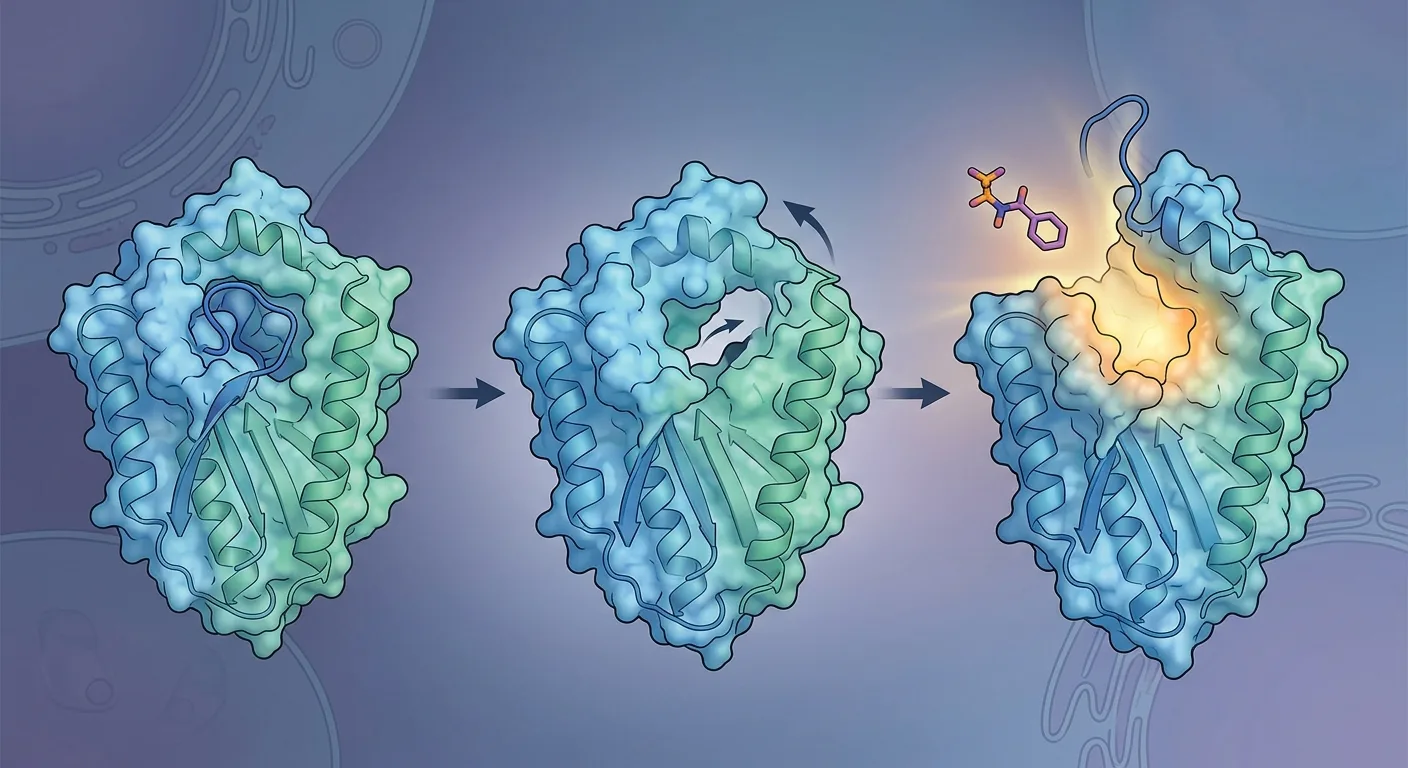
Standard practice trims FGF21 down to its folded β-trefoil core. The platform went the other way — extending ~23 native residues past the core (to residue 192), keeping a flexible, proline/serine-rich stretch that expression pipelines almost always cut.
The sequence is 100% native FGF21; there are no engineered mutations. The novelty is the boundary choice, not the sequence — and a search against public databases returned no deposited construct with this boundary. It's exactly the kind of non-obvious call a human heuristic tends to exclude.
Yield lost, developability won
Here's the part we could have buried, but won't: on raw yield, the textbook construct won. It produced about 2.4× more purified protein (~0.71 vs ~0.30 mg). We report that number first, because it's true.
Then we concentrated both — the step where a sample becomes something you can actually use. The textbook construct stalled at 0.7 mg/mL, shedding material to aggregation as it was pushed. The Orbion construct concentrated cleanly to 1.4 mg/mL, stayed monodisperse (PDI 0.21 vs 0.30), and — despite entering the step with far less protein — ended up holding more usable material (~84 vs ~70 µg). The unconventional tail behaved like a built-in solubility handle: exactly the property that decides whether a protein survives downstream.
Both constructs ran as a single clean band by SDS-PAGE — so the Orbion result isn't "dirty but soluble." It's genuinely better-behaved protein.
The prediction came first
The most important number came before any of this. The platform had scored its own design higher than the expert's — composite 68.7 vs 59.0 — before a single tube was filled. It predicted the Orbion construct would be the more disordered, more extended molecule (consistent with the retained tail), and its yield and solubility calls matched what the bench found.
Those signals come from Orbion's Astra models — solubility, intrinsic disorder (AstraUNFOLD), aggregation propensity, PTM liability, and binding-region preservation — combined into a single developability ranking rather than a one-property score. The platform didn't just search faster. It made a call a human heuristic would have excluded, and explained why, in advance.
What this is — and what it isn't
We're deliberately careful about the claim. This is a single, scoped case study: one construct pair, one run, with biological activity not assayed. The two constructs differ in more than one feature, so we don't attribute the result to any single design choice. It's a demonstration of a capability, not a population-level benchmark — and the preprint says so plainly.
Leading with the yield loss isn't a disclaimer bolted onto a win. It is the point. The reversal is only credible because we report the number that doesn't flatter us first.
Why it matters
The practical reading is straightforward: the highest-leverage decision in a protein campaign often isn't "maximize yield." It's "design the molecule that survives contact with reality" — the one that concentrates, stays monodisperse, and makes it downstream. Raw yield overstated the textbook construct's real advantage; the usable amount, at usable concentration, favoured the prediction-guided design.
That's what developability-aware design is for: removing the make–test–redesign cycles that difficult targets are built from. This is our first public wet-lab study — and the first of more to come.
Try it on a hard target
If your programs stall at construct design, expression, or purification, that's the bottleneck Orbion is built for. Point Orbion's Characterization and Bench modules at a target you're stuck on and see the construct and protocol design that produced this result — live at orbion.life.
→ Read the full preprint on bioRxiv
Prediction-Guided Design of a More Developable FGF21 Construct — Bozkurt, Nathanail, Goteti (Orbion GmbH).