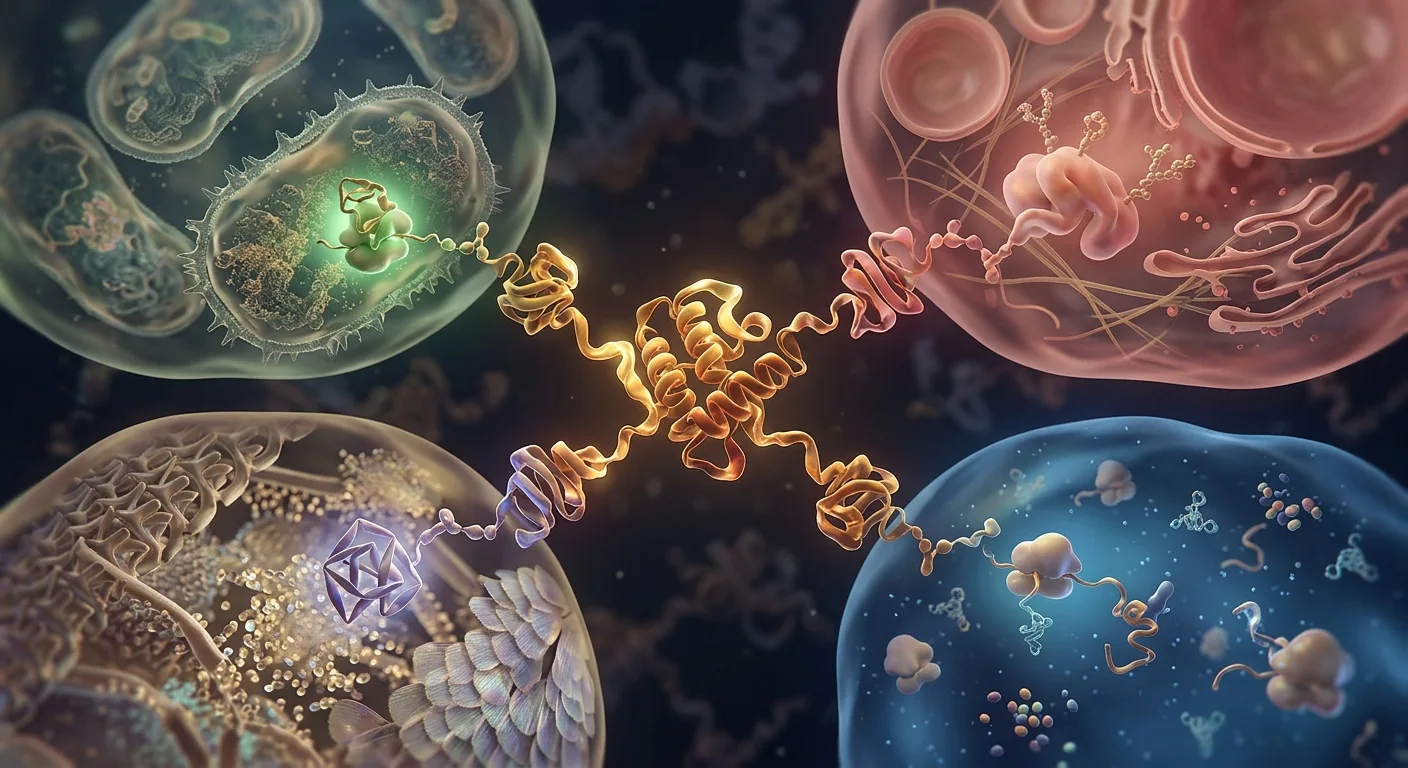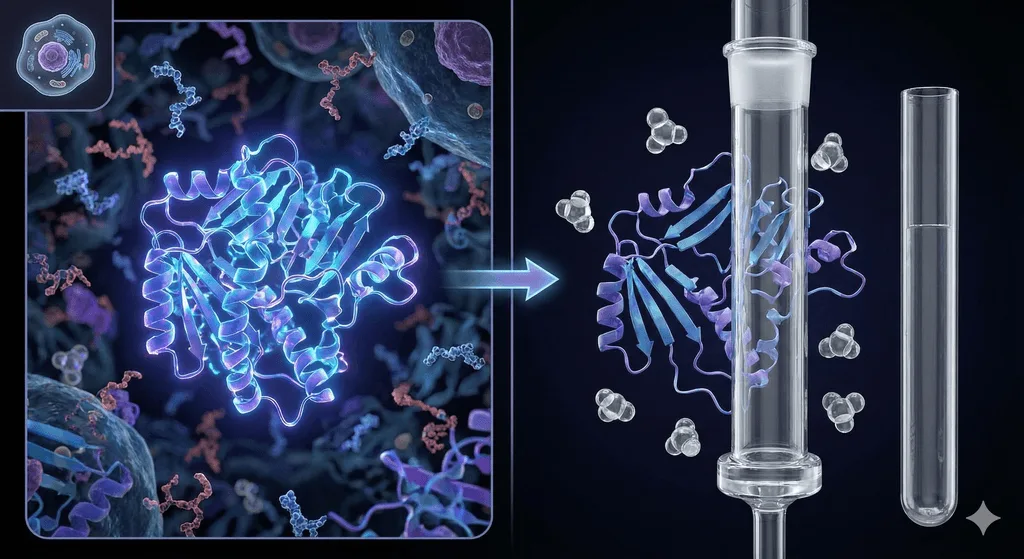
The chromatogram looked perfect. You ran the gel—single band at the expected molecular weight. The mass spec confirmed the identity. Your protein is >95% pure. Then you ran the activity assay. Nothing. The enzyme that was robustly active in crude lysate is now completely dead.
You didn't lose purity. You lost function. And the purification itself was the culprit.
Key Takeaways
-
Pure protein is not the same as functional protein: Purification removes more than just contaminants—it can strip essential cofactors, metal ions, and binding partners
-
IMAC is particularly problematic: His-tag purification on nickel/cobalt columns can strip metal ions from metalloproteins
-
Cofactors don't survive purification: Heme, PLP, FAD, NAD, and metal ions often need reconstitution
-
Buffer composition matters enormously: Wrong pH, missing reducing agents, or incompatible additives cause irreversible damage
-
Activity loss is often preventable: Understanding your protein's requirements before purification is the key
The Purity-Activity Paradox
Why Do We Purify Proteins?
Purification is supposed to give us:
-
Homogeneous material for structural studies
-
Defined composition for biochemical assays
-
Contaminant-free samples for therapeutic development
-
Reproducible starting material for downstream experiments
The assumption: If we remove everything except our target protein, we'll have functional protein.
The reality: Many proteins need "contaminants" to function.
What Gets Lost
During purification, your protein can lose:
| Component | How It's Lost | Consequence |
|---|---|---|
| Metal ions | Chelation, EDTA, IMAC | Loss of catalysis, unfolding |
| Cofactors | Dilution, dissociation | Complete activity loss |
| Lipids | Detergent extraction | Membrane protein dysfunction |
| Binding partners | Separation | Instability, wrong conformation |
| PTMs | Phosphatase activity | Altered regulation |
| Proper redox state | Oxidation | Disulfide scrambling |
The Six Ways Activity Dies During Purification
Problem 1: Metal Ion Stripping
The mechanism:
Many enzymes require metal ions for catalysis:
-
Zinc: Metalloproteases, carbonic anhydrase, zinc fingers
-
Iron: Cytochromes, iron-sulfur proteins, non-heme iron enzymes
-
Magnesium: Kinases, ATPases, polymerases
-
Copper: Oxidases, electron transport proteins
-
Manganese: Arginase, superoxide dismutase
During purification, metal ions are stripped by:
-
EDTA in buffers (even trace amounts)
-
Competition with IMAC column metals
-
Dilution below binding threshold
-
pH changes that alter coordination
The IMAC problem:
Research has shown that metalloproteins are particularly problematic for IMAC purification because they can scavenge metal ions from the column or have their native metals stripped. Both M-PMV and HIV-1 proteins were found to scavenge Zn²⁺ and Ni²⁺ ions from charged IMAC column matrix during elution—meaning your protein may come off the column with the wrong metal.
Case study: Zinc finger proteins
Studies on zinc-binding transcriptional regulators have demonstrated that EDTA, commonly present at 0.1-5 mM in purification buffers, can completely sequester Zn²⁺ from zinc finger proteins. The log formation constant for Zn-EDTA is 13.3, while zinc finger domains bind with constants of only 10⁷ to 10¹¹—meaning EDTA wins the competition for zinc almost every time.
Worse, some zinc-binding domains are irreversibly denatured after zinc removal and cannot refold even when zinc is added back.
Prevention:
-
Never use EDTA in buffers for metalloproteins
-
Include the native metal ion in all purification buffers
-
Consider alternative affinity tags (Strep-tag, FLAG) instead of His-tag
-
If using IMAC, reconstitute metal after elution
Problem 2: Cofactor Dissociation
The mechanism:
Many enzymes have non-covalently bound cofactors:
-
Heme: Cytochromes P450, peroxidases, globins
-
FAD/FMN: Oxidoreductases, monooxygenases
-
PLP (pyridoxal phosphate): Transaminases, decarboxylases
-
NAD/NADP: Dehydrogenases
-
Biotin: Carboxylases
-
Thiamine pyrophosphate: Decarboxylases, transketolases
Cofactors dissociate during:
-
Dilution (reduces effective concentration)
-
Buffer exchange (washes away free cofactor)
-
Prolonged purification (equilibrium shifts)
-
Storage (slow dissociation over time)
The heme problem:
Research on recombinant heme proteins has shown that production in E. coli is often limited by the host's heme biosynthesis, resulting in only partially assembled holo-heme protein. Even proteins that express with heme can lose it during purification.
In vitro reconstitution studies found that purified cytochrome c synthases contain only ~10% occupied heme; a special "heme-loading" protocol was needed to increase this to ~30%.
Case study: PLP-dependent enzymes
A transaminase purified without PLP supplementation:
-
Crude lysate: 100% activity (cellular PLP present)
-
After Ni-NTA: 60% activity (PLP diluting out)
-
After size exclusion: 25% activity (more dilution)
-
After concentration: 10% activity (most PLP lost)
The same purification with 100 μM PLP in all buffers: 95% activity retention.
Prevention:
-
Include cofactor in all purification buffers
-
Minimize dilution during purification
-
Add excess cofactor before storage
-
For heme proteins, consider reconstitution protocols
Problem 3: Oxidative Damage
The mechanism: Many proteins contain:
-
Free cysteines: Subject to oxidation
-
Iron-sulfur clusters: Oxygen-sensitive
-
Reduced cofactors: Air-oxidizable
-
Methionine residues: Oxidize to sulfoxide
Atmospheric oxygen causes:
-
Disulfide bond formation (aggregation, wrong structure)
-
Cysteine sulfenic acid formation (activity loss)
-
Iron-sulfur cluster destruction
-
Cofactor oxidation
The cysteine problem: DTT and other reducing agents are essential for proteins with free cysteines. Without them, artefactual disulfide bonds form, leading to aggregation and misfolding. However, DTT itself is unstable—its half-life is only 1.4 hours at pH 8.5 and 20°C.
For proteins that require native disulfide bonds, the situation is reversed: reducing agents will destroy the correct disulfide bonds, causing unfolding and activity loss.
Case study: Non-heme iron enzymes
Non-heme iron (II) enzymes face a particular challenge: the iron readily oxidizes to iron (III), which is catalytically inactive. A significant fraction of purified protein often contains no iron at all, requiring reconstitution after purification.
Prevention:
-
Use TCEP instead of DTT (more stable, compatible with IMAC)
-
Degas buffers for oxygen-sensitive proteins
-
Include antioxidants (ascorbate, reduced glutathione) where appropriate
-
Purify in anaerobic chamber for extreme cases
-
Know whether your protein needs reducing or oxidizing conditions
Problem 4: Proteolytic Degradation
The mechanism: Cell lysis releases proteases from their normal compartmentalization. These proteases can:
-
Clip terminal regions (removing tags or functional domains)
-
Cleave internal loops (fragmenting the protein)
-
Remove regulatory domains (altering activity)
Research on proteolysis during purification emphasizes that the problem is insidious: partial proteolysis may not be visible on a gel but can cause "striking changes to kinetic and regulatory properties."
The inhibitor challenge: No single protease inhibitor works against all proteases. Standard cocktails contain:
-
AEBSF/PMSF: Serine proteases
-
E-64: Cysteine proteases
-
Pepstatin: Aspartic proteases
-
Bestatin: Aminopeptidases
-
EDTA: Metalloproteases
But EDTA creates its own problems (see Problem 1), and PMSF has a half-life of only ~30 minutes in aqueous solution.
Prevention:
-
Work fast—minimize time between lysis and first chromatography
-
Keep everything cold (4°C)
-
Use fresh protease inhibitor cocktails
-
Consider protease-deficient expression strains
-
Monitor for degradation products on gels
Problem 5: Aggregation During Concentration
The mechanism: After purification, proteins are often concentrated for storage or downstream applications. During concentration:
-
Local protein concentration increases dramatically
-
Hydrophobic patches find each other
-
Aggregation-prone intermediates form
-
Once aggregated, protein is often irreversibly lost
Studies on protein aggregation show that the problem worsens with:
-
Higher target concentration
-
Higher temperature
-
Suboptimal pH
-
Ionic strength extremes
-
Surface adsorption in concentrators
The concentration trap: Protein is soluble at 1 mg/mL during purification. You concentrate to 10 mg/mL for storage. Overnight at 4°C, white precipitate appears. The protein is lost.
This happens because:
-
Many proteins have concentration-dependent aggregation thresholds
-
Concentration increases the rate of all association events, including unwanted ones
-
Impurities or misfolded species nucleate aggregation
Prevention:
-
Know your protein's solubility limit before concentrating
-
Use appropriate concentrator MWCO (not too close to protein MW)
-
Add stabilizers (glycerol, arginine, trehalose)
-
Don't over-concentrate—leave margin below solubility limit
-
Flash-freeze immediately after concentration
Problem 6: Wrong Buffer Conditions
The mechanism: Proteins have optimal conditions for stability and activity:
-
pH: Most enzymes have narrow pH optima
-
Ionic strength: Too low = aggregation; too high = denaturation
-
Specific ions: Some require specific cations/anions
-
Osmolytes: Some need stabilizers
-
Temperature: Some are cold-sensitive or heat-labile
During purification, conditions change multiple times: Lysis buffer → Binding buffer → Wash buffer → Elution buffer → Storage buffer. Each transition is an opportunity for damage.
Case study: The elution step
Many elution conditions are harsh:
-
Low pH (4.0) for Protein A
-
High imidazole (500 mM) for IMAC
-
High salt for ion exchange
-
Organic solvents for hydrophobic interaction
The protein may not survive these conditions, even briefly.
Prevention:
-
Buffer exchange immediately after elution
-
Use gradient elution where possible (less harsh)
-
Know your protein's pH stability range
-
Include stabilizers in elution buffers
-
Neutralize immediately after low-pH elution
The Diagnostic Workflow
When Activity Is Lost, Ask These Questions
Step 1: At which step did activity disappear?
Run activity assays at each purification stage:
-
Lysate
-
Post-affinity
-
Post-ion exchange
-
Post-gel filtration
-
After concentration
-
After storage
The step where activity drops is where the damage occurs.
Step 2: What changed at that step?
| Step | Common Culprits |
|---|---|
| Lysis | Proteolysis, oxidation, metal loss |
| Affinity (IMAC) | Metal stripping, wrong metal incorporation |
| Ion exchange | pH stress, ionic strength shock |
| Gel filtration | Dilution of cofactors, partner loss |
| Concentration | Aggregation, surface adsorption |
| Storage | Oxidation, freeze-thaw damage |
Step 3: Can activity be rescued?
Try reconstitution:
-
Add back suspected metal ion
-
Add cofactor in excess
-
Add reducing agent
-
Add suspected binding partner
-
Change to optimal buffer
If activity is rescued, you've identified the problem.
Prevention Strategies
Before Purification: Know Your Protein
Predict requirements: From sequence analysis:
-
Metal binding sites → Which metals?
-
Cofactor binding domains → Which cofactors?
-
Free cysteines → Reducing agents needed?
-
Disulfide bonds → Oxidizing conditions needed?
-
Membrane association → Detergent requirements?
From literature:
-
What conditions have others used?
-
What activity assay is appropriate?
-
What are known stability issues?
During Purification: Protect Your Protein
Design the workflow with function in mind:
-
Minimize steps: Every column is an opportunity for loss
-
Work fast: Time is the enemy for unstable proteins
-
Stay cold: 4°C slows most degradation processes
-
Include protectants: Metals, cofactors, reducing agents
-
Monitor activity: Not just purity—catch problems early
The protective buffer approach: Instead of standard purification buffers, design buffers that include:
-
The native metal ion (1-10 μM range)
-
The cofactor (10-100 μM range, or saturating)
-
Appropriate reducing agent (0.5-5 mM DTT or TCEP)
-
Stabilizers (5-10% glycerol, 100-500 mM salt)
-
Protease inhibitors (during early steps)
After Purification: Verify Activity
Never assume pure means functional:
-
Run activity assay on final material
-
Compare specific activity to published values
-
Check for time-dependent activity loss
-
Verify activity is stable under storage conditions
If activity is low:
-
Try reconstitution (add metals, cofactors)
-
Check for aggregates (DLS, SEC)
-
Assess for degradation (mass spec)
-
Compare to different purification protocol
Reconstitution Protocols
Metal Reconstitution
General approach:
-
Dialyze protein against metal-free buffer (add EDTA briefly, then remove)
-
Add stoichiometric metal ion (1:1 to 3:1 metal:protein)
-
Incubate (1-4 hours, 4°C)
-
Remove excess metal by dialysis or desalting
For zinc proteins:
-
1-10 molar excess ZnCl₂ or ZnSO₄
-
Avoid phosphate buffers (zinc phosphate precipitates)
-
pH 7-8 optimal for most zinc finger proteins
For iron proteins:
-
Use ferrous iron (Fe²⁺) under reducing conditions
-
Ferrous ammonium sulfate is common source
-
Work quickly—ferrous oxidizes rapidly
Cofactor Reconstitution
For heme proteins:
-
Add hemin (ferric heme) or hematin
-
Typical ratio: 1.2-2× molar excess
-
Incubate 1-4 hours at 4°C
-
Remove excess heme by gel filtration
For PLP-dependent enzymes:
-
Add 100-500 μM pyridoxal 5'-phosphate to buffers
-
PLP binds non-covalently; needs to be present throughout
For FAD/FMN enzymes:
-
Add 1-10× molar excess cofactor
-
Some flavoproteins need extended incubation
-
Remove excess by dialysis
Activity Verification
After reconstitution:
-
Measure activity under standard conditions
-
Calculate specific activity (units/mg)
-
Compare to literature values
-
Verify Km and kcat are normal (not just Vmax)
The Economics of Getting It Right
What Activity Loss Costs You
Time:
-
Failed purification: 1-2 weeks
-
Troubleshooting: 2-4 weeks
-
Repeat with modifications: 2-3 weeks
-
Total: 5-9 weeks for what should have been 2 weeks
Materials:
-
Wasted expression (media, cells, inducer)
-
Wasted chromatography consumables
-
Wasted activity assay reagents
-
Repeated ordering costs
Data:
-
Biochemical characterization with dead protein = wrong kinetics
-
Structural studies with inactive protein = potentially wrong conformation
-
Drug screening with compromised target = false negatives
What Prevention Costs You
Upfront investment:
-
1-2 hours literature research on protein requirements
-
Additional buffer components (~$50-100)
-
Activity assays at each step (~2-4 hours per purification)
Return:
-
First-time success rate improves from ~50% to >80%
-
No wasted weeks troubleshooting
-
Reliable, reproducible protein
The Bottom Line
Purity is not activity. The most common reasons for activity loss during purification are:
| Problem | Solution |
|---|---|
| Metal stripping | Avoid EDTA, include native metal |
| Cofactor loss | Include cofactor in all buffers |
| Oxidative damage | Use appropriate reducing agents |
| Proteolysis | Work fast, use inhibitors |
| Aggregation | Know solubility limits, use stabilizers |
| Wrong conditions | Optimize buffer for your specific protein |
The difference between a failed purification and a successful one is often not technique—it's knowledge. Knowing what your protein needs before you start purification prevents most activity loss problems.
Protein-Specific Purification Planning
For researchers working with challenging proteins, platforms like Orbion can help identify potential purification problems before you encounter them:
-
Metal binding site prediction: Know which metals your protein requires
-
Cofactor binding analysis: Identify cofactor requirements from sequence
-
PTM prediction: Understand modification requirements
-
Disorder and aggregation prediction: Anticipate concentration limits
The goal is to design your purification around your protein's requirements—not discover them after activity is already lost.
References
-
Block H, et al. (2009). Immobilized-metal affinity chromatography (IMAC): a review. Methods in Enzymology, 463:439-473. PMC3134162
-
Krizek BA, et al. (1993). That zincing feeling: the effects of EDTA on the behaviour of zinc-binding transcriptional regulators. Journal of Biological Chemistry, 268(17):12387-12392. PMC1133908
-
Londer YY, et al. (2018). Improved method for the incorporation of heme cofactors into recombinant proteins using Escherichia coli Nissle 1917. Biochemistry, 57(19):2764-2770. Link
-
Sutherland MC, et al. (2021). In vitro reconstitution reveals major differences between human and bacterial cytochrome c synthases. eLife, 10:e64891. PMC8112865
-
Ocaña-Calahorro F, et al. (2022). Protein purification strategies must consider downstream applications and individual biological characteristics. Protein Expression and Purification, 191:106026. PMC8991485
-
Ryan BJ & Henehan GT. (2016). Avoiding proteolysis during protein purification. Methods in Molecular Biology, 1485:53-69. PubMed
-
Bondos SE & Bhattacharya A. (2003). Detection and prevention of protein aggregation before, during, and after purification. Analytical Biochemistry, 316(2):223-231. PubMed
-
Cleland WW. (1964). Dithiothreitol, a new protective reagent for SH groups. Biochemistry, 3:480-482. ScienceDirect