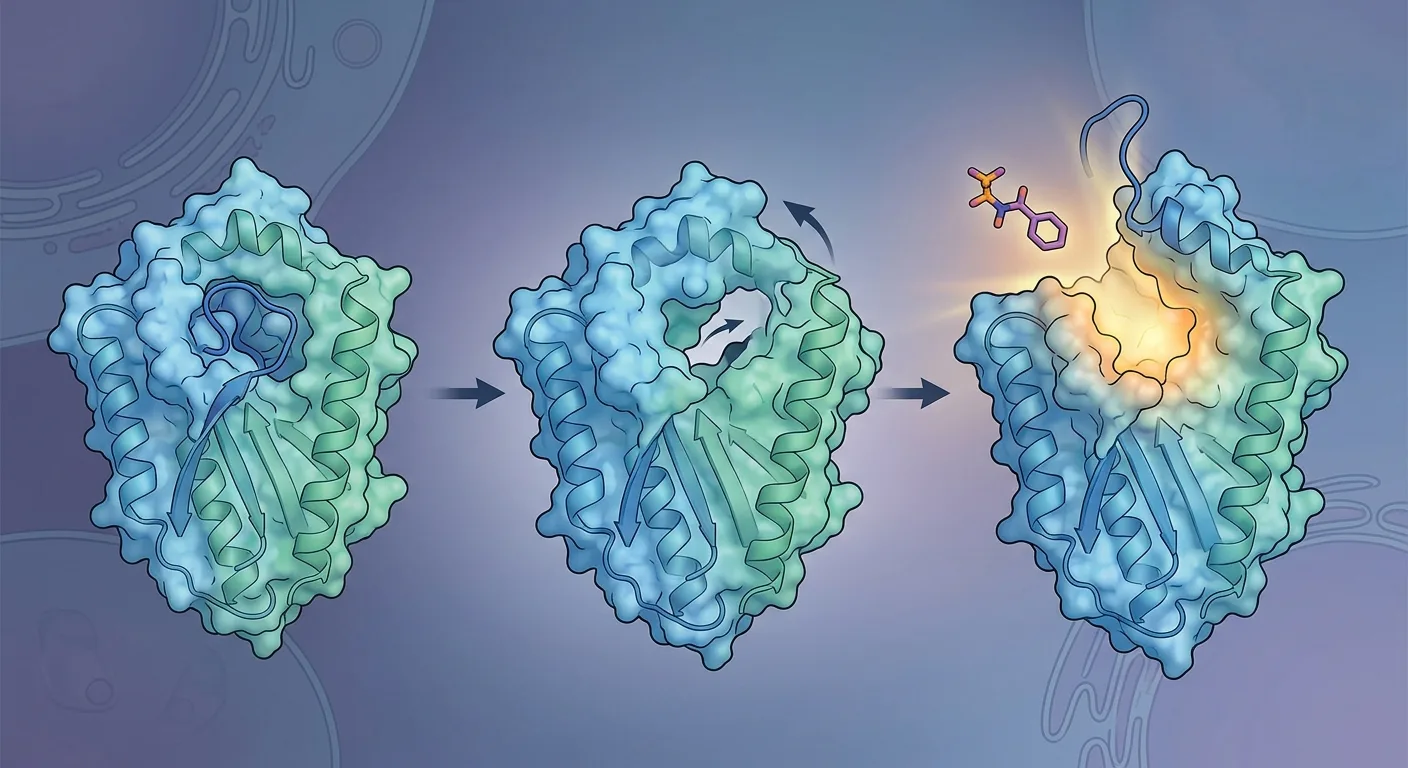
You have a target sequence, a predicted structure, and compounds waiting to be screened. The model looks convincing. Can you dock into it?
Yes, an AlphaFold structure can be a useful docking input, but it is not automatically a docking-ready receptor. The relevant question is whether the particular pocket represents the chemical and biological state your experiment needs. A confident fold does not establish side-chain placement, ligand affinity, or the accessibility of one binding site.
Treat docking readiness as a set of decisions you can record. That makes it easier to distinguish an informative screen from a large calculation built on an untested receptor assumption.
1. Define the binding question before preparing the file
Write down the site, the expected receptor state, and the result that would influence your next experiment. Screening inhibitors of an active enzyme differs from finding a ligand that stabilizes an inactive GPCR. An orthosteric pocket differs from a transient allosteric site.
Also specify the molecular system. Is the pocket formed by one chain, a biological oligomer, a cofactor, or an interface? A monomeric prediction may omit part of the site even when its visible residues are well structured. For membrane targets, consider which side of the membrane the ligand can access and whether the proposed cavity faces lipid or solvent.
Look for relevant experimental structures first, including homologues and alternative states. They can identify pocket residues and missing chemistry without being perfect templates. Record why you selected the predicted receptor over, or alongside, those structures. This is a hypothesis about the target state, not a vote for whichever model has the most attractive rendering.
Figure 1. Docking readiness starts with a defined receptor state, pocket context, and experimental endpoint.
2. Inspect confidence locally
Color the residues around the proposed site by confidence. Inspect the cavity entrance and any loop that could cover it, not just the residues touching a reference ligand. If the pocket spans domains or chains, inspect uncertainty in their relative placement as well.
There is no universal pLDDT cutoff that makes docking reliable. pLDDT describes a prediction's local structural confidence; it is not an affinity measurement. PAE provides a different view of relative positional uncertainty. Our guide to what pLDDT and PAE actually tell you explains the distinction.
A useful review ends with specific observations: “the entrance loop is uncertain,” “the interface position varies,” or “the side chain that sets cavity volume differs between models.” These are more actionable than a whole-protein average. Experimental comparisons support treating AlphaFold models as testable structural hypotheses rather than substitutes for experimental determination. Terwilliger and colleagues discuss this distinction in detail.
Figure 2. Three complementary checks for the proposed binding site; no single confidence threshold establishes docking reliability.
3. Check the chemical environment
Before deleting nonprotein components or adding hydrogens, make a short inventory of what the binding site requires.
| Component | Question to resolve |
|---|---|
| Protonation and tautomers | Which plausible states exist at the assay pH, especially near catalytic or buried groups? |
| Metals and cofactors | Do they participate in binding, coordination, or receptor geometry? |
| Waters | Is there evidence for a bridging or structural water that changes the interaction hypothesis? |
| Disulfides and modifications | Does the modeled sequence represent the mature, modified target? |
| Partner chains | Does the biological assembly complete or obstruct the pocket? |
Do not add a metal solely because a related protein contains one. Do not remove every water solely because a preparation tutorial does. Use target-specific evidence, and check whether the docking method can represent the chemistry you retain. Some scoring functions handle metal coordination or covalent binding only with specialized settings.
AlphaFold 3 broadened prediction to biomolecular complexes, including ligands, but a predicted complex still needs chemical and experimental evaluation. The original AlphaFold 3 study establishes capabilities and limitations; it does not make a predicted pose an observed interaction. See also our practical discussion of AlphaFold 3 binding predictions.
4. Prepare the receptor without hiding the uncertainty
Repair problems that the intended calculation requires you to repair. Check atom names, chain identity, missing atoms, alternative conformations, hydrogen placement, and the format expected by the docking engine. Verify that preparation did not move a key side chain into an implausible contact or create an artificial cavity.
Minimization can remove clashes. It cannot establish that an uncertain loop now occupies its biological conformation. Keep the original model and a preparation log so you can inspect consequential changes.
For a hypothetical receptor with two plausible rotamers at the pocket entrance, retain both as explicit alternatives if resources allow. Run the same ligand and control set against each. If the candidate ranking changes dramatically, receptor uncertainty is part of the result. Do not silently choose the conformation that favors the compound you hoped would win.
Figure 3. A preparation record preserves the original model and makes consequential receptor alternatives explicit.
5. Use controls that test the actual question
Controls should expose whether the setup can distinguish useful signal from convenient scoring artifacts.
If a relevant experimental complex exists, redocking its ligand can test whether your preparation and search settings recover a plausible pose in that receptor. It does not establish that a predicted receptor has the same geometry. Cross-docking into an alternative structure addresses another, harder question.
If known actives and suitable comparison compounds exist, test whether the workflow separates them under a prespecified evaluation. Choose comparisons carefully: obvious differences in size, charge, or hydrophobicity can make apparent enrichment misleading. Avoid tuning the workflow on every compound you later call validation data.
If no validated ligands exist, say so. You can still use docking to organize experimental hypotheses, but you cannot report target-specific retrospective performance. Inspect plausible interactions, buried unsatisfied groups, ligand strain, exposure, and sensitivity to receptor choices. Docking scores alone should not be translated into binding constants.
Figure 4. Redocking, reference-compound evaluation, and sensitivity analysis test different parts of the workflow.
6. Make a go, revise, or defer decision
Proceed to a controlled pilot when the site is well motivated, essential chemistry is represented, preparation is reproducible, and the available controls behave usefully. A pilot might nominate a manageable set of compounds for an orthogonal binding or functional assay.
Revise the receptor hypothesis when a missing partner, uncertain loop, or inappropriate conformational state dominates the pocket. Alternative experimental structures, homologues, or carefully selected receptor models may be more valuable than screening additional compounds.
Defer a large screen when you cannot explain what site is being tested or what result would count as success. More docking calculations do not resolve an unidentified binding mechanism.
Consider a hypothetical kinase model with a confident core but a pocket-forming loop that differs between an inhibitor-bound homologue and the prediction. A practical next step is to compare defined receptor states with a small reference ligand set. Ranking a million molecules against only one uncertain loop placement would leave the central assumption untested.
Figure 5. A three-way readiness decision connects evidence to the appropriate next experiment.
Keep a compact readiness record
Save the exact sequence, model identifier, receptor state, pocket residue list, preparation settings, retained components, docking box, software version, and controls. Include unresolved assumptions and the experimental endpoint. A colleague should be able to understand why this receptor was used without reconstructing a series of screenshots.
Orbion Characterize can support the structural assessment that precedes candidate selection. Keep the distinction clear: organizing structural evidence helps you decide what to test; measured binding or function determines whether the hypothesis holds. Our structure-based drug-design guide places that decision in the broader discovery workflow.
Common questions
Is a high-pLDDT pocket enough?
No. It is useful evidence about local structure, but docking also depends on receptor state, side-chain geometry, protonation, cofactors, and how the scoring method represents the interaction.
Should I always use an ensemble?
Use alternatives when they represent a specific, plausible uncertainty. Adding many arbitrary models increases computation without necessarily improving interpretation. Define how results across models will be compared before examining your favorite compounds.
Can I claim a predicted hit binds?
A docking hit is a candidate for testing. Report the computational evidence and its assumptions, then use an appropriate experiment to establish binding, functional activity, and specificity.