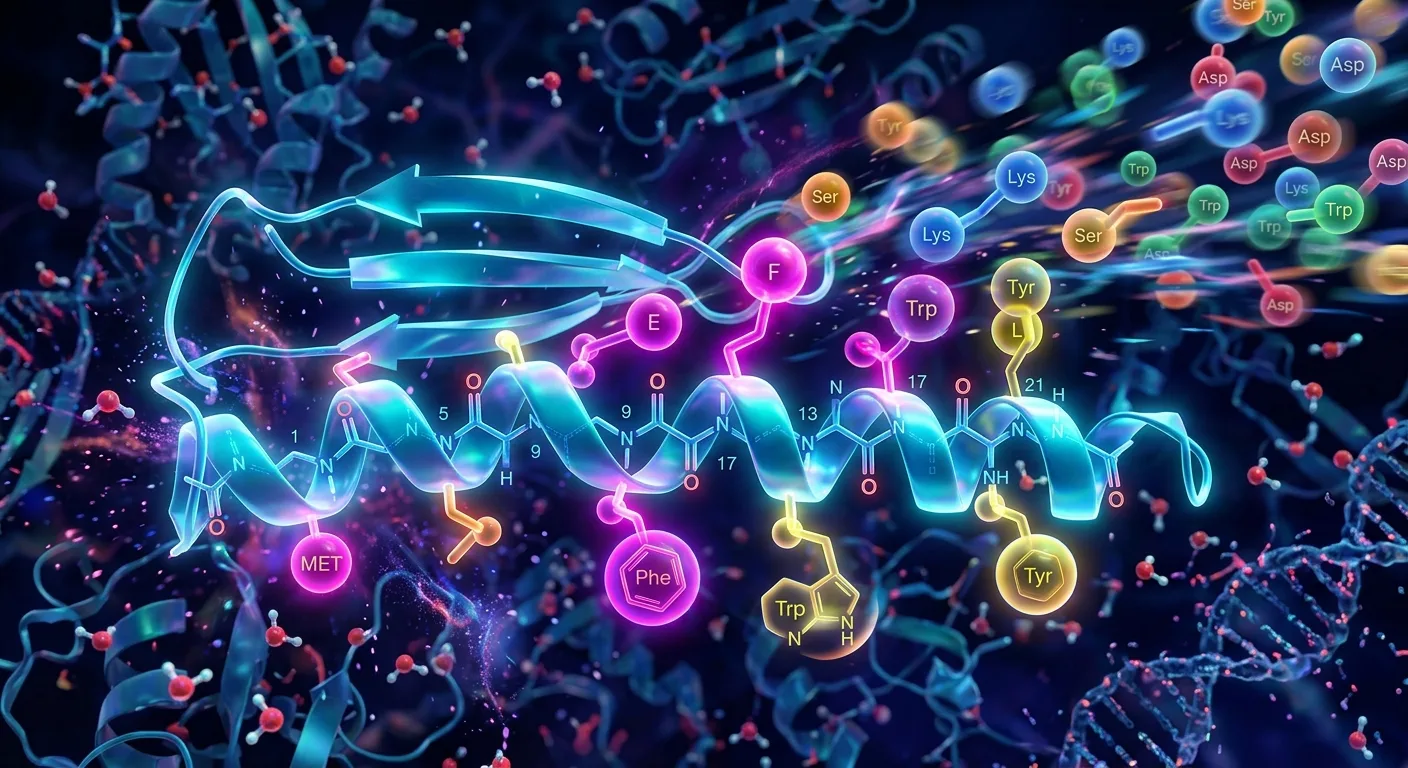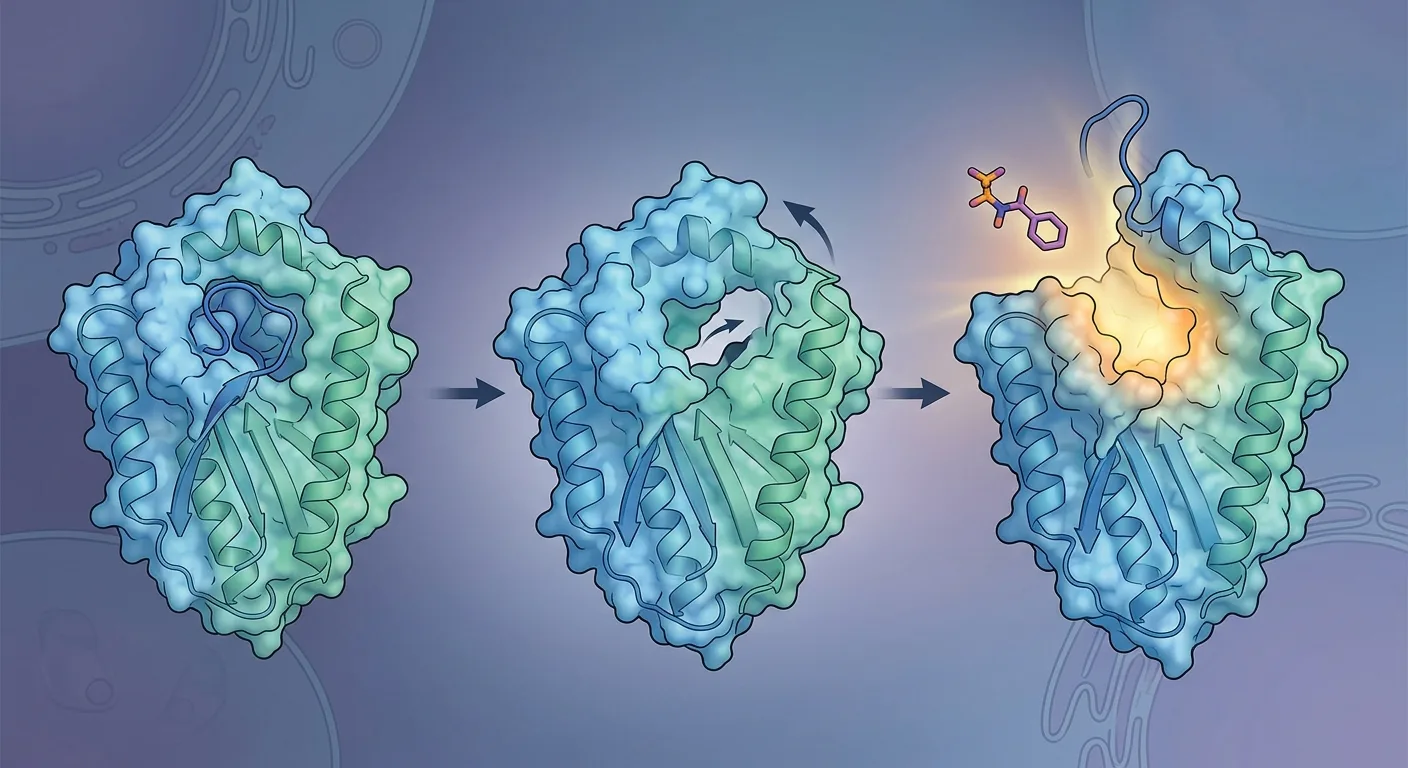
The apo structure looks smooth. The active site is conserved, polar, and already crowded by substrate. Then one loop moves, a helix rotates, and a pocket appears where the static model showed only protein surface. That transient cavity may offer selectivity the obvious site cannot.
Cryptic pockets are ligand-binding sites that are absent or poorly formed in a commonly observed structure and become available after conformational change. They expand the druggable surface of a target—but every hidden indentation is not a useful pocket, and every predicted site is not ligandable.
Key Takeaways
- A cryptic pocket is a conformational hypothesis. Its geometry depends on a state or ensemble, not one coordinate file.
- Static-structure methods can identify susceptible regions. They usually do not produce the open state by themselves.
- Simulations and ensemble prediction can sample openings. Sampling frequency is not binding affinity.
- Druggability requires chemistry as well as volume. Shape, enclosure, hydration, hotspots, dynamics, and selectivity all matter.
- Use orthogonal evidence. Conservation, fragments, HDX-MS, NMR, mutagenesis, and structures can promote a predicted cavity to a validated site.
- Avoid overclaiming. The honest progression is predicted site → sampled pocket → probeable hotspot → ligand-bound pocket → validated functional mechanism.
What Makes a Pocket Cryptic?
In an apo structure, residues may pack tightly enough that no cavity is detectable. A ligand, mutation, partner, phosphorylation event, or thermal fluctuation can shift the local structure and create a pocket.
Common opening motions include:
- loop displacement;
- side-chain rotamer changes;
- helix translation or rotation;
- local secondary-structure change;
- domain movement;
- interface separation or closure.
PocketMiner’s benchmark, for example, includes loop, secondary-structure, and interdomain rearrangements and shows that both opening and “reverse” closing motions can create ligand-competent sites (Meller et al., 2023).
The word “cryptic” should be reserved for sites whose pocket character changes materially across conformations. A shallow groove visible in every structure may still be hard to drug, but it is not necessarily cryptic.
Why the Active Site Is Not Always the Best Site
Orthosteric active sites can be:
- highly conserved across paralogs;
- occupied by abundant endogenous substrate;
- too polar for cell-permeable ligands;
- geometrically shallow;
- subject to resistance mutations;
- inaccessible in a disease-relevant state.
A cryptic allosteric site can provide a different chemical environment and a route to state selectivity. It may modulate function without competing directly with substrate.
The tradeoff is evidence. An obvious active site exists in a dominant state. A cryptic pocket may be rare, conditional, and difficult to stabilize.
Five Ways to Find Hidden Sites
1. Compare experimental conformations
Overlay apo, holo, active, inactive, mutant, and partner-bound structures. This is the strongest starting point when available because the alternative states were observed experimentally.
Check that apparent pocket changes are not caused by missing density, crystal contacts, construct differences, or unresolved loops.
2. Analyze static structures for cryptic propensity
Machine-learning approaches can score residues or regions likely to form hidden pockets from one folded structure. CryptoSite and PocketMiner exemplify this strategy. These methods prioritize where to look; they do not establish a ligand-bound open conformation.
3. Generate conformational ensembles
Molecular dynamics, enhanced sampling, normal modes, or model perturbation can produce alternative states. The key output is not one dramatic frame. It is the reproducibility, population, connectivity, and physical plausibility of pocket-opening events.
4. Use probe-based mapping
Fragment screening, mixed-solvent simulations, FTMap-like probes, and cosolvent experiments locate energetic hotspots. A pocket with complementary probe clusters is more compelling than a cavity defined only by geometric volume.
5. Learn from sequence and functional data
Conserved residues can indicate functional importance; variable surrounding residues can offer selectivity. Disease mutations, resistance sites, allosteric networks, and HDX protection changes help connect pocket formation to biology.
From Pocket Detection to Druggability
Evaluate at least six dimensions:
| Dimension | Useful question | Warning sign |
|---|---|---|
| Geometry | Is the site enclosed enough to make multiple contacts? | broad flat surface or unstable slit |
| Chemistry | Are hydrophobic, polar, donor, and acceptor features balanced? | uniformly charged or fully solvent-exposed |
| Hydration | Are there displaceable waters or costly desolvation? | tightly bound water network with no compensation |
| Dynamics | Does the pocket remain open long enough to bind? | one isolated strained frame |
| Conservation | Can function and selectivity be reconciled? | identical pocket across close paralogs |
| Coupling | Does perturbing the site affect the desired mechanism? | cavity far from any supported network |
“Druggable” is not a permanent property of a structure. It is a claim about whether a chemical series can bind with useful affinity, selectivity, and properties while modulating biology.
Static AI Models: Useful, but Not an Ensemble by Default
AlphaFold and related predictors often return one dominant-looking state. High pLDDT indicates confidence in local geometry, not absence of dynamics. A hidden pocket may be missing because the model selected a closed conformation from its structural prior.
Repeated predictions, MSA subsampling, templates, mutations, ligand-aware co-folding, or dedicated ensemble methods can produce alternatives. These outputs must be checked for steric quality and independence. Ten models with nearly identical training priors are not equivalent to ten experimentally supported states.
The 2026 evaluation of ligand-conditioned AlphaFold 3 predictions found that known cryptic pocket states can be favored when the relevant ligand is supplied, while ligand-free predictions more often favor the closed state (Lazou et al., 2026). That makes co-folding useful for hypothesis generation and also raises a circularity warning: providing the answer-shaped ligand can bias the state.
A Practical Discovery Funnel
Stage 1: Site nomination
Combine static pocket analysis, cryptic-propensity prediction, conservation, known functional networks, and structural comparisons. Keep several sites.
Stage 2: State generation
Sample alternative conformations. Track pocket volume, enclosure, residue contacts, and state populations. Cluster structures rather than cherry-picking the largest cavity.
Stage 3: Chemical probing
Map fragments or probe molecules. Look for repeated hotspots across states and methods. Prioritize sites with coherent interaction opportunities.
Stage 4: Functional plausibility
Ask how binding could alter catalysis, assembly, regulation, or partner recognition. Avoid stories that require unsupported long-range coupling.
Stage 5: Experimental validation
Use fragment screening, NMR, HDX-MS, mutagenesis, binding assays, and structural methods. A ligand-bound structure is strong evidence for the pocket; functional modulation is separate evidence for mechanism.
Worked Example: A Flat Protein–Protein Interface
A disease-relevant adaptor binds its partner through a broad, apparently undruggable surface. The apo crystal structure contains no deep cavity.
An evidence-driven workflow might find:
- static cryptic-propensity scoring highlights a loop beside the interface;
- several MD replicas sample loop displacement and reveal a 280 ų pocket;
- the open state appears in independent trajectories rather than one frame;
- mixed-solvent probes cluster at two subpockets;
- sequence comparison shows conserved central residues and variable rim residues;
- an HDX-MS experiment detects protection in the same region for an initial fragment;
- a pocket-lining mutation reduces fragment binding without globally unfolding the protein;
- a co-structure confirms the opened loop and direct contacts.
Only at step 8 is the structural pocket firmly validated. Whether the fragment disrupts the disease-relevant interaction at useful concentrations remains another experiment.
Common Failure Modes
Choosing the largest cavity
Volume alone ignores chemistry, hydration, state population, and selectivity.
Cherry-picking an open simulation frame
Proteins fluctuate. A distorted, high-energy structure can contain impressive cavities. Require recurrence and physical plausibility.
Docking to a closed state
If pocket formation requires induced fit, rigid docking may reject the correct chemotype. Dock across a curated ensemble.
Treating predicted binding as functional modulation
A compound can bind without changing the desired activity. Measure coupling directly.
Ignoring construct and environment
Truncations, crystal contacts, membrane composition, protonation, cofactors, and partners reshape dynamics.
How Orbion Supports Pocket Hypotheses
Orbion’s AstraBIND can surface residue-level binding-site hypotheses. Combined with conformational-state prediction and structural context, those hypotheses can help prioritize where hidden sites may emerge and which residues define them.
The responsible output is a ranked site map with evidence and uncertainty. It should distinguish a sequence- or structure-derived signal from an open pocket sampled in an ensemble and from a site validated by ligand binding.
For a broader view of pocket detection, see Finding Druggable Pockets When the Active Site Is Too Conserved. For downstream use, see Structure-Based Drug Design: From Protein Structure to Lead Compound.
Bottom Line
Cryptic pockets make “undruggable” a testable assumption rather than a final label. Find them by combining structure, dynamics, chemistry, and functional evidence. Use static prediction to nominate regions, ensembles to generate states, probes to assess ligandability, and experiments to establish binding and mechanism.
The hidden pocket is not the discovery. The discovery is a reproducible, chemically addressable conformation that changes the biology you care about.
References
- Cimermancic P, et al. CryptoSite: expanding the druggable proteome by characterization and prediction of cryptic binding sites. Journal of Molecular Biology. 2016. doi:10.1016/j.jmb.2016.01.029
- Meller A, et al. Predicting locations of cryptic pockets from single protein structures using the PocketMiner graph neural network. Nature Communications. 2023. doi:10.1038/s41467-023-36699-3
- Bowman GR, Geissler PL. Equilibrium fluctuations of a single folded protein reveal a multitude of potential cryptic allosteric sites. PNAS. 2012. doi:10.1073/pnas.1209309109
- Zimmerman MI, et al. SARS-CoV-2 simulations go exascale to predict dramatic spike opening and cryptic pockets across the proteome. Nature Chemistry. 2021. doi:10.1038/s41557-021-00707-0
- Lazou M, et al. The influence of ligands on AlphaFold3 prediction of cryptic pockets. Communications Biology. 2026. doi:10.1038/s42003-026-10596-z