In ordinary structure prediction, you provide a sequence and ask for a fold. In inverse folding, you provide a backbone and ask which sequences are compatible with it. ProteinMPNN makes that reversal fast enough to propose dozens or thousands of sequences—but it does not know which biological functions you forgot to protect.
That distinction is the practical heart of ProteinMPNN. It is a powerful sequence-design engine, not a substitute for biochemical constraints, expression strategy, or experimental screening.
Key Takeaways
- ProteinMPNN solves a structure-conditioned sequence problem. The backbone is the design specification; amino-acid identities are the variables.
- High sequence probability is not the same as high activity. Catalytic residues, binding motifs, PTMs, trafficking signals, and allosteric networks may need explicit protection.
- The input backbone limits the answer. A wrong conformation or interface can produce a beautifully optimized sequence for the wrong geometry.
- Use constraints aggressively. Fix indispensable residues and redesign only the positions tied to a clear objective.
- Sample a library, not a single winner. Temperature, sequence recovery, diversity, and independent rescoring help prevent overcommitment.
- Close the loop experimentally. Expression, monodispersity, stability, binding, and activity are separate filters.
Forward Folding Versus Inverse Folding
Forward folding asks:
Given this amino-acid sequence, what three-dimensional structure is likely?
Inverse folding asks:
Given this backbone geometry, which amino-acid sequences are likely to support it?
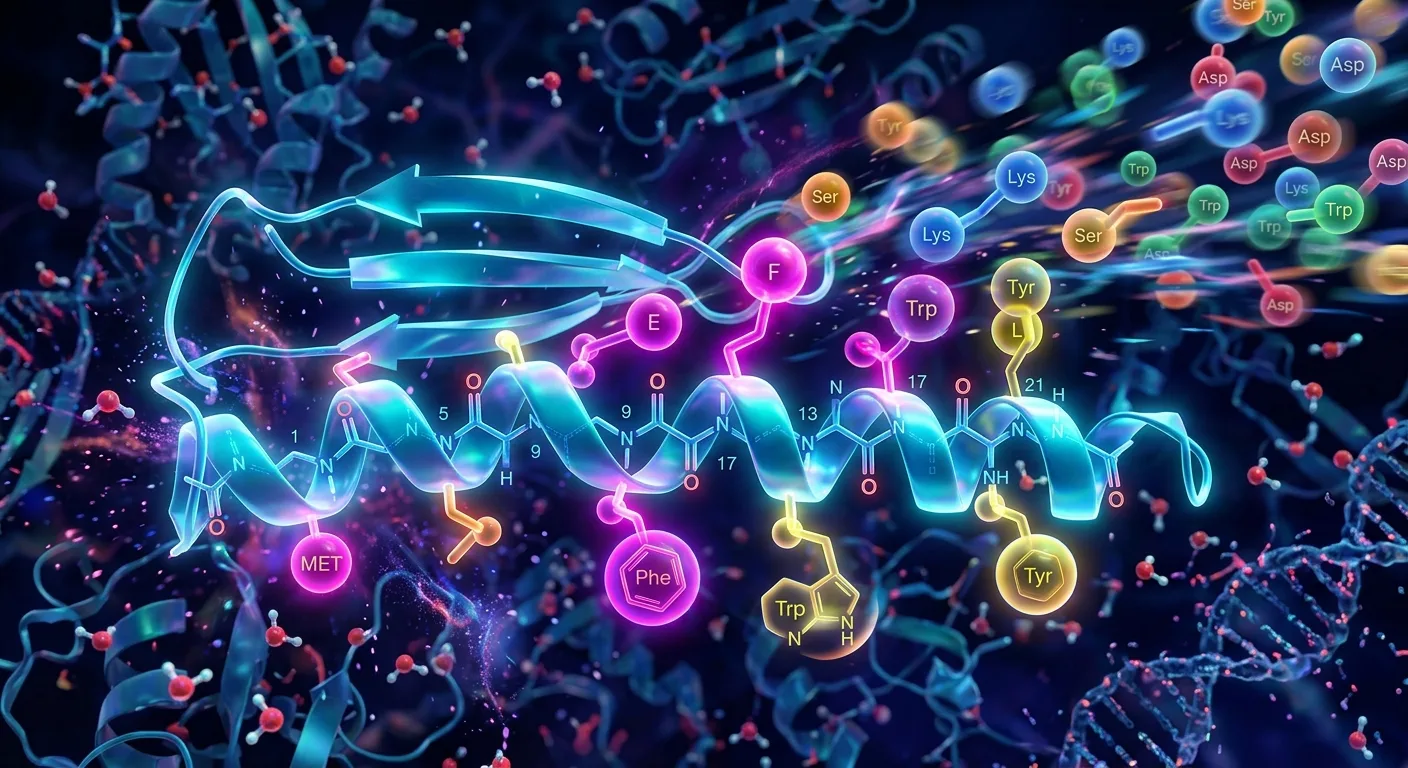
ProteinMPNN represents the backbone as a geometric graph. It uses the spatial relationships among residues to predict amino-acid identities one position at a time, conditioned on the structure and the sequence choices already made. The original study reported strong native-sequence recovery and experimental success across designed proteins and complexes (Dauparas et al., 2022).
For a bench scientist, the output is best understood as a conditional proposal distribution. It tells you which residues the model considers compatible with the supplied backbone and neighboring identities. It does not prove folding, function, or manufacturability.
What You Provide
A typical run starts with:
- backbone coordinates;
- one or more chains;
- positions allowed to change;
- positions held fixed;
- optional symmetry or chain constraints;
- sampling temperature and number of sequences.
The backbone may come from an experimental structure, a confident prediction, a designed scaffold, or a modeled complex. Each source has different risks.
| Backbone source | Strength | Main risk |
|---|---|---|
| High-resolution experimental structure | realistic local geometry | trapped state, crystal contacts, missing regions |
| Cryo-EM model | native assembly context | local coordinate uncertainty |
| AlphaFold model | accessible full-length hypothesis | single-state bias and uncertain interfaces |
| De novo backbone | direct design control | model-generated geometry may not be physically realizable |
| Docked complex | interface redesign opportunity | incorrect pose becomes a hard design constraint |
What ProteinMPNN Returns
For each sampled design you typically receive a sequence, a score or log-probability, and per-position probabilities. Useful derived views include:
- native-sequence recovery;
- mutation count and distribution;
- amino-acid entropy per position;
- charge and hydrophobicity changes;
- conservation of protected motifs;
- sequence diversity within the proposed library.
A lower model loss or higher probability means the sequence is more consistent with the learned structure–sequence relationship. It does not mean “best protein” in every experimental dimension.
The Core Design Logic
Buried positions
The model often selects hydrophobic residues that pack the core without obvious clashes or cavities. These changes can improve compatibility with a chosen backbone, but an overly hydrophobic redesign may worsen expression or aggregation if the backbone breathes and exposes the core.
Surface positions
Surface residues tolerate greater diversity. They are also where solubility, nonspecific binding, proteolysis, PTMs, localization, and immunogenicity can change. A structurally permissible mutation is not automatically neutral.
Interfaces
At a designed interface, ProteinMPNN can coordinate residues across chains to improve packing and chemical complementarity. The design is conditional on the pose. If the docking geometry is wrong, inverse folding can make the wrong interface more internally convincing.
What to Fix Before You Sample
Protect positions whose function is not encoded by backbone compatibility alone:
- catalytic residues and first-shell partners;
- metal- and cofactor-binding residues;
- ligand-contact residues that define specificity;
- disulfide cysteines;
- experimentally validated interface hotspots;
- cleavage sites or processing motifs;
- PTM sites required for function;
- trafficking and localization motifs;
- glycosylation sequons you need to retain;
- residues whose mutation disrupts allostery despite little local structural change.
Do not freeze every conserved residue automatically. Some conservation reflects phylogeny or functions irrelevant to the assay. Classify each protected position by reason so the constraint can be reviewed.
Choosing a Design Scope
The safest early projects redesign a limited, interpretable region.
Core repacking
Goal: improve stability or rescue an underpacked core.
Protect active sites and networks; allow a shell of core residues to change; penalize new buried polar atoms and large cavities in downstream scoring.
Surface redesign
Goal: improve solubility or reduce nonspecific association.
Restrict mutation to exposed patches, preserve binding epitopes, and rescore aggregation propensity, charge distribution, and chemical liabilities.
Interface redesign
Goal: strengthen or alter a protein–protein interaction.
Use an experimentally supported pose, preserve chain folds, design both sides only when necessary, and check specificity against unwanted partners.
Fixed-backbone rescue of a de novo design
Goal: find alternative sequences for a promising but unsuccessful geometry.
Sample broadly, then demand independent structure prediction and experimental diversity. A family of unrelated sequences predicted to recover the same fold is more informative than ten near-clones.
Sampling Temperature and Library Diversity
ProteinMPNN sampling temperature controls how strongly the model favors its highest-probability amino acids.
- Lower temperature: conservative, higher-probability, less diverse sequences.
- Higher temperature: broader exploration, more unusual sequences, higher experimental risk.
Use at least two temperatures for discovery. A practical library might include:
- conservative designs near the native sequence;
- moderate-diversity designs for balanced exploration;
- a small number of high-diversity designs to test whether the backbone supports a wider sequence family.
Sequence identity alone is a poor diversity measure. Ten designs can differ at 20 positions yet make nearly identical chemical choices. Cluster by position-specific patterns, charge, hydrophobicity, and predicted structural outcome.
A Multi-Stage Selection Funnel
ProteinMPNN should propose; other checks should challenge.
Stage 1: Hard constraints
Reject any sequence that breaks protected residues, length, chain identity, required motifs, or forbidden liabilities.
Stage 2: Sequence-level developability
Check aggregation-prone segments, surface hydrophobicity, extreme charge patches, cleavage liabilities, oxidation/deamidation risks where relevant, PTM retention, and host compatibility.
Stage 3: Structure recovery
Predict the designed sequence independently. Compare the recovered structure with the design backbone, paying attention to the redesigned region, alternative folds, pLDDT, and PAE. Be cautious when closely related model families design and validate the same sequence.
Stage 4: Physics-aware review
Evaluate packing, unsatisfied polar groups, steric strain, electrostatics, interface area, and alternative oligomeric states. Rosetta or other energy functions can add a different failure detector even when they are not used as the primary generator.
Stage 5: Experimental library
Select candidates that span distinct sequence solutions and uncertainty modes. Include controls: wild type, a minimally changed design, and one or more deliberately risky designs that reveal whether the model’s assumption matters.
Worked Example: Stabilizing an Enzyme Without Touching Catalysis
An enzyme expresses but loses half its activity after two hours at room temperature. A confident structure shows a loosely packed peripheral helical bundle 18 Å from the active site.
A disciplined design might:
- fix catalytic residues, substrate contacts, metal ligands, and a known allosteric salt bridge;
- allow 24 residues in the helical bundle and adjacent core to change;
- sample 1,000 sequences at two temperatures;
- filter to 100 by constraint compliance and developability;
- predict structure recovery for those 100;
- inspect packing and electrostatics for 30;
- choose 12 diverse sequences for expression;
- measure soluble yield, monodispersity, melting behavior, and activity separately.
The top ProteinMPNN score might not be the best enzyme. A moderately scored design that preserves dynamics and remains soluble may win the bench campaign.
Failure Modes Bench Teams Should Expect
Backbone overcommitment
Fixed-backbone design treats the supplied conformation as correct. Mobile loops, induced-fit interfaces, and alternate oligomers are compressed into one state.
Functional amnesia
The model optimizes compatibility, not the assay. Unprotected catalytic or regulatory residues may change.
Solubility tradeoffs
Better core packing can coincide with worse surface properties. Every design needs both structural and developability review.
False validation consensus
A designed sequence that a related predictor folds back to the target is encouraging, but shared data and priors reduce independence.
Library collapse
Selecting only the lowest-loss near-clones wastes experimental capacity. Diversity should cover alternative chemical solutions.
ProteinMPNN in Orbion’s Mutation Engine
Orbion’s Mutation Engine combines multiple proposal strategies, including a structure-conditioned ProteinMPNN stage, with sequence and physics-aware evaluation. That staged approach is useful because no single proposer sees every failure mode. ProteinMPNN can ask, “Which sequences fit this backbone?” while additional filters ask, “Which designs preserve the required biology and remain worth making?”
The output should remain a ranked, auditable library. Each mutation needs a reason, every fixed position needs a reason, and the selection criteria should match the experimental objective.
For complementary methods, see Modern Alternatives to FoldX and Rosetta. For sequence-model context, read Protein Language Models vs MSA-Based Predictors.
Bottom Line
ProteinMPNN is best understood as a rapid inverse-folding proposer. Give it a credible backbone, protect the biology it cannot infer, sample a diverse library, and challenge every candidate with independent sequence, structure, physics, and bench evidence.
The powerful move is not asking ProteinMPNN for “the best sequence.” It is using it to explore which sequence solutions are compatible with a clearly stated structural hypothesis—and then designing an experiment that can prove the hypothesis wrong.
References
- Dauparas J, et al. Robust deep learning–based protein sequence design using ProteinMPNN. Science. 2022. doi:10.1126/science.add2187
- Anishchenko I, et al. De novo protein design by deep network hallucination. Nature. 2021. doi:10.1038/s41586-021-04184-w
- Cao L, et al. Design of protein-binding proteins from the target structure alone. Nature. 2022. doi:10.1038/s41586-022-04654-9
- Baek M, et al. Accurate prediction of protein structures and interactions using a three-track neural network. Science. 2021. doi:10.1126/science.abj8754
- Kuhlman B, Baker D. Native protein sequences are close to optimal for their structures. PNAS. 2000. doi:10.1073/pnas.97.19.10383