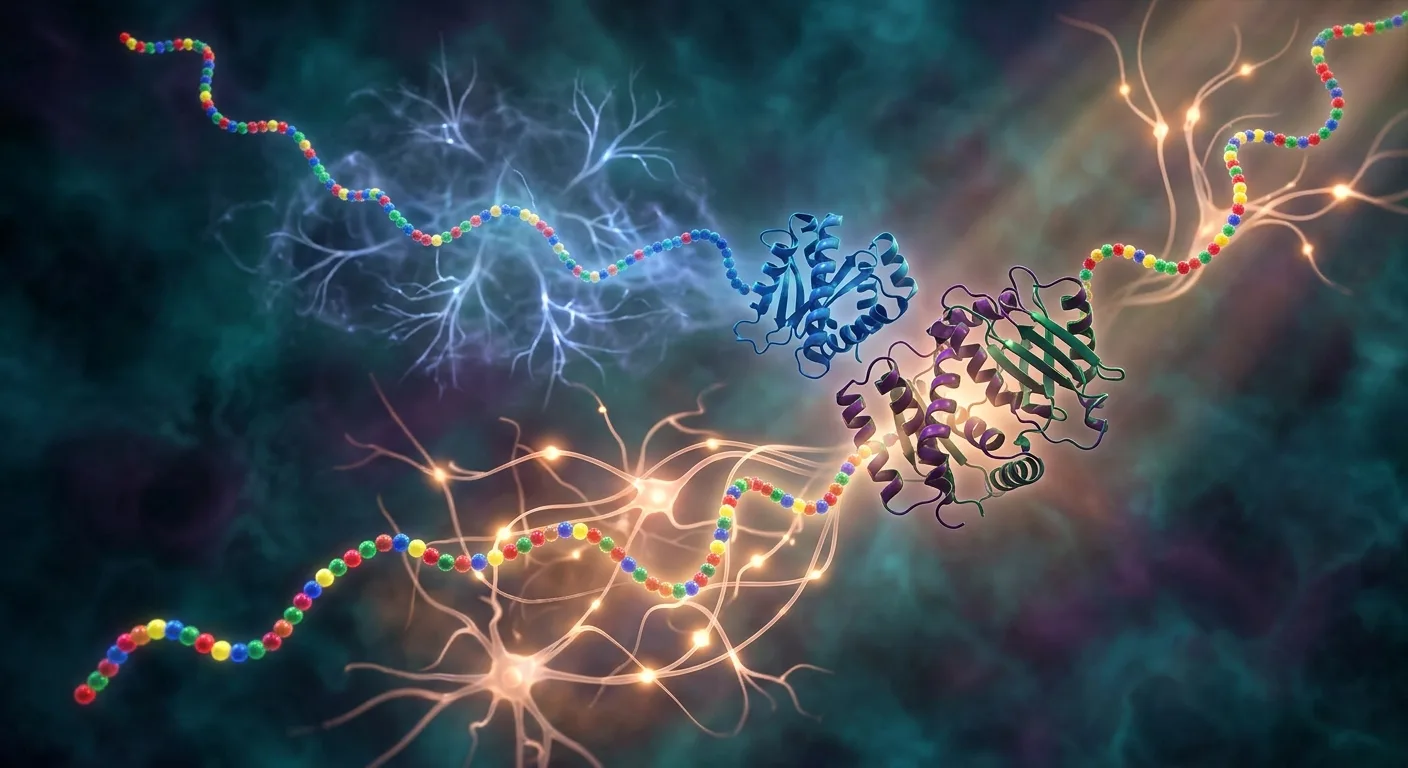
AlphaFold searches for a family. ESM-2 has already compressed patterns from a vast sequence universe into its parameters. When your target has thousands of informative homologs, explicit family evidence is hard to beat. When it has eight—or none—the balance can change.
“ESM-2 vs AlphaFold” sounds like a model leaderboard. For bench decisions, that framing is too crude. ESM-2 is a protein language model, not a complete experimental oracle, and AlphaFold is a structure-prediction system that integrates sequence, multiple-sequence alignments (MSAs), templates, and learned structural priors. Their strengths diverge because their information paths differ.
Key Takeaways
- AlphaFold usually remains the first choice for homolog-rich natural proteins. Target-specific coevolution is powerful evidence.
- ESM-2-derived tools are valuable when the MSA is shallow, expensive, noisy, or absent. Orphan proteins, de novo designs, and large libraries are the clearest cases.
- “MSA-free” is not “evolution-free.” ESM-2 learned from natural sequences shaped by evolution; it simply does not retrieve a target MSA at inference time.
- A language model can beat AlphaFold on the decision even when its 3D model is less accurate. Fast sequence-level triage may be the relevant endpoint.
- Do not compare raw confidence numbers across model families as if they share calibration. Compare claims, perturbations, and orthogonal evidence.
- Agreement is useful; disagreement is actionable. It tells you where to place the next low-cost experiment.
What ESM-2 Actually Learns
ESM-2 is trained with a masked-language objective: hide part of a protein sequence and predict the missing amino acids from context. To perform that task at scale, the network develops internal representations that reflect residue compatibility, motifs, secondary structure, domain organization, and evolutionary constraints.
Those representations—often called embeddings—can feed downstream predictors for structure, solubility, function, localization, variant effects, or other properties. ESMFold uses a language-model representation to produce three-dimensional structures without building a target-specific MSA. Its speed enabled structure prediction across hundreds of millions of metagenomic sequences (Lin et al., 2023).
The advantage is not mystical “understanding.” It is amortized retrieval. Much of the expensive learning happened during pretraining, so each new sequence can be processed quickly.
What AlphaFold Adds
AlphaFold2 explicitly retrieves homologs and aligns them. Correlated substitutions provide target-family evidence about which residues constrain one another. The Evoformer combines that information with pair representations, optional templates, and geometric reasoning before the structure module produces coordinates (Jumper et al., 2021).
This matters because a deep, diverse MSA contains natural perturbation experiments. Evolution has sampled alternative amino acids while preserving fold and function. Compensatory substitutions can reveal contacts that are difficult to infer from one sequence.
The cost is dependency. If the family is missing, redundant, misaligned, domain-shuffled, or paired incorrectly for a complex, the most informative input weakens.
The Comparison That Actually Matters
| Target condition | AlphaFold advantage | ESM-2-derived advantage |
|---|---|---|
| Deep, diverse homolog family | explicit coevolution and templates | fast independent cross-check |
| True orphan or lineage-specific protein | learned priors still help, but MSA signal is thin | single-sequence inference without a failed search |
| De novo designed sequence | structure module can still assess geometry | no natural MSA required; high-throughput scoring |
| Millions of sequences | accurate but search-heavy | very high throughput |
| Multidomain natural protein | PAE helps expose uncertain domain placement | rapid domain-level alternative |
| Protein complex | paired-MSA and multimer-specific models | useful monomer features; interaction claims need dedicated validation |
| Variant triage | structure context and conservation | contextual sequence likelihood at scale |
The right question is therefore: which evidence is available, and which output changes the experiment?
Case 1: The Orphan Protein
An orphan target has few detectable homologs. AlphaFold may still return a useful fold because its learned priors are strong, but a shallow MSA removes a major source of target-specific evidence. Single-sequence models were built for this regime. RGN2, for example, outperformed AlphaFold2 and RoseTTAFold on the authors’ orphan and designed-protein sets (Chowdhury et al., 2022).
That does not justify automatically choosing the ESM-derived answer. Instead:
- run a sensitive homology search and inspect local coverage;
- generate an MSA-based model and retain all confidence outputs;
- generate one or more single-sequence models;
- compare fold topology and domain boundaries, not just mean pLDDT;
- test the disputed claim with CD, limited proteolysis, cross-linking, SAXS, or a construct panel.
When independent single-sequence methods agree and the MSA-based output changes across subsamples, the language-model hypothesis has earned priority.
Case 2: De Novo Designs and Large Libraries
Designed proteins have no evolutionary family by definition. Building a synthetic MSA does not create natural coevolution. A fast language-model pipeline can score thousands of candidates for sequence plausibility, predicted structure, and undesirable features before expensive synthesis.
The trap is circular validation. If related priors helped generate and evaluate the sequence, confidence can reflect model agreement with itself rather than physical foldability. For finalists, use architecturally different structure predictors, physics-aware checks, and experiments.
Case 3: Noisy or Misleading MSAs
More sequences are not always more information. An MSA can fail when it mixes paralogs, crosses incompatible domain architectures, overrepresents close relatives, or aligns low-complexity regions badly.
Warning signs include:
- strong depth in one domain and almost none in another;
- inconsistent boundaries across homologs;
- an apparent contact map driven by one taxonomic clade;
- alternative MSA pipelines producing different folds;
- a model that changes dramatically when templates are disabled.
A single-sequence model bypasses alignment construction and can expose the failure. It does not remove ambiguity from genuinely disordered or conformationally variable regions.
Case 4: The Endpoint Is Not Structure
Sometimes ESM-2 “beats” AlphaFold because you are asking the wrong system to do the job.
If the task is to rank 100,000 sequences for expression difficulty, identify unusual mutation candidates, or cluster proteins by learned similarity, generating a full 3D structure for every sequence may be wasteful. Embedding-based predictors can operate directly on sequence representations.
Conversely, if you must place a catalytic side chain, model an interface, or select a cryo-EM template, the three-dimensional and confidence outputs from a structure-focused workflow are essential.
Why Confidence Scores Cannot Settle the Fight
Both ESMFold and AlphaFold can output pLDDT-like values. They were not necessarily calibrated on the same targets, data distributions, or error modes. An 85 from one pipeline is not a guaranteed match for an 85 from another.
Compare the models at four levels:
- Local structure: secondary structure, loops, active-site geometry.
- Fold topology: order and connectivity of structural elements.
- Domain architecture: boundaries and relative placement.
- Biological assembly: partners, stoichiometry, ligands, membranes, and state.
Then ask whether the disputed region is stable to seeds, recycles, MSA subsampling, templates, or model choice.
A Practical Decision Tree
Start with the target family
- Deep and diverse MSA with uniform coverage: start with AlphaFold or another MSA-based predictor.
- Shallow MSA, orphan target, or designed sequence: run both families from the beginning.
- Massive sequence set requiring fold-level triage: start with a single-sequence method and reserve slower work for finalists.
Then match the model to the claim
- Need a monomer fold: compare topology and local confidence.
- Need domain orientation: inspect PAE and perturb MSA/template inputs.
- Need a complex: use a complex-capable predictor and inspect inter-chain confidence.
- Need a sequence property: validate a task-specific head rather than assuming structure accuracy transfers.
Finally match validation to decision cost
- Cheap exploratory analysis: model consensus may be enough.
- Construct selection: add disorder, topology, and solubility evidence.
- Interface mutagenesis: add experimental interaction constraints.
- Drug discovery or mechanism: require direct structural or biophysical evidence.
Worked Example: A Viral Accessory Protein
Imagine a 170-residue viral protein with 22 homologs, most above 80% identity. AlphaFold returns a β-rich fold with low confidence in residues 40–90. An ESM-derived predictor returns a helical bundle with high confidence across the same region.
A disciplined comparison finds:
- the effective MSA depth is only six;
- AlphaFold’s β-rich region changes topology across MSA subsamples;
- two single-sequence predictors agree on the helical core;
- transmembrane prediction finds no membrane-spanning segment;
- CD spectroscopy supports predominantly helical structure;
- limited proteolysis identifies a stable core matching the language-model boundary.
The ESM-derived hypothesis now deserves the first construct. It won because independent evidence converged, not because its confidence number was larger.
If CD instead showed strong β-sheet content, the decision would reverse.
Where Both Approaches Fail
Neither method directly resolves every biologically important problem:
- intrinsically disordered ensembles;
- ligand-dependent conformational changes;
- membrane composition effects;
- transient complexes;
- chemical modifications not represented in the input;
- kinetic traps and expression-host effects;
- aggregation during purification.
A confident structure is a statement about a structural hypothesis, not a guarantee of soluble expression, stability, activity, or correct regulation. Our guide to why a high-confidence AlphaFold model can still misbehave at the bench covers that gap.
Using ESM-2 Signals in an Integrated Workflow
The Astra suite uses ESM-2-derived representations alongside task-specific features to assess practical protein-development questions. The value is not that one embedding replaces every structure calculation. It is that sequence-level evidence can be combined with topology, disorder, aggregation, host suitability, stability, and other target-specific signals before you commit to a construct.
For a high-value target, an effective workflow is:
- characterize the sequence and family;
- compare MSA-based and language-model-derived predictions;
- identify where their claims diverge;
- design constructs or mutations that remain sensible under both models;
- use the cheapest discriminating experiment at the disagreement;
- update the design with the result.
For a broader treatment of this choice, see Protein Language Models vs MSA-Based Predictors. For alignment depth, see How Many Homologs Does AlphaFold Need?.
Bottom Line
ESM-2 does not universally beat AlphaFold, and AlphaFold does not make single-sequence models obsolete. AlphaFold is strongest when the target provides rich family evidence and the biological question matches the modeled system. ESM-2-derived methods become especially useful when that evidence is sparse, the sequence is designed, the MSA is unreliable, or the scale makes homology search the bottleneck.
Choose by information regime and experimental decision—not by brand, parameter count, or the largest confidence number.
References
- Rives A, et al. Biological structure and function emerge from scaling unsupervised learning to 250 million protein sequences. PNAS. 2021. doi:10.1073/pnas.2016239118
- Lin Z, et al. Evolutionary-scale prediction of atomic-level protein structure with a language model. Science. 2023. doi:10.1126/science.ade2574
- Jumper J, et al. Highly accurate protein structure prediction with AlphaFold. Nature. 2021. doi:10.1038/s41586-021-03819-2
- Chowdhury R, et al. Single-sequence protein structure prediction using a language model and deep learning. Nature Biotechnology. 2022. doi:10.1038/s41587-022-01432-w
- Mirdita M, et al. ColabFold: making protein folding accessible to all. Nature Methods. 2022. doi:10.1038/s41592-022-01488-1