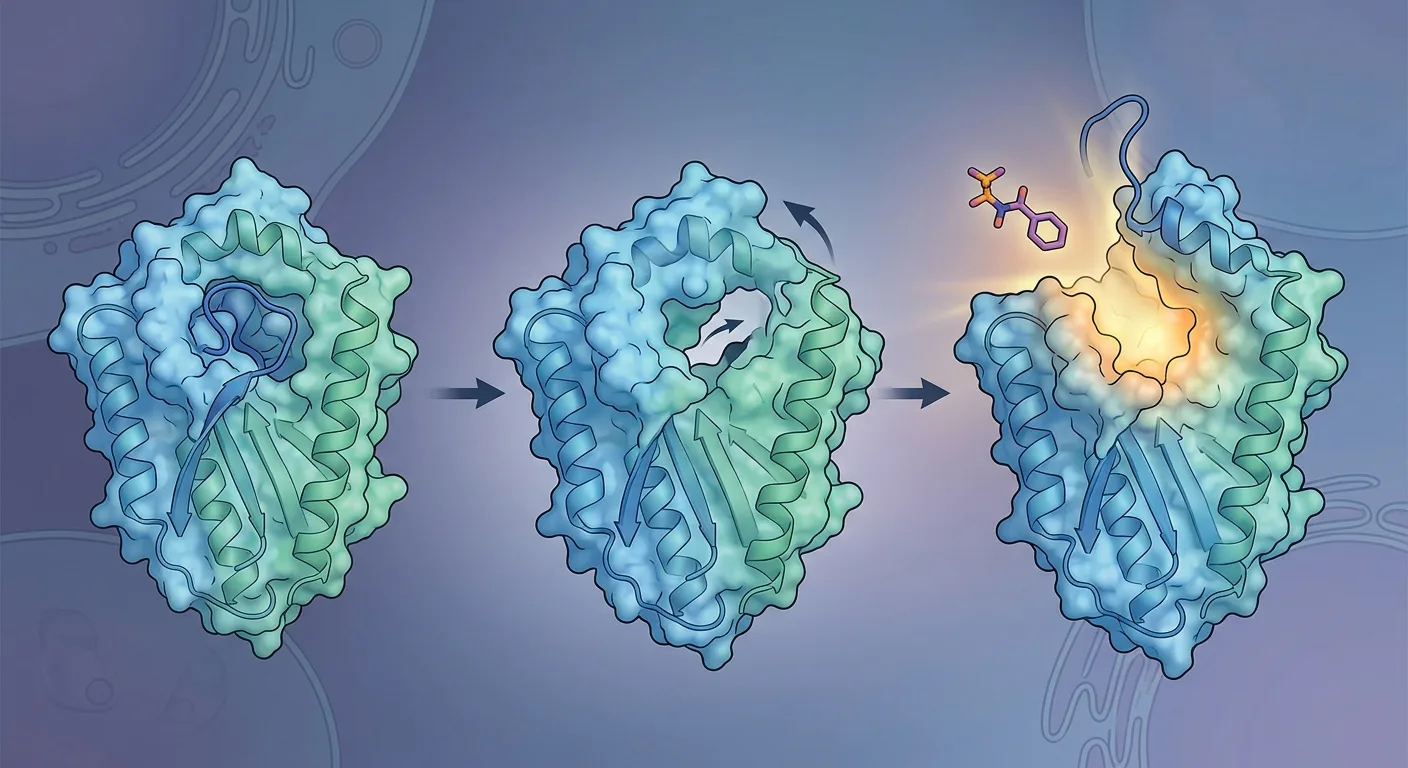
You align a protein family and notice that your target differs from the most common amino acid at several positions. Those differences become an appealing mutation list: replace unusual residues with the family consensus and make the protein more stable.
Consensus information can generate useful stability hypotheses, but residue frequency is not a stability measurement. The alignment may mix functions, organisms, sequence redundancy, and structural contexts. A common residue can be incompatible with the particular background or biological activity you need to preserve.
The practical task is to turn a family-level pattern into a small, testable set of changes for one defined protein.
Key takeaways
- Consensus frequency proposes a hypothesis; it does not measure stability in the target.
- Inspect family composition, local coverage, and sensitivity to redundant sequences.
- Evaluate stability, recovery, function, and mutation combinations as separate outcomes.
What consensus design actually contributes
Consensus approaches use evolutionary sequence information to identify residues that are common at aligned positions. The rationale is that patterns retained across a family can contain information about compatibility with the fold and its function.
Sternke, Tripp, and Barrick tested consensus sequence design across several protein families, showing that the approach can produce stable, biologically active proteins. Those results support the strategy; they do not imply that every consensus substitution stabilizes every target. Full consensus proteins and a handful of substitutions in an existing sequence are also different design experiments.
For your target, consensus is one evidence source. Structural context, biochemical function, sequence quality, and the intended assay determine which suggestions deserve experimental priority.
A consensus sequence is not an ancestral reconstruction
Three related ideas are often conflated. A full consensus sequence chooses a representative residue at each aligned position. Consensus-guided mutagenesis transfers selected family preferences into an existing target. An ancestral reconstruction estimates a historical sequence under an evolutionary model. They use related evidence but answer different questions and create different sequence backgrounds.
A full consensus protein may combine residues that never appeared together in a sampled natural sequence. That does not make it invalid; it means that its behavior must be evaluated as a new combination. Conversely, a single consensus substitution is being tested in a particular existing background. Success of the full consensus does not establish the effect of that isolated change, and failure of one substitution does not refute consensus design as a strategy.
Early work by Steipe et al. (1994) demonstrated that sequence statistics could identify stabilizing changes in an antibody variable domain. The later multi-family study by Sternke et al. (2019) examined full consensus proteins and measured structure, stability, and activity. These are complementary forms of evidence, not interchangeable estimates of a success rate for a new project.
The practical consequence is to name the design strategy precisely. “We selected several consensus-supported candidates for this construct” communicates a narrower claim than “we made the family consensus.” It also defines the appropriate comparison: the parental construct for targeted substitutions, or relevant natural homologues and functional requirements for a full consensus design.
Frequency is best treated as information about the sampled family. It can reflect structural compatibility, function, lineage history, and environmental adaptation together. The design problem is to decide which of those constraints are relevant to the intended application. A residue can be common for a reason that has little to do with the property you are trying to improve.
First define the family you want to learn from
Start with homologues appropriate to the target domain and function. A sequence set that contains related but functionally distinct paralogues may reflect a different biological solution. Mixing domain architectures can also make positions appear equivalent when their surrounding constraints differ.
Inspect fragments, unusual insertions, low-quality sequences, and duplicate or near-duplicate entries. A database containing many closely related organisms can make one lineage look like a strong evolutionary consensus. Use a defensible redundancy-control or weighting approach and record it.
Do not solve every problem by making the identity filter narrower. A very narrow set may contain too little diversity to provide useful information. The aim is a relevant, interpretable alignment, with the tradeoff between diversity and comparability made explicit.
Document sequence sources, retrieval date, selection criteria, and alignment settings. Without that record, a future change in the database can produce a different “consensus” that is difficult to explain.
Inspect the alignment around every candidate
Look beyond the most frequent letter. For each position, inspect the number and diversity of contributing sequences, gap frequency, competing residues, and alignment quality. A majority based on a few usable sequences is different from a consistent pattern across a diverse family.
Positions near indels and flexible termini deserve extra attention. Poor alignment can create an apparently strong substitution proposal at a site that is not truly homologous. Map the position to the exact target sequence and structure before ordering a mutation.
As a hypothetical example, a position may be leucine in 70% of the unweighted sequences because one closely related group dominates the dataset. After redundancy control, leucine and isoleucine may be similarly represented. The original percentage did not establish a universal preference; it partly described the sampling of the database.
Figure 1. Sequence frequency is meaningful only in the context of family diversity and a reliable alignment. These abstract sequences are illustrative and encode no actual mutation recommendations.
A worked example of alignment sensitivity
Suppose an illustrative alignment contains 100 sequences. Seventy nearly identical sequences from one subgroup carry leucine at a candidate position; the remaining 30, spread across several other groups, mostly carry isoleucine. The raw count suggests a strong leucine preference. It does not provide 70 independent observations that leucine is better for stability.
After reducing redundancy, the apparent preference may weaken or reverse. Now suppose the target belongs to the isoleucine-rich subgroup and shares a nearby interaction network characteristic of that group. The candidate deserves a different interpretation: it may be a subgroup difference rather than a broadly supported improvement for this target. The right response is to inspect the family definition and local context before increasing confidence from the raw percentage.
The issue is experimentally motivated. Jäckel et al. (2010) examined consensus design using functionally selected sequence populations to avoid phylogenetic bias in their input. Their approach is not a universal correction to apply blindly to a natural-family alignment. It establishes why the origin and composition of the sequence population matter to the conclusion drawn from it.
Use sensitivity as a diagnostic: does the candidate retain support when reasonable sequence selection or redundancy choices change? A candidate that depends on one dominant cluster should carry that qualification. A candidate that remains supported across relevant subsets may be more robust to sampling choices, although this still does not establish its experimental effect.
Keep gaps visible as well. A position observed in 12 complete sequences and absent from 88 fragments should not be described as having the same support as a position covered by all 100. State the effective evidence at the site, not just the total number of sequences downloaded. Local coverage and diversity are what make a position-level claim interpretable.
Protect the biology you need
Mark catalytic residues, ligand contacts, metal coordination, disulfides, processing sites, oligomeric interfaces, and known regulatory positions. Do not automatically exclude every nearby mutation, but give changes in these regions a higher burden of justification and a relevant functional assay.
A residue that looks unusual in your target may support a specialized activity. Replacing it with the family majority could increase an apparent stability readout while weakening the property that makes the protein useful.
For membrane proteins, inspect the local environment: lipid-facing, buried within the bundle, water-exposed, or involved in conformational switching. A change that favors one receptor state may affect signaling or ligand binding. Evidence from a soluble enzyme family should not be assumed to transfer directly to a GPCR or transporter.
Our article on why stabilizing mutations can make other properties worse explains why activity and stability need to remain separate endpoints.
Figure 2. Candidate changes must be interpreted in their structural and functional context, including packing and interfaces. This generic model illustrates context and does not identify a stabilizing mutation.
Rank candidates by evidence, not frequency alone
| Evidence | What it contributes | What it cannot establish alone |
|---|---|---|
| Curated consensus signal | Family-level sequence preference | Stability in the exact target background |
| Structural context | Plausible packing, exposure, or interaction changes | The sign and magnitude of an experimental effect |
| Prior experimental data | Direct evidence under specified conditions | Transfer to a different assay or construct |
| Computational prediction | A way to prioritize a manageable test set | Guaranteed improvement or retained function |
Prefer candidates with interpretable alignment support, plausible structural context, and a clear assay plan. Also retain some diversity in the hypotheses you test. Ten nearly identical packing suggestions can fail together if the underlying interpretation is wrong.
There is no universal consensus-frequency threshold that produces a reliable hit list. A threshold can be useful for reproducibility, but it should be a stated selection rule, not a claim of biological certainty.
Experimental work on consensus-guided lipoxygenase stabilization provides a target-specific example of moving from sequence information to measured outcomes. Use such studies as evidence for a method, while preserving the limits of the tested system.
Test single changes before trusting a combination
For an initial small screen, individual substitutions help identify which changes contribute to the observed phenotype. Include the parental construct and relevant assay controls, and compare expression or recovery as well as the intended stability endpoint.
Then combine selected changes deliberately. Mutation effects can depend on sequence background, so the effect of a combination need not equal the sum of its parts. A mutation that helps alone may lose its benefit or become harmful in another background.
You do not need to test every possible combination. Choose a manageable set that examines the most important dependencies and preserves a clear comparison to the parent and component variants. Our guide to moving from single mutants to combinatorial libraries discusses the transition.
Define success before seeing the curves
Specify which property you are improving: apparent thermal transition, activity after incubation, storage behavior, monodisperse recovery, or another endpoint. These measures can disagree without either being wrong.
For a hypothetical enzyme project, success might require improved activity retention after a defined handling period while maintaining acceptable initial activity and recovery. A higher thermal transition alone would not satisfy that requirement. For a receptor, retained binding or signaling may be essential even if the engineering goal concerns purification stability.
Repeat promising results with an independent preparation where practical. A single plate or purification batch cannot separate sequence effects from every handling difference. Retain failures and uninterpretable measurements with their reasons; they can expose alignment or assay assumptions that need revision.
Read stability and function as separate outcomes
Consider an illustrative comparison of two candidate variants. Variant A has a higher apparent thermal transition but lower initial activity. Variant B has a smaller transition change while retaining activity and improving the amount recovered after the intended handling period. Neither can be called the better design without specifying the objective.
For a reagent whose value is usable activity after storage, B may be the more useful outcome. For a structural experiment requiring a particular inactive state, A might deserve investigation under a different objective. What matters is that the objective is stated before interpreting the favorable number. A stability proxy does not decide the biological tradeoff automatically.
Keep four questions distinct: did the variant produce enough material, did its measured stability endpoint improve, did it retain the required function, and did the result reproduce? A failure at one stage should not be relabeled as a measurement at another. “Insufficient purified material for stability measurement” is different from “destabilized,” even if both candidates fail to advance.
When combining favorable substitutions, preserve the component evidence. If a combination underperforms both singles, possible explanations include interaction between the changes, a shift in the assay response, or preparation variability. The comparison should distinguish these possibilities before the result becomes a broad claim about epistasis. A repeated background-dependent effect is stronger evidence than one disappointing combined sample.
A candidate record can capture the reasoning without pretending to know the answer: family support, alignment caveat, structural context, functional constraint, predicted endpoint, measured result, and next decision. For example, “supported across relevant subgroups, outside known functional sites, favorable handling result, function retained” is an evidence summary. A consensus percentage by itself is not.
This is where negative outcomes help. If well-supported consensus candidates repeatedly reduce function, the selected family may encode a different functional compromise from the target. If the effects disappear across independent preparations, the assay or production variability may dominate. If a subgroup-specific set succeeds where broad-family suggestions fail, that supports narrowing the biological question. The next alignment and candidate set should reflect those observations rather than simply increasing the frequency cutoff.
Use the result to improve the next design round
Orbion Stabilize can help prioritize candidate mutations alongside structural and sequence evidence. Keep its predictions separate from the measured outcome, and attach both to the exact sequence and assay conditions.
After the first round, ask which hypothesis survived. Did packing changes help? Did the apparent benefit disappear when activity was measured? Did a family subgroup prove more relevant than the broad alignment? Those observations are more useful than labeling the entire consensus strategy a success or failure.
The next round should reflect what you learned about this protein. Consensus becomes most valuable when it is part of an experimental feedback process with defined references, reproducible measurements, and explicit functional constraints.
Common questions
Is the most frequent amino acid always the best choice?
No. Frequency depends on alignment quality, sequence sampling, family composition, and evolutionary constraints. It is a proposal-generating signal, not a direct fitness score.
Should I replace every nonconsensus residue?
That creates a different design problem from testing a few mutations. Extensive changes can alter function and introduce interactions that are difficult to diagnose. Match the scope to your experimental capacity and objective.
Can I add the predicted benefits of several mutations?
Do not assume additivity. Test the selected combination against the parent and informative component variants, using the endpoint that matters for the project.
References
- Steipe B, et al. Sequence statistics reliably predict stabilizing mutations in a protein domain. Journal of Molecular Biology. 1994. doi:10.1006/jmbi.1994.1434
- Jäckel C, et al. Consensus protein design without phylogenetic bias. Journal of Molecular Biology. 2010. doi:10.1016/j.jmb.2010.04.039
- Sternke M, Tripp KW, Barrick D. Consensus sequence design as a general strategy to create hyperstable, biologically active proteins. PNAS. 2019. doi:10.1073/pnas.1816707116
- Qian H, et al. Consensus design for improved thermostability of lipoxygenase from Anabaena sp. PCC 7120. BMC Biotechnology. 2018. doi:10.1186/s12896-018-0468-4